
Diamond color
Diamond color is graded by what you cannot see
GIA grades most gem-quality diamonds on the absence of color, from D through Z. The distinctions are subtle, and they move both quality and price.
What diamond color actually means
Understanding what diamond color means helps you choose the right stone. The color evaluation of most gem-quality diamonds is based on the absence of color: a chemically pure and structurally perfect diamond has no hue, like a drop of pure water, and consequently a higher value.
GIA’s D-to-Z color-grading system measures the degree of colorlessness by comparing a stone under controlled lighting and precise viewing conditions against masterstones of established color value. Many of these distinctions are so subtle they are invisible to the untrained eye, yet they make a very big difference in quality and price. That is why an expert opinion matters when you are choosing the best color for your diamond.
The scale
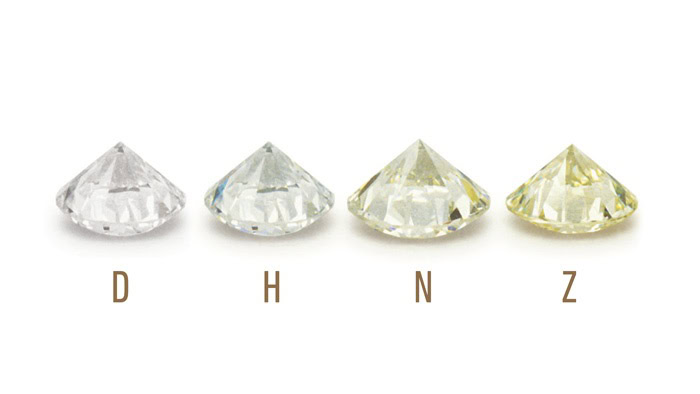
The GIA D-to-Z color scale
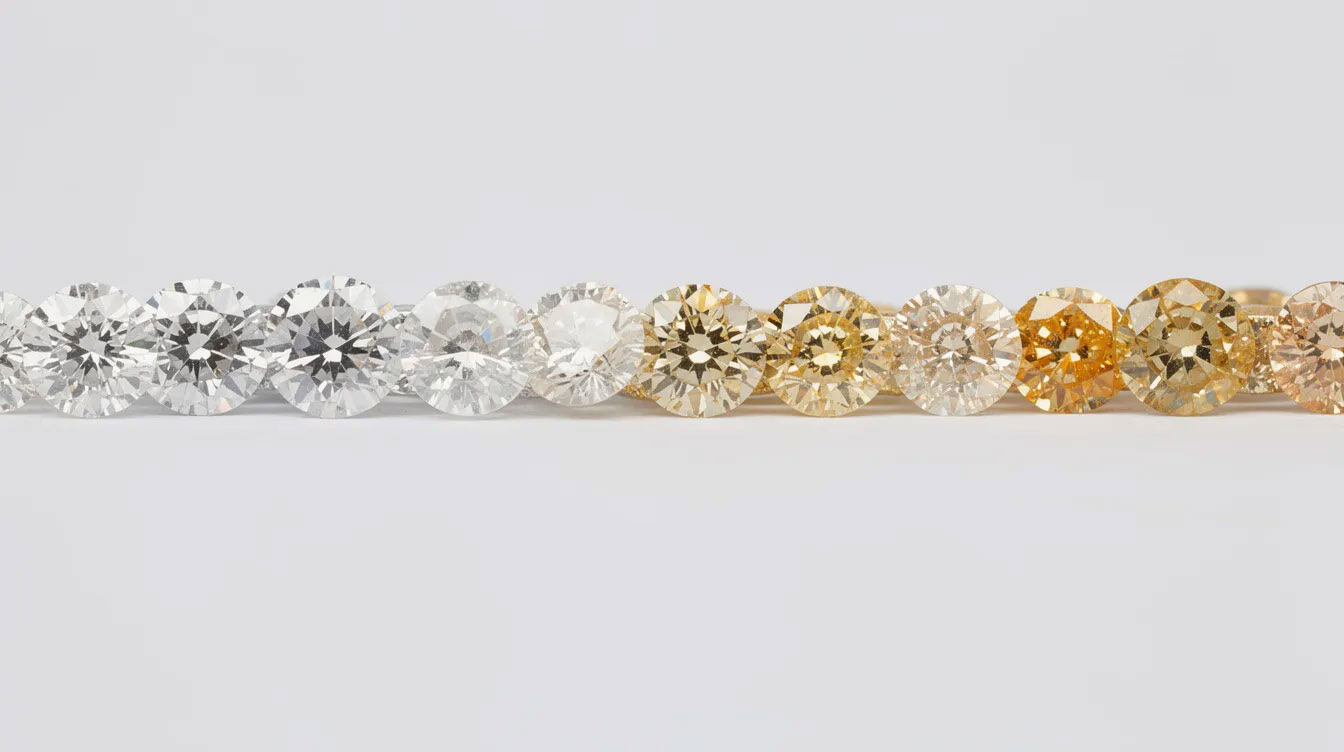
The diamond color scale runs from D, completely colorless, through Z, where a yellow or brown tint is obvious to the naked eye. Grades are grouped into ranges that behave differently once a stone is set.
| Grade range | Classification | Appearance |
|---|---|---|
| D–F | Colorless | No detectable color, even under magnification |
| G–J | Near colorless | Slight traces visible under magnification, face up white |
| K–M | Faint color | Subtle warmth a trained eye can see |
| N–R | Very light | Noticeable yellow or brown tint |
| S–Z | Light yellow | Obvious color visible to the naked eye |
Origin
Why does the GIA color grading system start at D?
Before GIA universalized the D-to-Z scale, there was no clear standard for describing diamond color. A variety of systems were used loosely: A, B and C without clear definition, Arabic numbers (0, 1, 2, 3), Roman numerals (I, II, III), and descriptive terms like “gem blue” or “blue white” that were notorious for misinterpretation.
The creators of the GIA diamond color scale wanted to start fresh, with no association with any earlier system, so the scale begins at the letter D. Very few people still cling to other grading systems, and no other system has the clarity and universal acceptance of the GIA scale.
Outside the normal range
Are diamonds graded Z considered fancy-color?
No. Diamond color grades stop at Z, and naturally colored diamonds outside the normal color range are called fancy-color diamonds. The FTC provides no guidelines for use of the term in the US, but there is general agreement in the international trade about what range is customary: either yellow or brown diamonds with more color than a Z masterstone, or stones that exhibit a color other than yellow or brown.
For those stones the hierarchy inverts. Where colorless diamonds are valued for the absence of color, fancy pinks, blues, greens and vivid yellows are prized for intensity, described by hue, tone and saturation as Fancy Light, Fancy, Fancy Intense and Fancy Vivid.
Choosing
How to choose the best diamond color for your ring
Color is the one C where most buyers can save real money without seeing a difference, provided you account for the setting and the shape.
01
G and H are the value grades
They face up white in a finished piece without the premium a D, E or F grade carries.
02
Metal changes perception
Yellow and rose gold make near colorless stones read whiter, so I and J still look warm rather than tinted. Platinum highlights warmth.
03
Shape shows color differently
Ovals, pears and marquises concentrate color at their points, so many buyers move up a grade from what a round would need.
04
Size raises the stakes
Color is easier to see in larger stones, so a two carat may want a grade or two above what works at half a carat.
Judge color the way graders do, by comparison. Two stones a single grade apart are almost impossible to separate alone, and obvious side by side. We will set that comparison up for you in the showroom.
Continue through the 4Cs
Reading the scale
Reading the diamond color scale, range by range
The diamond color scale is usually discussed in four bands rather than twenty-three letters. D to F is colorless and the rarest; G to J is near colorless, where a faint warmth exists on paper but disappears once the stone is set; K to M is faint yellow, visible face up to most people and a genuine bargain in warm metal; N to Z is very light to light yellow, obvious in any setting and priced accordingly.
Grades are assigned by comparing a stone face down against a set of masterstones under controlled lighting, because that is the only way the difference between adjacent letters is reliably visible. Face up, in a ring, on a hand, in a restaurant, most of those distinctions vanish. That gap between how diamond color grades are determined and how a diamond is actually looked at is the single most useful thing to understand here.
How grading works
How GIA actually assigns diamond color grades
The stone is examined face down in a white tray under standardized daylight-equivalent lighting, alongside masterstones of known grade. It is never graded face up, because the fire and brilliance coming out of a well-cut diamond mask body color completely. Two graders work independently and a grade is only issued when they agree, which is why GIA diamond color grading is so much more consistent than in-house grading elsewhere.
That consistency is the whole value of the report. Several laboratories apply the same letters far more generously, commonly by one to three grades, so an H from a soft lab can be a J at GIA and priced as though it were not. Compare diamond color grades only between reports from the same issuer, and treat the letter on an unfamiliar report as a claim rather than a fact.
Where the money goes
Which diamond color grades are worth paying for
Price climbs steeply at the top of the scale and the visible return falls away just as fast. D, E and F command a substantial premium over G for a difference that almost nobody can see in a finished ring, and the jump from G to H is smaller again. For most buyers the sensible ceiling is G and the sensible floor is J, which is why diamond color grades in that band account for so much of what actually sells.
Two things shift the calculation. Size raises the stakes, because a larger stone holds more body color and shows it more readily — above about 1.50 carats it is worth moving up a grade or two. Setting metal moves it the other way: yellow and rose gold reflect warmth into the stone regardless of its grade, so paying for colorless in warm metal is money spent on a number rather than an appearance.
Setting and metal
The best diamond color for yellow and rose gold
Match the stone to the metal and you can spend less without seeing any difference. In yellow or rose gold the best diamond color is usually J, K or even L: the mounting already casts warm light into the stone, so a colorless diamond looks no whiter there than a faintly tinted one, and the saving is considerable. Many people are surprised at how well a K faces up once it is set in gold.
Platinum and white gold work in the opposite direction. Cool white metal sits beside the stone and makes any warmth easier to read, so the best diamond color in a white setting is generally G or above, and H at the outside. A halo complicates it further, because small colorless accent stones ringing a warmer center will make the center look yellower than it would alone.
See the difference
Diamond color grades only make sense in person
Bring a certificate or a budget and we will lay out real stones across the scale, D against G, H against J, in the metal you actually plan to wear, so you can spend where you can see it.
Diamond color questions we hear most
Can anyone actually see the difference between D and G?
Side by side under grading light, yes. In a finished ring, worn on a hand, almost never. That gap is where most of the savings on color live.
Does the setting metal really matter?
Quite a lot. Yellow and rose gold reflect warmth into the stone, so a near colorless G through J looks bright and consistent. Platinum and white gold are less forgiving and can make a lower grade read warm.
Do fancy shapes need a higher color grade?
Often. Elongated outlines like oval, pear and marquise concentrate color at the points, so a grade that looks white in a round can show warmth in a fancy shape.
Are lab grown diamonds graded on the same scale?
Yes, the same D-to-Z system. Some lab grown stones show faint blue or gray undertones, which is one more reason to view any diamond in person before buying.
Is a Z diamond the same as a fancy yellow?
No. Fancy-color diamonds sit outside the normal range: they carry more color than a Z masterstone, or a hue other than yellow or brown, and they are graded and priced on intensity instead.
What is the best diamond color grade to buy?
G or H for a white metal setting, J or K for yellow and rose gold. The best diamond color is the lowest grade at which you cannot see warmth in the finished ring, and that point moves with the metal, the shape and the size of the stone rather than being a fixed letter.
How many diamond color grades are there?
Twenty-three, from D through Z, grouped into colorless (D-F), near colorless (G-J), faint (K-M) and very light to light (N-Z). Diamond color grades below Z are no longer graded on this scale at all — those stones become fancy colored diamonds and are described by hue, tone and saturation instead.
Can you see the difference between adjacent grades?
Almost never, face up. The diamond color scale was built for face-down comparison against masterstones under controlled light, which is the only reliable way to separate one letter from the next. Set in a ring and viewed normally, a two-grade gap is usually the smallest difference an ordinary eye can detect.
Why does the GIA D to Z color scale start at D?
To break with everything that came before it. Earlier systems used A, B and C, plus roman numerals and terms like river and jager, all applied inconsistently. Starting the GIA D-to-Z color scale at D made it impossible to confuse a new grade with an old claim, and no seller could pretend an A was the top.
Does diamond color affect resale value?
Yes, and more than most people expect. Diamond color grades are one of the two figures a buyer checks first, and the premium attached to D through F carries through into resale. That cuts both ways: you pay it going in and recover part of it coming out, so the practical question is whether you want that money sitting in a letter.
Is a warmer stone a lower quality diamond?
Not in any meaningful sense. A K with an excellent cut outperforms a D that was cut to save weight, every time. The diamond color scale measures how little body color a stone has, not how beautiful it is, and a warm stone in the right setting can look better than a colorless one in the wrong one.
Do lab grown diamonds use the same diamond color scale?
Yes, the same D-to-Z letters and the same grading method. The difference is in the market rather than the material: colorless lab grown stones are far less rare than natural ones, so the price premium attached to the top diamond color grades is much smaller and behaves differently over time.
Does fluorescence change how color looks?
Occasionally, and sometimes in your favor. Medium to strong blue fluorescence can make a J or K face up slightly whiter in daylight, which is why faintly tinted fluorescent stones are often good value. In a small number of cases strong fluorescence causes a hazy or oily look, so it is worth seeing the stone before buying.
Which shapes hide diamond color best?
Round brilliants, by a clear margin — the faceting scatters light so effectively that body color is hardest to read. Radiants and cushions also hide warmth well. Emerald and Asscher cuts show it most, because their broad flat facets act like windows, so step cuts generally want a grade or two higher.
Should I buy a higher color grade for a bigger stone?
Usually yes. Body color accumulates with depth, so a three carat J reads noticeably warmer than a half carat J of the same grade. Above roughly 1.50 carats it is worth moving up one or two diamond color grades; below a carat you can drop down without anyone noticing.
Can a jeweler tell me the grade without a report?
Only approximately, and you should treat any ungraded claim as an estimate. We will put your stone beside masterstones and tell you honestly what we see, but a documented grade requires a laboratory. If a seller quotes a letter with no report behind it, ask which laboratory issued it.
Is it worth upgrading color or cut first?
Cut, always, and it is not close. Cut governs how much light comes back out of the stone, which is the thing people actually respond to; diamond color only determines the faint tint of that light. Spend on an excellent cut, then buy the lowest color grade you cannot see.
What is a masterstone, and why does it matter?
A masterstone is a diamond of known, verified grade that a grader compares your stone against. The whole diamond color scale is comparative rather than absolute, so the grade on your report exists only because a grader set your stone beside a reference set under standardized light and judged which two letters it fell between.
Does the diamond color scale apply to fancy shapes the same way?
The letters are the same, but the outcome is not. Step cuts such as emerald and Asscher show body color far more readily than round brilliants, so the same G can look noticeably warmer in an emerald cut. For those shapes it is worth buying one or two diamond color grades higher than you otherwise would.
Visit us
21073 Powerline Rd, #37
Boca Raton, FL 33433
Mon to Fri 9:30 to 5:30
Saturday 10:30 to 4:30
Sunday Closed
Walk in any time to compare color grades under grading light with a gemologist, or book ahead for an appraisal or a custom design consult.