

The 4Cs of diamonds—cut, color, clarity, and carat—form the universal language for evaluating diamond quality worldwide. Whether you’re shopping for an engagement ring or a statement piece, these four factors determine both the beauty and the price of every stone you consider. Understanding the 4Cs helps balance quality with price, allowing for better decision-making when purchasing a diamond.
The 4Cs of diamonds, which stand for cut, color, clarity, and carat, are used to assess and grade the quality of diamonds. Here’s what each means at a glance: a diamond’s cut determines how brilliantly it reflects light; diamond color measures the presence or absence of yellow tint; diamond clarity assesses internal and external imperfections; and carat weight quantifies the stone’s mass. Each of the 4Cs has its own grading scale, which helps consumers understand the quality and value of a diamond.
This guide walks you through the history, science, and practical application of the 4Cs—plus how they apply to fancy shapes, colorful diamonds, and smart budget strategies that can save you thousands without sacrificing sparkle.
History & Origin of the Diamond 4Cs
Before the 20th century, diamond trading was chaotic. Dealers described stones using inconsistent, subjective terms—one jeweler’s “fine quality” meant something entirely different from another’s. This lack of standardization bred confusion and mistrust between buyers and sellers across the globe.
Robert M. Shipley, the founder of the Gemological Institute of America (GIA), coined the term “4Cs” in the 1940s to standardize the grading of diamonds. Shipley created the concept as a teaching tool for his students, but it quickly became the industry standard. His work transformed diamond commerce from subjective haggling into transparent, verifiable transactions.
Richard T. Liddicoat and colleagues later expanded this foundation, developing the modern GIA International Diamond Grading System—including the D–Z color scale, the GIA clarity scale, standardized cut grading, and precise carat weight measurements. By 2026, the diamond 4Cs form a universal language: a certified diamond graded in New York means the same thing to a buyer in London, Tokyo, or anywhere else. This standardization protects consumers and enables confident purchasing decisions.
Diamond Cut: The Sparkle & Brilliance Factor
A diamond’s cut refers to its proportions and the arrangement of its facets, which significantly affects how well it interacts with light, impacting its brilliance, sparkle, and fire. Cut is not the same as shape—cut describes how precisely the faceted diamond was crafted, while shape refers to its outline.
When a diamond reflects light optimally, incoming rays enter through the crown, bounce off the pavilion facets at precise angles, and return to your eye as white light (brilliance), spectral colors (fire), and flashing patterns (scintillation). A poorly cut diamond allows light to escape through the sides or bottom, resulting in a dull, lifeless appearance regardless of its other qualities.
The GIA diamond grading scale for cut ranges from Excellent to Poor, with Excellent cut diamonds maximizing light return and sparkle due to their optimal facet arrangement. Currently, GIA assigns formal cut grades only to round diamonds. Key elements of a well cut diamond include:
- Balanced table size (53–56% of diameter)
- Crown angles of 34–35 degrees
- Pavilion angles of 40.6–41 degrees
- Proper depth percentage (59–62.5%)
- Thin-to-medium girdle thickness
- Small or pointed culet
Cut quality is considered the most important of the 4Cs because it determines the diamond’s overall appearance and value, influencing how sparkly the diamond appears. Even a 1.00-carat D-color, internally flawless diamond looks dull if poorly cut. If you must compromise on any of the 4Cs, cut should rarely be the one.
Cut vs. Diamond Shape
Diamond shape is the outline you see—round, oval, pear, emerald, cushion, marquise, princess, radiant, or heart. Cut quality describes how well that shape was executed in terms of proportions, symmetry, and polish.
The same carat weight can face up quite differently across shapes. A 1.00-carat oval often appears larger than a 1.00-carat round diamonds because its elongated outline distributes weight across a broader surface area. Similarly, marquise and pear shapes maximize visual spread for their weight.
Fancy shapes don’t always receive formal cut grades from all labs, so buyers should rely on specific dimensions, depth percentage, table percentage, and visual inspection through photos and 360° videos. Shape also affects how forgiving a diamond is: cushion and radiant cuts tend to hide slight inclusions and color better, while emerald cuts act as transparent windows that reveal clarity characteristics more readily.
Diamond Color: From Colorless to Colorful Diamonds
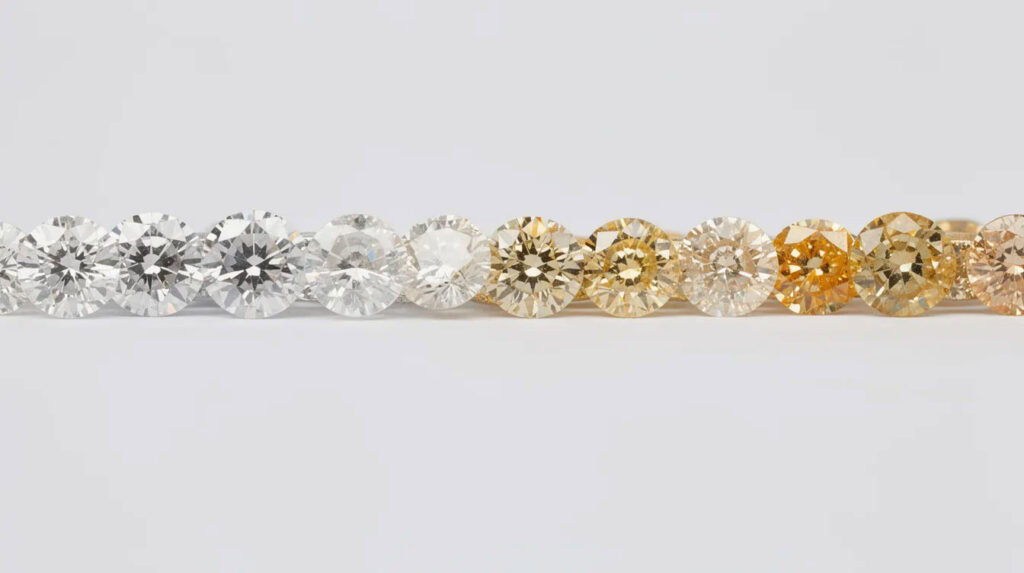
For white diamonds, diamond color measures the presence of yellow or brown tint. The diamond grading color scale ranges from D to Z, with D being completely colorless and Z showing the most color, typically a yellow or brown tint.
Here’s how the scale breaks down:
Grade Range | Classification | Appearance |
|---|---|---|
D–F | Colorless | No detectable color, even under magnification |
G–J | Near colorless | Slight traces visible under magnification |
K–M | Faint color | Subtle warmth visible to trained eye |
N–R | Very light | Noticeable yellow or brown tint |
S–Z | Light yellow | Obvious color visible to naked eye |
Diamonds graded D-F are considered colorless, while G-J diamonds are classified as near colorless, showing only slight traces of color that are difficult to detect without magnification. G and H color diamonds are often considered the best value because they appear white without the premium price of colorless diamonds one of the best sweet spots in the market.
Metal color affects perception significantly. Yellow gold settings make near colorless stones appear whiter, while platinum or white gold can highlight subtle warmth in lower color grades. Lab grown diamonds follow the same D–Z diamond color system, though lab processes occasionally produce subtle blue or gray undertones.
Colorful Diamonds & Fancy Color Grading
Colored diamonds—also called fancy color or colorful diamonds—follow entirely different rules. While colorless stones are valued for their lack of color, fancy yellows, pinks, blues, greens, and browns are prized specifically for color intensity.
Fancy color diamonds are described by hue, tone, and saturation using terms like Fancy Light, Fancy, Fancy Intense, and Fancy Vivid. These designations dramatically influence diamond price—a 1.00-carat Fancy Vivid Pink diamond can cost many times more than a 1.00-carat D-color white diamond of similar clarity and cut.
For colored diamonds, the traditional 4Cs hierarchy inverts: color becomes the primary driver of rarity and value. Cut, clarity, and carat weight still matter, but they take a supporting role to the intensity and saturation of the hue.
Diamond Clarity: Inclusions, Blemishes & Visibility
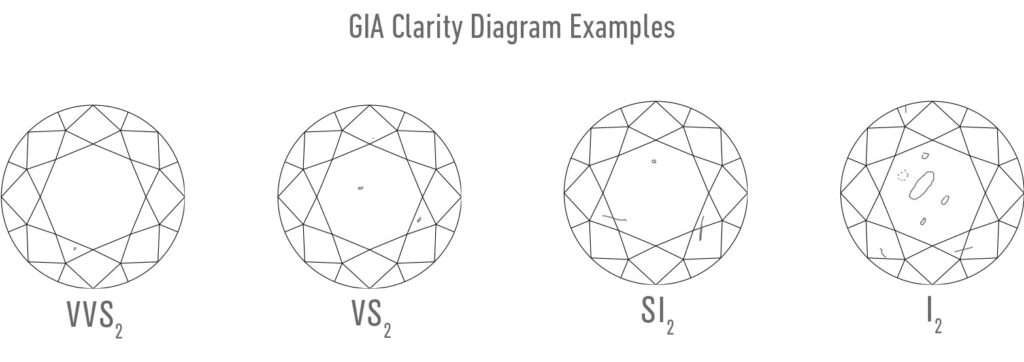
Clarity refers to the presence and amount of flaws or imperfections in a diamond, known as inclusions, which can affect its brilliance and transparency. These internal characteristics—called inclusions—and external blemishes form naturally over billions of years or during the cutting process.
Diamonds are graded on a clarity scale that ranges from Flawless (FL) to Included (I3), with fewer inclusions resulting in a higher clarity grade and value. The complete scale:
Grade | Name | Visibility |
|---|---|---|
FL | Flawless | No inclusions under 10x magnification |
IF | Internally Flawless | No internal inclusions |
VVS1–VVS2 | Very Very Slightly Included | Extremely difficult to see under 10x |
VS1–VS2 | Very Slightly Included | Minor inclusions under 10x |
SI1–SI2 | Slightly Included | Noticeable under 10x |
I1–I3 | Included | Visible to naked eye |
Most diamonds sold in retail fall within the VS–SI range. The term “eye-clean” describes diamonds fall where no visible inclusions appear without magnification—often achieved around VS2 or well-chosen SI1 stones.
Diamonds with Very Slightly Included (VS1 and VS2) clarity grades have minor inclusions that are noticeable under 10x magnification but are typically considered “eye clean” and good value. Common inclusion types include crystals, feathers, clouds, and needles. Flawless diamonds are extraordinarily rare and command premium prices, but most buyers can save significantly by choosing lower clarity grades that remain eye-clean to the naked eye.
How Clarity Impacts Appearance & Durability
Location matters as much as size. A large dark inclusion positioned under the table is far more noticeable than scattered smaller inclusions near the girdle. Diamond experts recommend studying inclusion maps on grading reports to understand exactly where characteristics appear.
Step-cut shapes like emerald and Asscher highlight clarity more because their large, flat facets create a “window” effect. Brilliant-cut shapes—round, oval, cushion—scatter light in ways that better disguise minor inclusions.
Heavily included stones (I1–I3) may have reduced structural integrity, particularly if inclusions reach the surface or create internal stress points. For everyday wear, rely on certified diamond reports and expert advice. When buying online, scrutinize magnified photos or 360° videos to confirm inclusions won’t distract during wear.
Carat Weight: Size, Perception & Diamond Price
Carat weight is a measure of how heavy a diamond is, with one carat equal to 200 milligrams—derived historically from carob seeds used as counterweights. One carat equals 100 points, so a 0.50-carat stone equals 50 points, measured in metric carats.
Critically, a diamond’s weight doesn’t always equal visible size. Two diamonds with identical carat weight can have different face-up dimensions depending on cut proportions. A deep, narrow diamond concentrates mass vertically, while a well-proportioned stone spreads weight across a larger surface.
Diamonds are priced per carat, and the price increases at each size category, meaning a diamond weighing just below a major size category can be better priced than one that exceeds it. These “magic numbers”—0.50ct, 0.75ct, 1.00ct, 1.50ct, 2.00ct—create pricing thresholds where diamond price per carat jumps significantly.
Larger diamonds cost more per carat due to their extreme scarcity, and the price increases exponentially with carat weight. A one carat diamond doesn’t cost twice as much as a 0.50-carat—it often costs three to four times more. The most common diamond weights range from 0.5 to 5 carats, but diamonds can be found in sizes up to 10 carats or more.
Shop just below magic numbers—0.90ct instead of 1.00ct, or 1.45ct instead of 1.50ct—for similar visual size at 15–25% lower prices.
Certain shapes face up larger at the same carat weight. Oval, marquise, and pear-shaped diamonds distribute weight across elongated outlines, making a 1.00-carat oval appear similar to a 1.10 or 1.15-carat round.
Carat Weight vs. Everyday Wearability
While large carat weights impress, they sit higher on the finger and prove more prone to catching on clothing or knocking against surfaces. Consider your lifestyle—active jobs, sports, frequent travel—when deciding between a 1.00ct and 2.00ct stone.
Balance carat weight with a secure setting. Six-prong solitaires, bezel settings, and halos all protect the stone while preserving the diamond shape and maximizing light return. Compare actual millimeter measurements, not just carat weight, to visualize how each option appears on the hand. A diamond’s brilliance depends more on cut than size—a smaller, excellently cut stone often outshines a larger, mediocre one.

How the 4Cs Work Together to Determine Diamond Quality & Price
No single C exists in isolation. Diamond grading and value always reflect the combination of cut, color, clarity, and carat weight working together. Understanding this interplay unlocks significant value opportunities.
Smart trade-offs can produce stunning results. Consider these two diamonds:
- Diamond A: 0.96ct, G color, SI1 clarity, Excellent cut
- Diamond B: 1.00ct, D color, IF clarity, Excellent cut
Diamond B costs significantly more—often 40–60% higher—yet most observers cannot distinguish between them in normal settings. The G color appears white; the SI1 clarity is eye-clean; the Excellent cut ensures maximum sparkle. The slight reduction in carat weight is visually imperceptible.
Rarity compounds exponentially at the top of each scale. Finding a 2.00ct+ D-color, flawless diamond with excellent cut grade is extraordinarily rare because scarcity in each category multiplies. This explains why diamond price rises sharply for stones achieving top grades determine across all four factors.
Personal style ultimately guides priorities. Some buyers want maximum size and presence; others prioritize icy-white color grade or the prestige of flawless clarity. The perfect diamond is the one that matches your values and budget.
Tips for Balancing the 4Cs for Your Budget
Practical guidelines for maximizing value:
- Prioritize cut quality above all—never compromise to Excellent or Very Good grades
- Target near colorless (G–H) over colorless stones for substantial savings with minimal visual difference
- Aim for eye-clean clarity (VS2–SI1) rather than paying premiums for FL or IF that look identical without magnification
- Consider “just below” magic carat weights for 15–25% savings
- Round diamonds demand higher price per carat; fancy shapes like oval, cushion, or radiant offer more spread at the same carat weight
For warm metals like yellow or rose gold, slightly lower color grades (I–J) still look attractive and help manage diamond price. Buyers seeking maximum sparkle should compromise slightly on color and clarity before ever reducing cut quality.
Certified Diamonds & Trusted Diamond Grading Reports
A certified diamond has been independently evaluated by a recognized gemological laboratory. This third-party verification confirms that stated characteristics match actual quality—protecting buyers from overpaying or misrepresentation.
Leading labs in 2026 include:
- GIA (Gemological Institute of America) – Industry gold standard
- IGI (International Gemological Institute)
- HRD (Hoge Raad voor Diamant)
- GCAL (Gem Certification and Assurance Lab)
Each provides a diamond grading report documenting the 4Cs plus additional details: measurements, fluorescence, symmetry, polish, and inclusion diagrams. Review certificate diagrams showing inclusion maps and proportion illustrations to understand your stone comprehensively.
Choose sellers who provide clear certificate numbers and allow verification on the issuing lab’s official database. This transparency ensures the diamond guide specifications match the actual stone.
Natural vs. Lab-Grown Diamonds & the 4Cs
Natural diamonds and lab grown diamonds are graded using identical 4Cs standards—cut, color, clarity, and carat weight. Lab diamonds appear visually identical to natural diamonds when matched for quality and composition.
Lab grown diamonds, widely available by 2026, typically cost 30–50% less than comparable gem quality diamonds from natural sources. This pricing allows buyers to move up significantly in carat weight or quality grades for the same budget.
While lab-created diamonds may depreciate faster on the secondary market, they’re ideal for buyers focused on size, sparkle, and ethical sourcing considerations. Compare certified natural and certified lab diamonds side by side, focusing on how the 4Cs affect actual appearance rather than only paper specifications.
Fancy Shapes, Colorful Diamonds & Special Considerations
Fancy-shaped and colorful diamonds follow the same 4Cs principles but behave differently in terms of apparent size, color visibility, and clarity requirements.
Fancy shapes like oval, pear, and marquise often show color more strongly at their pointed tips, so many buyers target slightly higher color grades than they would for round diamonds. An I-color round might look white, while an I-color pear shows noticeable warmth at the extremities.
Certain shapes demand higher clarity grade attention:
- Emerald and Asscher cuts: Transparent “windows” that reveal inclusions clearly—consider VS1 or better
- Round, cushion, radiant cuts: Light scatter helps disguise slight inclusions—SI1 often works well
For colorful diamonds (fancy yellow, pink, blue), cut is optimized to showcase hue and saturation rather than maximize light return. Diamond experts recommend working closely with jewelers who understand how to balance the 4Cs for these specialty colorless stones alternatives.
How to Use the Diamond 4Cs When Buying a Diamond
Here’s a practical framework for first-time buyers:
- Set your budget – This creates boundaries for all decisions that follow
- Choose your diamond shape – Personal style preference comes first
- Prioritize your Cs – Usually cut first, then decide between color, clarity, and carat weight based on what matters most to you
- Compare options – Evaluate 3–5 diamonds with different 4Cs combinations to see how changes affect appearance and pricing
- Verify certification – Always confirm the stone is a certified diamond with a reputable grading report
Shop diamonds in different lighting conditions—natural daylight, indoor LEDs, soft ambient light—to see how cut determines light performance in real-world settings. Excellent cuts maintain sparkle across all conditions; poor cut diamonds may appear dead under certain light source conditions.
View the diamond from multiple angles and distances. Check that any visible inclusions don’t distract during normal wear. Compare mm measurements alongside carat weight to understand actual finger coverage.
By understanding the diamond 4Cs and using them as a guide—not strict rules—you can confidently select a stone that matches both your budget and your vision. The framework exists to empower you, not constrain you. Whether you prioritize a larger stone, icy-white color, or flawless clarity, the 4Cs give you the vocabulary and knowledge to shop diamonds with clarity and make the choice that feels right for you.