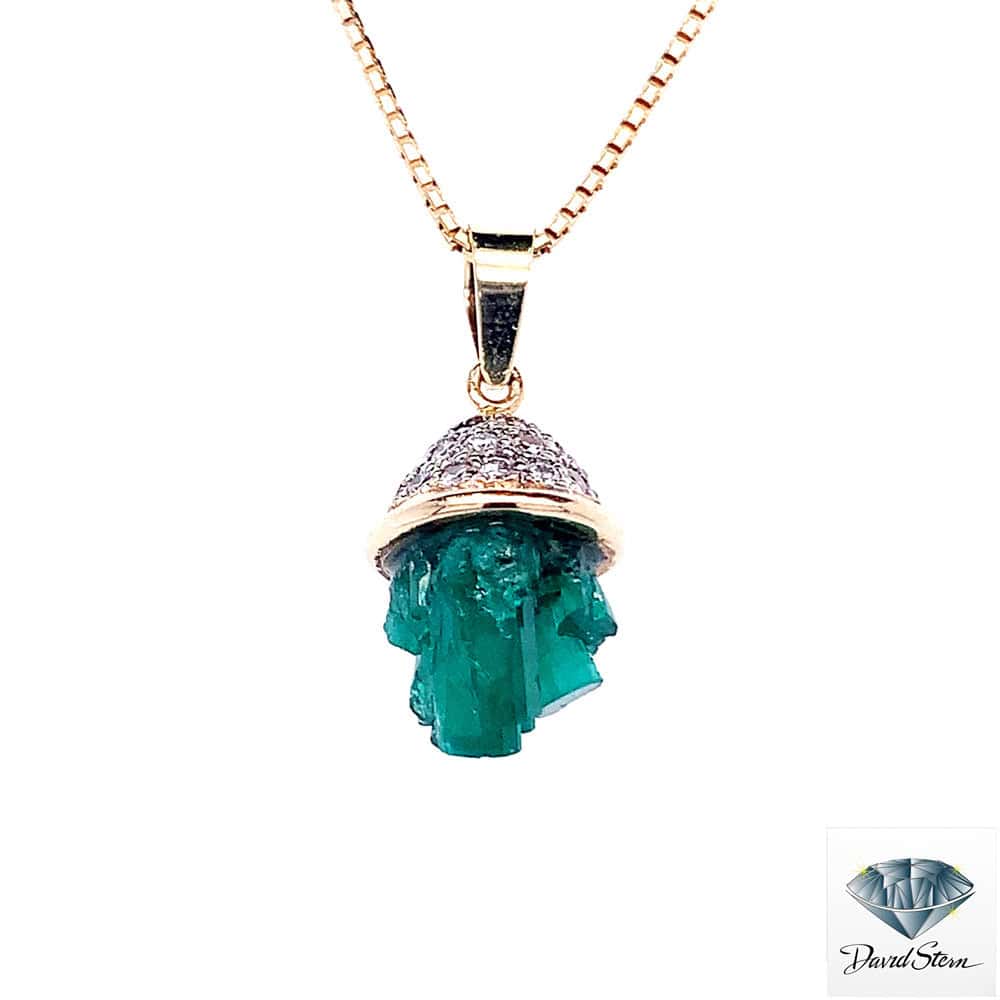
2.25 CT Uncut Crystal Chatham Emerald Couture Necklace in 14kt Yellow Gold
A one-of-a-kind Chatham emerald necklace in 14kt yellow gold. The center is an uncut cluster of Chatham lab-created emerald crystals, about 2.00 carats of rich green, hanging beneath a domed gold cap set with twenty-one pavé diamonds, about 0.25 carats in total, for 2.25 carats of total gem weight. The emerald is lab-created, not mined. It comes with a written appraisal that identifies it as such, and can be seen in person at our Boca Raton showroom.
PRODUCT DETAILS
- Designed By:
- David Stern Jewelers
- Sub Category:
- Necklaces, Pendants
- Sku Number:
- dsj_fcj_07700051
STONE DETAILS
- Center Stone:
- Uncut Crystal Chatham Emerald
- Secondary Stone:
- 0.25 ct tw Round Diamond
- Color And Clarity:
- I
- Total Carat Weight:
- 2.25 ct tw
METAL DETAILS
- Metal Type:
- 14kt Yellow Gold
- Gold Content:
- 58.3% pure
CERTIFICATION
- Appraised By:
- David Stern, G.I.A. Gemologist
- Appraisal Included:
- Yes, complimentary

Free Jewelry Appraisal with $2500 Purchase
David Stern Jewelers guarantees every piece of jewelry we sell, which is why we include a free jewelry appraisal with every item purchased.
DESCRIPTION
This Chatham emerald necklace is a one-of-a-kind piece in 14kt yellow gold, built around an uncut cluster of Chatham lab-created emerald crystals of about 2.00 carats. The green crystals hang beneath a domed yellow gold cap set with twenty-one small pavé diamonds, about 0.25 carats in total, for a total gem weight of 2.25 carats. What follows describes the exact piece you will see in our Boca Raton showroom, including exactly what a Chatham emerald is.
What a Chatham emerald is
We want to be clear from the start: the emerald in this necklace is lab-created, not mined. It was grown by Chatham, one of the oldest and best-known makers of laboratory-grown gemstones, which has been producing created emeralds since the 1930s.
A Chatham-created emerald is real emerald in the mineral sense. It is beryl colored green by chromium, with the same chemical composition, hardness and optical properties as an emerald from the ground. The difference is where it formed: in a laboratory over months, rather than in the earth over millions of years. The International Gem Society explains how lab-created gemstones are grown and how they compare with natural stones.
Lab-created emeralds are valued well below natural emeralds of similar appearance, and that is part of their appeal. They let you wear a large, vivid green crystal at a fraction of the cost of a mined stone, with known origin and no mining involved. Your appraisal will describe the stone as a Chatham lab-created emerald.
An uncut emerald crystal pendant
What makes this piece unusual is that the emerald has not been cut. Instead of an oval or emerald-cut gem, the pendant uses the crystals exactly as they grew: a cluster of long, six-sided green prisms, with natural faces, ridges and terminations.
Emerald crystallizes in hexagonal columns, and this cluster shows that structure clearly. Several crystals grow side by side, each with its own glassy faces, so the piece catches light in an irregular, natural way that no faceted stone can imitate.
That is what makes this an emerald crystal pendant rather than a conventional gemstone pendant. It celebrates the raw form of the gem, and it reads as organic and modern at the same time.
The color is a rich, saturated green, the shade that has made emerald one of the most prized gems in history. The Gemological Institute of America describes the most valued emeralds as a bluish green to pure green with strong saturation, and that is the tone these crystals show.
An emerald and diamond pendant with a pavé cap
The crystals are held by a domed cap of yellow gold, like the cap of an acorn, and the dome is covered in twenty-one small round diamonds set in pavé. The diamonds total about 0.25 carats and are recorded as I color and SI1 clarity.
That diamond cap is what turns a lab-grown crystal into a finished emerald and diamond pendant. The white sparkle of the pavé contrasts with the deep, glassy green below it, and the polished gold rim gives the whole piece a clean edge.
On this Chatham emerald necklace, a yellow gold bail connects the cap to the chain, so the crystal cluster hangs freely and moves as you do.
The 14kt yellow gold setting
The pendant is made in 14kt yellow gold. Warm yellow gold is the classic partner for green: it brings out the richness of the emerald and gives the piece a warm, glowing feel. 14kt is also a practical choice, harder than 18kt and well suited to a piece that will be worn often.
According to our listing, the necklace comes on a 16-inch yellow gold chain with a spring ring clasp, and the gold weighs about 6.9 grams. In the photograph it hangs on a box chain. We will confirm the chain and length with you in the showroom.
Why choose a lab created emerald necklace
A lab created emerald necklace offers several real advantages. Created emeralds tend to be cleaner than mined emeralds, which are almost always heavily included, so their color can look brighter and more even. They are also far more affordable, which is why a crystal cluster of this size is attainable.
For many buyers, known origin matters too. A Chatham emerald is grown under controlled conditions, so there is no question about where or how it was produced.
The important thing is disclosure. A lab created emerald necklace should always be described as lab-created, and we will always tell you exactly what you are buying.
How this Chatham emerald necklace wears
This Chatham emerald necklace is a conversation piece. The crystal cluster is sculptural and eye-catching, yet the pendant is compact enough to wear every day.
On a lab created emerald necklace like this one, emerald green flatters almost every skin tone, and it pairs beautifully with white, cream, black, navy and earth tones. With its pavé cap, the pendant has enough sparkle for evening wear while staying relaxed enough for daytime.
We will fit it on you in the showroom so you can see how it hangs. The cluster has a little more depth than a flat pendant, so it sits slightly forward from the chest and catches light from the side as well as the front. Most people find a length that lets it rest just below the collarbone shows the crystal best, but we will help you find what suits you and the necklines you wear most often.
A May birthstone necklace
Emerald is the birthstone for May, and GIA's guide to the May birthstone covers its long history as a symbol of rebirth and love. An emerald crystal pendant is a striking, unexpected way to give the May stone.
Emerald is also the traditional gift for the twentieth and thirty-fifth wedding anniversaries. A lab-created emerald crystal is a thoughtful choice for either.
Because every crystal cluster grows differently, a May birthstone necklace like this is truly one of a kind.
Lab-created, natural and imitation emeralds
It helps to know the three categories. A natural emerald is mined from the earth. A lab-created emerald, like this Chatham stone, is real emerald grown in a laboratory, with the same composition and properties as natural emerald. An imitation is a different material altogether, such as green glass, made only to look like emerald.
Lab-created emeralds sit between the two: real emerald, honestly described, at a far lower price than natural stones.
To the naked eye, a lab-created emerald and a natural one can look alike. Gemologists tell them apart under magnification and with laboratory instruments, by studying the tiny inclusions and growth patterns left behind as the crystal formed. Natural emeralds carry the fractures and mineral inclusions of the rock they grew in; created emeralds show the characteristic patterns of their growth process. That is one reason buying from a jeweler with gemological training matters, and why we will always tell you plainly what a stone is before you buy it.
How Chatham emeralds are grown
Created emeralds are grown by recreating, under controlled conditions, the heat and chemistry that form emerald in nature. The ingredients of beryl, along with the chromium that colors it green, are dissolved and then allowed to crystallize slowly onto seed crystals over a period of months.
The result is emerald that grows the same way natural emerald does, as hexagonal crystals, but without the fractures and heavy inclusions that most mined emeralds contain. Clusters like the one in this pendant form when several crystals grow side by side, just as they would in a natural pocket in the rock.
Most created emerald is cut into faceted gems. Leaving a cluster uncut, as here, shows the crystal growth itself, which is what gives this Chatham emerald necklace its sculptural character.
Emerald through history
Emerald has been prized for thousands of years. Cleopatra was famously fond of the stone, and emeralds from Egypt, and later from Colombia, adorned the treasures of empires across Europe, India and South America.
Its green has long been associated with spring, renewal and love, which is why emerald became the May birthstone and a symbol of hope. That history carries through to a lab-created stone: the color and meaning are the same, even though the stone was grown rather than mined.
Why a gold cap suits a crystal
Crystals are irregular, so they cannot be held by ordinary prongs or bezels in the way a cut stone can. A cap, fitted closely over the top of the cluster, is one of the most secure and attractive ways to mount them.
Here the cap does more than hold the stone. Covered in pavé diamonds and finished with a polished gold rim, it becomes a design feature in its own right, giving this emerald and diamond pendant a crown of sparkle above the green.
How to judge an emerald crystal pendant in person
Start with color. Look for a rich, even green across the crystals, without gray or yellowish areas. Chatham emeralds are known for their saturated color.
Next, look at the crystal faces. The long hexagonal prisms should be crisp and glassy, with natural ridges and terminations. That natural structure is the whole point of an uncut crystal.
Then look at the setting. The cap should hold the crystals securely, and the pavé diamonds should sparkle evenly with none missing.
Finally, look at the bail and chain. A crystal cluster has some weight, so the bail and clasp should be sturdy. That is where a well-made emerald and diamond pendant shows its quality.
What sets this Chatham emerald necklace apart
Most emerald pendants use a small faceted stone in a simple frame. This one uses an uncut crystal cluster, capped with pavé diamonds in yellow gold, which makes it look more like a natural specimen than a conventional gem.
And because no two crystal clusters grow the same way, you will not see another like it. This is the only one in our case.
Wearing an emerald crystal pendant with other jewelry
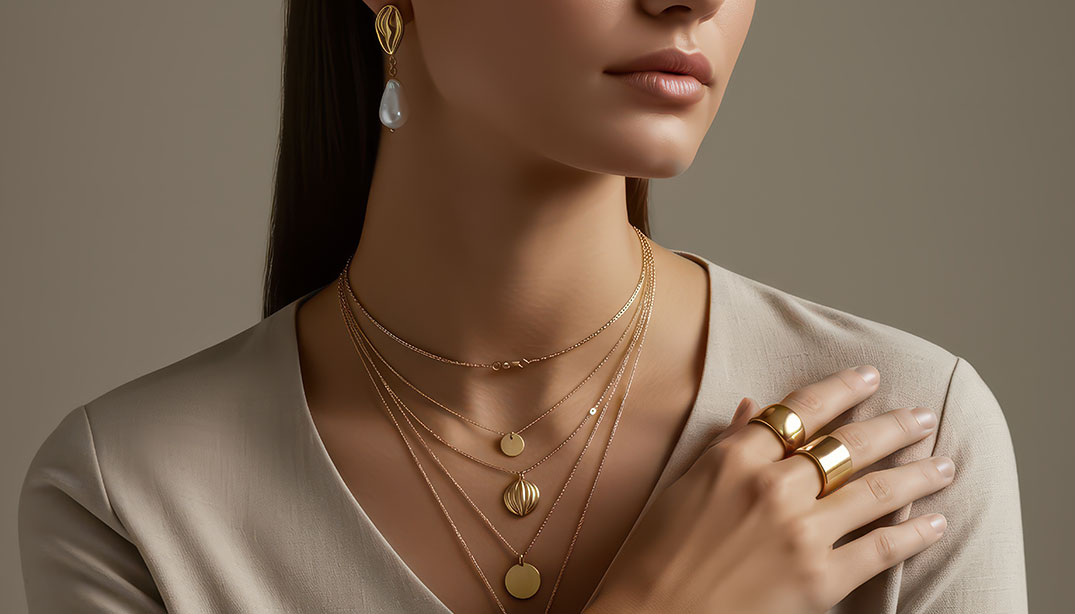
An emerald crystal pendant is a statement in its own right, so it looks best as the main piece at the neckline. Pair it with simple yellow gold hoops or diamond studs, and let the green crystal be the focus.
Green also sits beautifully with pearls and with other warm gold pieces, and it makes a striking contrast with white shirts and black evening wear.
Choosing a lab created emerald necklace as a gift
A lab created emerald necklace is an easy gift to get right. It does not depend on a ring size, green flatters almost everyone, and the crystal form makes it memorable. The questions worth asking are simple: does the person like organic, unusual designs, and do they wear yellow gold?
If it is a May birthday or a twentieth or thirty-fifth anniversary, the stone carries its own meaning as well. We are glad to help you decide, and we will tell you honestly whether this piece suits the person you have in mind.
Caring for an emerald crystal pendant
Emerald is 7.5 to 8 on the Mohs hardness scale, but the uncut crystals on an emerald crystal pendant have edges and points that can chip if knocked. Take the necklace off for sports, gardening and housework, and store it on its own in a soft, lined box.
Clean it with lukewarm water, a drop of mild soap and a soft brush, then dry it gently. Avoid ultrasonic and steam cleaners and sudden changes of temperature. Our jewelry care guide goes through the process step by step.
Bring it in once a year and we will check the cap, diamonds and bail at no charge.

Appraisal, documentation and what you receive
Every necklace at this level leaves with a written appraisal describing the metal, the stones, the measurements and a stated replacement value for insurance. For this piece, the appraisal clearly identifies the center stone as a Chatham lab-created emerald. Our jewelry appraisals page explains how we do it.
You can see our full range of necklaces and pendants alongside this one, and our diamond and gemstone education pages set out how grading actually works. If you would like a piece altered, or something built around a stone you already own, we do that too through our design service.
See this Chatham emerald necklace in Boca Raton
Photographs of green stones are unreliable. Screens push emerald green toward teal or olive, and a crystal cluster catches light differently from every angle. A piece like this is worth seeing in person, which is why we would rather you came in than bought it sight unseen.
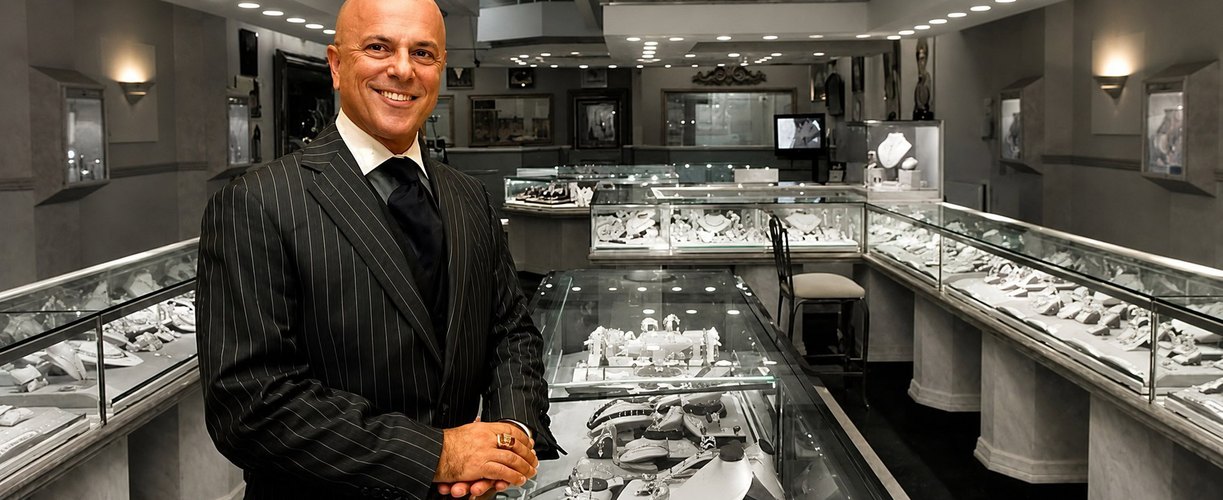
David Stern Jewelers has been in business for over 40 years, family owned since 1970, and the showroom is at 21073 Powerline Rd #37, Boca Raton. We are open Monday to Friday from 9:30am to 5:30pm and Saturday from 10:30am to 4:30pm. Call 561-994-3330 and we will have the piece waiting, or book an appointment for a quieter time.
Common questions about this Chatham emerald necklace
Is this a natural emerald?
No. It is a Chatham lab-created emerald. It is real emerald in composition and properties, but it was grown in a laboratory rather than mined, and it is valued well below natural emerald of similar appearance.
What is a Chatham emerald?
Chatham is one of the oldest makers of lab-created gemstones and has been growing emeralds since the 1930s. A Chatham emerald has the same chemical composition, hardness and optical properties as a mined emerald.
Why is the emerald uncut?
The emerald is left as a natural crystal cluster, showing the six-sided prisms that emerald grows in. It gives the pendant an organic, sculptural look that a faceted stone cannot match.
How large is the emerald?
The lab-created emerald crystal cluster weighs about 2.00 carats. With the twenty-one pavé diamonds, about 0.25 carats, the total gem weight is 2.25 carats.
What diamonds are in the pendant?
Twenty-one small round diamonds are set in pavé across the domed gold cap, about 0.25 carats in total, recorded as I color and SI1 clarity.
Does it come with a chain?
Our listing describes a 16-inch 14kt yellow gold chain with a spring ring clasp. We will confirm the chain and length with you in the showroom.
How should I care for an uncut emerald crystal?
Clean it with lukewarm, soapy water and a soft brush, and avoid ultrasonic and steam cleaners. Take it off for sports and housework, because the crystal points can chip if knocked.
Is emerald the May birthstone?
Yes. Emerald is the birthstone for May and a traditional gift for the twentieth and thirty-fifth wedding anniversaries.
Does the appraisal say it is lab-created?
Yes. The written appraisal describes the metal, the diamonds and the measurements, and clearly identifies the center stone as a Chatham lab-created emerald.
Can a similar piece be made with a natural emerald?
Yes. Through our custom design service we can create a comparable pendant around a natural emerald or another gemstone, including a stone you already own.
One last practical note. Because this is a single piece rather than stock, it can sell on any given day, and we do not hold items without a deposit. If you have seen this Chatham emerald necklace here and intend to come in, a phone call first will confirm it is still in the case and save you the trip if it is not.