0.40CT Diamond Earring Studs
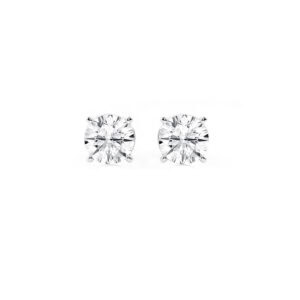
Diamond stud earrings in 14kt white gold. Two natural round brilliant cut diamonds, 0.20 carats in each ear for 0.40 carats in total, graded H to I color and SI1 clarity, each bezel set in a polished rim of white gold rather than prongs. There is nothing to snag on clothing or hair and the rim protects the edge of each stone. Light at 2.6 grams and designed by David Stern Jewelers. See them at our Boca Raton showroom.
PRODUCT DETAILS
- Designed By:
- David Stern Jewelers
- Sub Category:
- Earrings, Studs
- Sku Number:
- dsj_07700199
STONE DETAILS
- Center Stone:
- 0.20ct Round Diamond
- Total Carat Weight:
- 0.40ct
METAL DETAILS
- Metal Type:
- 14kt White Gold
- Metal Color:
- White Gold
- Gold Weight:
- 2.6grams
- Gold Content:
- 58.3% pure
CERTIFICATION
- Appraised By:
- David Stern, G.I.A. Gemologist
- Appraisal Included:
- Yes, complimentary

Free Jewelry Appraisal on Every Order
David Stern Jewelers guarantees every piece of jewelry we sell, which is why we include a free jewelry appraisal with every item purchased.
DESCRIPTION
These diamond stud earrings hold two natural round brilliant cut diamonds, 0.20 carats in each ear, bezel set in 14kt white gold. The pair weighs 0.40 carats in total and the earrings weigh 2.6 grams. They were designed by David Stern Jewelers. Everything below describes this exact pair, which you can see and try on at our Boca Raton showroom.
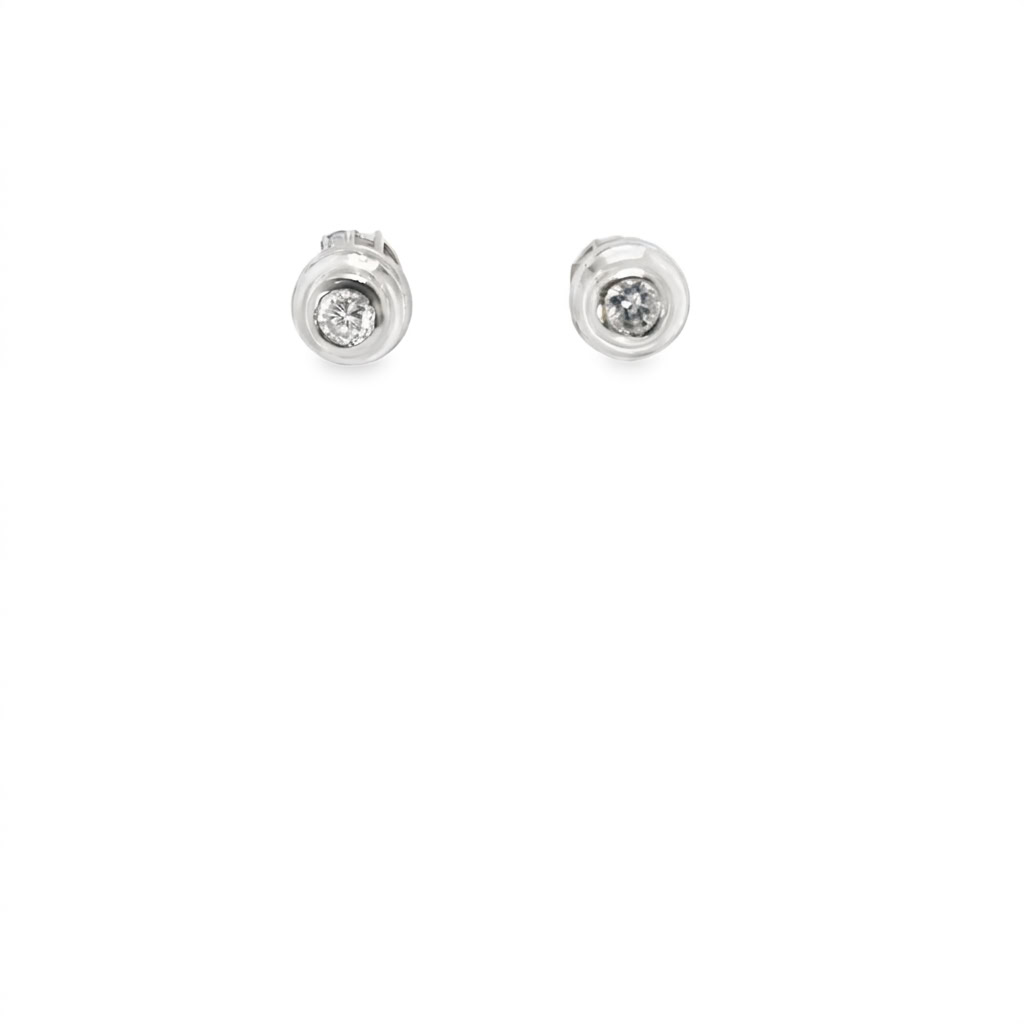
These diamond stud earrings at a glance
Here are the specifications of these diamond stud earrings, as recorded for this pair.
Each earring holds one natural round brilliant cut diamond of 0.20 carats. The two together weigh 0.40 carats, which jewelers write as 0.40 ct TW.
The diamonds are graded H to I color, which sits in the near-colorless range, and SI1 clarity, meaning small inclusions that are found under magnification rather than with the eye.
Each stone sits inside a polished rim of 14kt white gold rather than in prongs. The pair weighs 2.6 grams.
In short, this is the quiet version of a classic: a clean point of light at the lobe, with no metal claws to catch and nothing to think about once the earrings are in.
Is the 0.40 carats one diamond or two?
Two, and it is worth being clear. The 0.40 carats is the weight of the pair, not the weight of a single stone.
Each earring holds one diamond of 0.20 carats. Two of them make 0.40 carats total weight.
When you compare diamond stud earrings online, always check whether a listing gives the weight per ear or the total for the pair. The two are easy to confuse and the difference on the ear is obvious once you see them side by side.
How big are 0.40 carat diamond studs?
A well-cut 0.20 carat round brilliant measures a little under 4 millimeters across. For comparison, a 0.50 carat round is about 5 millimeters and a 1.00 carat round about 6.5 millimeters.
That makes 0.40 carat diamond studs a genuinely everyday size. They read clearly as diamonds from conversational distance, catch the light when you turn your head, and still disappear under a phone, a helmet strap or a pair of headphones.
Size is also why 0.40 carat diamond studs are such a common first pair of diamond stud earrings. They are large enough to feel like real jewelry and small enough to wear through an ordinary week without a second thought.
If you are weighing this size against a larger one, the useful test is to try several on at once. Stud sizes look very different on the ear from how they look in a tray.
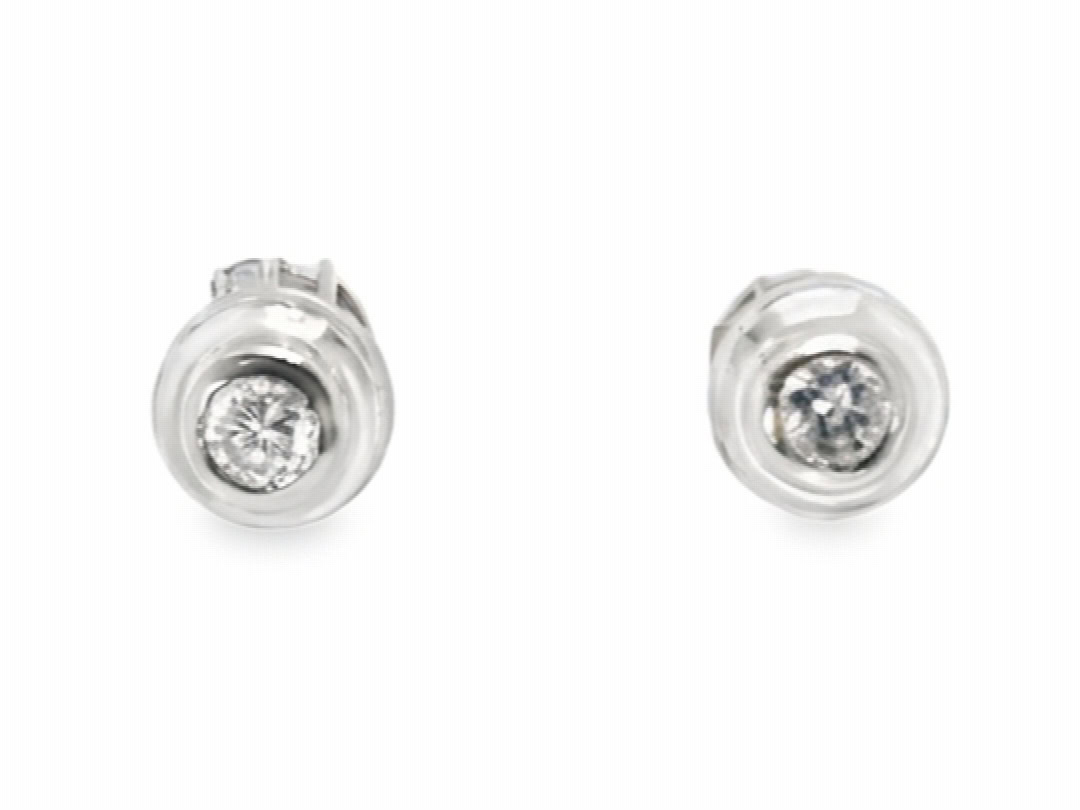
Bezel set diamond studs
Look closely at the photograph and you will see there are no prongs. Each diamond is held by a continuous rim of white gold that wraps the girdle of the stone. That is a bezel, sometimes called a rub-over setting, and bezel set diamond studs behave differently from the four-prong kind.
The practical advantage is that there is nothing to snag. Prongs are small claws standing proud of the stone, and they catch on scarves, sweaters, hair and towels. A bezel presents a smooth, rounded edge instead, which is why bezel set diamond studs are the usual recommendation for anyone who sleeps in their earrings, works with their hands, or has lost a stone from a prong setting before.
The bezel also protects the girdle, the thin outer edge of the diamond and the part most vulnerable to a knock. Wrapped in metal, it simply cannot be hit directly.
There is a visual trade-off worth knowing. A bezel covers the outer edge of the stone, so it shows slightly less diamond face-up than prongs would, and it reflects a ring of white metal around the gem. Many people prefer that look, because the rim reads as a deliberate circle of light rather than as hardware. If you want the maximum visible spread from the carat weight, a prong setting shows more stone; if you want security and a cleaner line, bezel set diamond studs are the better answer.
Natural diamond studs
The two stones here are natural diamonds, formed in the earth rather than grown in a laboratory. We say so plainly, because we sell both and the difference belongs on the label.
We also carry a full range of lab-grown studs, and they are real diamonds too: same chemistry, same crystal structure, same hardness. If you want far more carat weight for the same money, start with our 2 carat lab grown studs and compare.
What natural diamond studs offer is origin, and that is the one thing a laboratory cannot reproduce. The stones took an extraordinarily long time to form and were mined, sorted and cut rather than grown to order, and for many buyers that history is the point of owning a diamond at all.
At this size the price difference between natural and lab-grown is modest in absolute terms, which is part of why 0.40 carat diamond studs in natural stones remain such a sensible purchase. The decision is about what you want the stones to be, not about stretching a budget.
H to I color and SI1 clarity
Diamond color is graded on a scale that runs from D, completely colorless, down to Z, with a visible yellow tint. H and I sit in the near-colorless band: a trained eye can tell them from a D when the stones are loose and viewed from the side, but face-up in a white metal setting they look white.
Our guide to diamond color shows the full scale. The Gemological Institute of America explains how the grades are assigned under controlled lighting.
Clarity describes the tiny internal features, called inclusions, that almost every natural diamond contains. SI1 stands for slightly included: the inclusions are found under 10x magnification and in a stone of this size are generally not visible to the unaided eye.
H to I color and SI1 clarity is a deliberately sensible combination for studs. Earrings are seen in motion, from a few feet away, against skin and hair, and nobody examines them with a loupe. Paying for a flawless, colorless grade buys a difference you could not see on the ear, and that money is better spent on carat weight or on the setting.
For a broader overview of how color, clarity, cut and carat work together, see our guide to the diamond 4Cs.
The round brilliant cut
The round brilliant is the most studied cut in the trade. Its 57 or 58 facets are arranged to collect light through the table and return it to the eye in rapid white flashes rather than broad flares.
That geometry works in favour of a near-colorless grade. In a well-cut round, face-up brightness tends to mask the faint warmth an H or I color shows when the stone is examined loose and on its side.
Round is also the easiest shape to add to later. If you decide you want matching earrings higher on the ear, a pendant on the same scale, or a second pair in a larger weight, round stones are far simpler to pair than fancy shapes.
14kt white gold earrings
14kt gold is 58.3 percent pure gold, alloyed with other metals for strength. In 14kt white gold earrings that strength matters more than it would in a ring, because the whole weight of the stone hangs on a thin post and a small rim of metal.
White gold also keeps the setting neutral. There is no warm metal next to the stones to reflect color back into them, which helps near-colorless diamonds look as white as they can.
White gold is usually finished with a thin rhodium plating for a bright white surface. Over years of wear that plating can soften, particularly on the backs where the metal rubs. We can re-plate 14kt white gold earrings in store to restore the finish.
At 2.6 grams the pair is light. Studs are worn through a pierced lobe and weight is the main thing that makes earrings uncomfortable over a long day, so light is a feature rather than a shortcut.
Who these diamond stud earrings suit
They suit anyone who wants diamonds they do not have to manage. There is no cluster, no halo and no prongs: just two stones, sized to be worn.
They suit a first pair of diamond stud earrings. A graduation, an eighteenth or twenty-first birthday, a new job or a quiet anniversary are all occasions where diamond stud earrings are the obvious gift, and this weight is a considered place to start.
They suit people who already own statement jewelry. If you have a cocktail ring or a pair of drops for the evening, a small pair of studs is what you wear the rest of the time.
And they suit anyone who has had trouble with prong-set earrings. A bezel removes the single most common cause of a lost stone.
How to wear diamond stud earrings
Diamond stud earrings this size go with everything, which is the point. They sit comfortably under a collar, behind a scarf and inside a motorcycle or ski helmet, and they never compete with a necklace.
They also stack well. If you wear a second or third piercing, a small bezel-set pair in the lobe anchors a row of hoops or smaller studs higher up the ear without crowding them.
For evening, wear them with a tennis bracelet or a diamond line necklace and let the larger piece carry the look. For an ordinary day, wear them with nothing else at all.
Everyday wear and how the stones stay put
Diamond is the hardest natural material, 10 on the Mohs scale, and nothing in normal daily life will scratch it. The risk to any pair of diamond stud earrings is mechanical: a hard knock on the girdle, or a setting that gradually works loose.
A bezel addresses both. The rim shields the girdle, and a continuous band of metal cannot be bent open the way a single prong can.
What still deserves attention is the back. Check every few months that each backing threads or clips on firmly, and replace a back that has loosened rather than waiting. We can check and replace backs for you in store.
Take the pair out for contact sport and for anything where a direct blow to the ear is plausible. Everything else, including sleeping and showering, is a matter of preference rather than risk with a bezel setting.
Caring for your diamond studs
Diamond attracts oil. Lotion, hairspray, shampoo and the natural oils of the skin build up behind the stone and dull its sparkle long before anything else goes wrong, and that film is the single most common reason a pair of studs stops looking bright.
Soak the earrings in warm water with a drop of mild dish soap, brush gently behind each bezel with a soft toothbrush, rinse and pat dry. Our jewelry care guide has more detail.
A bezel traps that film particularly well, because the rim leaves less open space underneath than prongs do. Cleaning behind the setting makes far more difference than anything you can do to the front of the stone.
Store your diamond stud earrings in a soft pouch or a lined compartment, one to each side, rather than loose in a drawer, where diamonds can scratch other jewelry. We offer complimentary cleaning and inspection for jewelry bought from our store.
Seeing these diamond stud earrings in Boca Raton
Small diamonds photograph flatly, and a bezel reads differently in person than on a white background. You are welcome to try these diamond stud earrings on at our Boca Raton showroom and compare them with other sizes and settings.
We are open Monday to Friday, 9:30 to 5:30, and Saturday, 10:30 to 4:30. Directions are on our Visit Us page.
David Stern Jewelers has served Boca Raton for over 40 years. David Stern is a GIA Graduate Gemologist, so detailed questions about the diamonds can be answered on the spot.

Appraisal and insurance
Most homeowners and renters policies cover jewelry only up to a low limit unless a piece is scheduled separately, and scheduling usually requires a written appraisal.
We offer jewelry appraisals in store. An appraisal describes the diamonds, the gold and the setting, and gives a replacement value an insurer can work from. Ask us when you visit and we will tell you whether a pair at this value is worth scheduling on your own policy.
More diamond earrings
Browse all our diamond studs, or the full range of earrings, including drops, hoops and gemstone designs.
Questions about these diamond stud earrings
Is the 0.40 carats the total for both earrings?
Yes. The pair totals 0.40 carats, which is 0.20 carats in each earring. When you compare prices, check whether a listing gives the weight per ear or the total, because they are easy to confuse.
Are the diamonds natural or lab-grown?
They are natural diamonds, formed in the earth. We also sell lab-grown studs, and we always say which is which.
How big is a 0.20 carat diamond?
A well-cut 0.20 carat round brilliant is a little under 4 millimeters across. On the ear it reads clearly as a diamond without being a statement piece.
What does bezel set mean?
The diamond is held by a continuous rim of metal around its edge rather than by prongs. Bezel set diamond studs have nothing to snag on clothing or hair, and the rim protects the most vulnerable edge of the stone.
Are bezel settings more secure than prongs?
Generally yes. A single prong can be bent or worn through, which is the most common way a small stone is lost. A continuous bezel cannot open in the same way.
Does a bezel make the diamond look smaller?
Slightly. The rim covers the outer edge of the stone, so a bezel shows a little less diamond face-up than prongs. In exchange you get a cleaner outline and a more secure setting.
What are the diamond grades?
The two diamonds are graded H to I color, within the near-colorless range, and SI1 clarity, meaning inclusions that are found under magnification rather than with the eye.
Will I see the inclusions?
At SI1 and this size, almost certainly not. SI1 inclusions are identified under 10x magnification; at arm's length on an ear they are not visible.
What metal are they?
14kt white gold, which is 58.3 percent pure gold, and the pair weighs 2.6 grams. White gold is usually rhodium plated, and we can re-plate it in store when the finish softens.
Can I wear these every day?
Yes. Diamond is the hardest natural material and the bezel protects the edge of each stone. Check the backs every few months and take the pair out for contact sport.
How do I clean diamond studs at home?
Soak them in warm water with a drop of mild dish soap, brush gently behind each bezel with a soft toothbrush, rinse and pat dry. Most of the dullness people notice is oil behind the stone.
Do they come with an appraisal?
We can prepare a written appraisal in store, which is what an insurer needs to schedule a piece separately. Ask us when you visit.
Can I see them before I buy?
Yes. The pair is at our Boca Raton showroom, where you can compare sizes and settings side by side. We are open Monday to Friday, 9:30 to 5:30, and Saturday, 10:30 to 4:30.