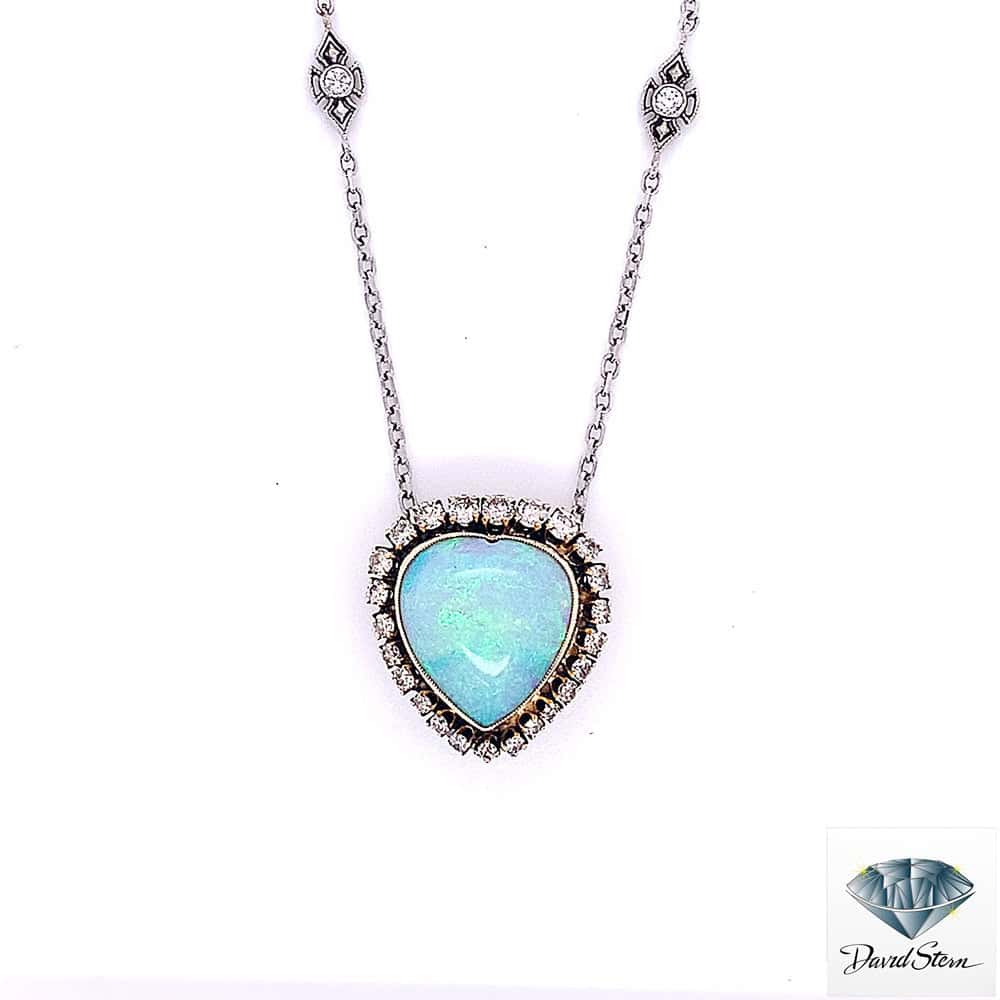
6.30 CT Heart Cabochon Opal Vintage Necklace in 14kt Yellow Gold
A one-of-a-kind vintage-style heart opal necklace in 14kt gold. A 4.90 carat heart-shaped cabochon opal, alive with green and blue play-of-color and flashes of red, sits in a milgrain bezel inside a halo of round diamonds, with two more diamonds in pierced stations on the chain. Thirty-one diamonds in all, for 6.30 carats of total gem weight. It comes with a written appraisal for insurance and can be seen in person at our Boca Raton showroom.
PRODUCT DETAILS
- Designed By:
- David Stern Jewelers
- Sub Category:
- Necklaces, Pendants
- Sku Number:
- dsj_fcj_660426
STONE DETAILS
- Center Stone:
- Heart Opal
- Secondary Stone:
- 1.5 ct tw Round Diamond
- Color And Clarity:
- SI-1
- Total Carat Weight:
- 6.3 ct tw
METAL DETAILS
- Metal Type:
- 14kt Yellow Gold
- Gold Content:
- 58.3% pure
CERTIFICATION
- Appraised By:
- David Stern, G.I.A. Gemologist
- Appraisal Included:
- Yes, complimentary

Free Jewelry Appraisal with $2500 Purchase
David Stern Jewelers guarantees every piece of jewelry we sell, which is why we include a free jewelry appraisal with every item purchased.
DESCRIPTION
This heart opal necklace is a one-of-a-kind vintage-style piece in 14kt gold, built around a 4.90 carat heart-shaped cabochon opal, full of green and blue play-of-color with flashes of red. A halo of round diamonds frames the heart, two more diamonds sit in pierced stations on the chain, and the total gem weight is 6.30 carats. What follows describes the exact piece you will see in our Boca Raton showroom.
The 4.90 carat heart opal
The center stone is a heart-shaped opal of 4.90 carats, cut as a cabochon: a smooth, polished dome rather than a faceted stone. That is the traditional way to cut opal, because the color in an opal comes from inside the stone, and a dome shows it off from every angle.
The Gemological Institute of America explains that opal's play-of-color comes from microscopic spheres of silica stacked inside the stone, which split light into spectral colors as it passes through. In this heart, that play shows mostly as green and blue, with red flashes appearing as the stone moves.
Play-of-color is what makes every opal different. No two stones show the same pattern, and the pattern changes with the light and the angle. The heart opal necklace you see in the photograph will look different again in daylight, under warm lamps and as you turn your head.
For a heart opal necklace, the shape is also one of the harder ones to cut well. The cutter has to keep the two lobes even and the point centered while working around the color in the rough. This heart is well balanced, with a clean outline and a full, even dome.
An opal and diamond necklace with a classic halo
What makes this an opal and diamond necklace rather than a simple pendant is the halo. A ring of round diamonds follows the outline of the heart, each held in its own small setting, so the opal is framed by a continuous line of white light.
The opal itself sits in a fine gold bezel with a milgrain edge, a row of tiny beads worked into the metal. Milgrain is a hallmark of vintage jewelry, and it gives the bezel a soft, textured line between the smooth opal and the bright diamonds.
Above the pendant, two more diamonds are set in pierced, shield-shaped stations on the chain. They repeat the sparkle of the halo higher up the neckline and give the whole piece the look of an early twentieth century design.
In total there are thirty-one round diamonds, ranging from about 0.015 to 0.05 carats each and recorded as SI1 clarity. With the 4.90 carat opal, the total gem weight is 6.30 carats.
Why this is a vintage opal necklace
This vintage opal necklace takes its character from the details: the milgrain bezel, the pierced diamond stations on the chain and the classic halo around a colored center. All three are signatures of jewelry from the early twentieth century, and together they give the piece an old-world elegance.
It is worth being precise about what vintage means here. The design is vintage in style and detail, and we will tell you everything we know about the piece's history when you see it in person rather than guessing at a date.
The opal and diamond necklace was a favorite of that period. The soft, shifting color of the opal and the hard white sparkle of the diamonds play against each other, which is why the combination still looks fresh a century later.
An opal heart pendant with meaning
A heart is the clearest symbol in jewelry, and an opal heart pendant adds a stone with its own long history. Opal has been prized for its color since antiquity, and in the Victorian era it became especially fashionable after Queen Victoria gave opal jewelry to her family.
That makes this an easy piece to give. An opal heart pendant says what it means without explanation, whether for an anniversary, a birthday, Valentine's Day or a new mother.
Opal is also the traditional gift for the fourteenth wedding anniversary. A heart opal with a diamond halo marks that milestone with a piece that will be worn, not stored.
An October birthstone necklace
Opal is a birthstone for October, alongside tourmaline, and GIA's guide to the October birthstones covers both. With its green, blue and red play-of-color, this heart is an October birthstone necklace with far more presence than a small stone on a chain.
Because every opal is unique, an October birthstone necklace like this is personal in a way few birthstone pieces are. Nobody else will have a stone with the same pattern of color.
Tourmaline, the other October stone, comes in almost every color but shows each one as a single body color. Opal is the stone for someone who loves color in motion. If the person you are buying for already wears blues and greens, the colors in this heart will sit naturally with the rest of their wardrobe, and the opal heart pendant will become an everyday favorite.
How this heart opal necklace wears
The heart is a generous size without being heavy, and it sits flat at the base of the throat. This heart opal necklace suits an open neckline, a scoop or a simple crew neck, and the soft colors pair naturally with white, cream, navy, black and blue.
Because the pendant is framed by diamonds and supported by diamond stations on the chain, it has enough sparkle for evening wear. The gentle colors of the opal also make it easy to wear in the daytime.
We will fit it on you in the showroom so you can see exactly where the heart falls. If you are unsure about chain length, ask us to measure it with you; a small change moves the pendant from the collarbone to just above a neckline.
What sets this opal and diamond necklace apart
Many opal pendants are simple: a stone in a plain bezel on a thin chain. This opal and diamond necklace is a complete design, with a milgrain bezel, a full diamond halo and a chain set with its own diamond stations. Every part of it was made to go with every other part.
The size of the opal matters too. At 4.90 carats, the heart is large enough to show a real pattern of color, rather than a few flashes in a small stone. Size is where opal's play-of-color really comes into its own, because a broader face gives the color more room to move.
And because every opal is unique, no one else has this pendant. Even another heart opal of the same weight would show a completely different pattern of color.
Where fine opal comes from
Most of the world's precious opal has come from Australia since the late nineteenth century, and Australian opal remains the standard the trade measures against. Significant deposits have also been found in Ethiopia, Mexico and Brazil, each with its own character.
Opal forms when water carrying dissolved silica seeps into cracks and cavities in rock and slowly deposits it. Over very long periods, the silica settles into the orderly stacks of tiny spheres that produce play-of-color. Only a small fraction of the opal that forms has spheres regular enough to show color at all.
That is why a well-colored heart of nearly five carats is worth studying in person. We are happy to show you this vintage opal necklace under different lights so you can see its full range before you decide.
How to judge an opal necklace in person
Start with play-of-color. Look at how much of the face shows color, how bright it is and how the pattern moves as you tilt the stone. Broad flashes of color across the whole dome are more valued than small pinpoints in one area.
Next, look at the colors themselves. Red is the rarest play-of-color in opal, followed by orange, with green and blue the most common. A stone that shows red flashes, as this one does, is showing the full range.
Then look at the body. Hold the pendant up and check for cracks or crazing, a network of fine surface lines. The dome should be smooth, evenly polished and free of scratches.
Finally, look at the workmanship. The bezel should hold the opal snugly all the way around, the halo diamonds should sit level and evenly spaced, and the back should be finished as carefully as the front. That is where a well-made opal and diamond necklace separates itself from a mass-produced one.
Opal compared with other colorful gemstones
Opal is unlike any other gem because its color moves. Moonstone has a soft blue glow, called adularescence, but no spectral colors. Labradorite flashes blue and green, but usually from a dark background and only at certain angles. Only opal shows a full, shifting pattern of spectral color across its face.
The trade-off is hardness. Opal sits at about 5.5 to 6.5 on the Mohs scale, softer than most gems used in jewelry, so it asks for more care. In a pendant, which sees far less contact than a ring, that is very manageable. The International Gem Society gives a good overview of how opal compares.
Choosing a vintage opal necklace as a gift
A vintage opal necklace is one of the more personal fine jewelry gifts you can choose. It does not depend on a ring size, the heart says what it means, and every opal is one of a kind. The questions worth asking are simple: does the person like vintage styling, and do they wear softer colors?
If the answer to both is yes, this is a piece that will be worn often. If it is an October birthday or a fourteenth anniversary, the stone carries its own meaning as well.
We are glad to help you decide. Bring a photo of what they usually wear, and we will tell you honestly whether this piece suits them or whether something else from the case would be the better choice.
Caring for an opal heart pendant
Opal contains a small amount of water, so it dislikes heat and sudden changes of temperature. Clean your opal heart pendant with lukewarm water, a drop of mild soap and a soft cloth, then dry it gently. Never use an ultrasonic or steam cleaner. The International Gem Society's opal care guide covers this in detail, and our jewelry care guide covers the rest of the piece.
Take the necklace off before swimming, bathing, exercising or cleaning. Chlorine, household chemicals and knocks are the main risks to opal, and avoiding them is most of the care it needs.
Store the heart opal necklace on its own in a soft, lined pouch or box. Diamonds are much harder than opal and can scratch it, so keeping this piece apart from other jewelry protects the dome.
Put it on last and take it off first. Perfume, hairspray and lotion leave a film that dulls the opal's color and the diamonds' sparkle.
Bring it in once a year and we will clean it professionally and check the bezel, halo and chain at no charge.

Appraisal, documentation and what you receive
Every opal necklace at this level leaves with a written appraisal describing the metal, the stones, the measurements and a stated replacement value for insurance. That document is what your insurer will ask for, and it is worth updating every few years as gold and gem prices move. Our jewelry appraisals page explains how we do it.
You can see our full range of necklaces alongside this one, and our diamond and gemstone education pages set out how grading actually works. If you would like a piece altered, or something built around a stone you already own, we do that too through our design service.
See this heart opal necklace in Boca Raton
Photographs of opal are especially unreliable. The play-of-color changes with every movement and every light source, and a still image can only ever show one moment of it. A piece like this has to be seen in person, which is why we would rather you came in and looked at it than bought it sight unseen.
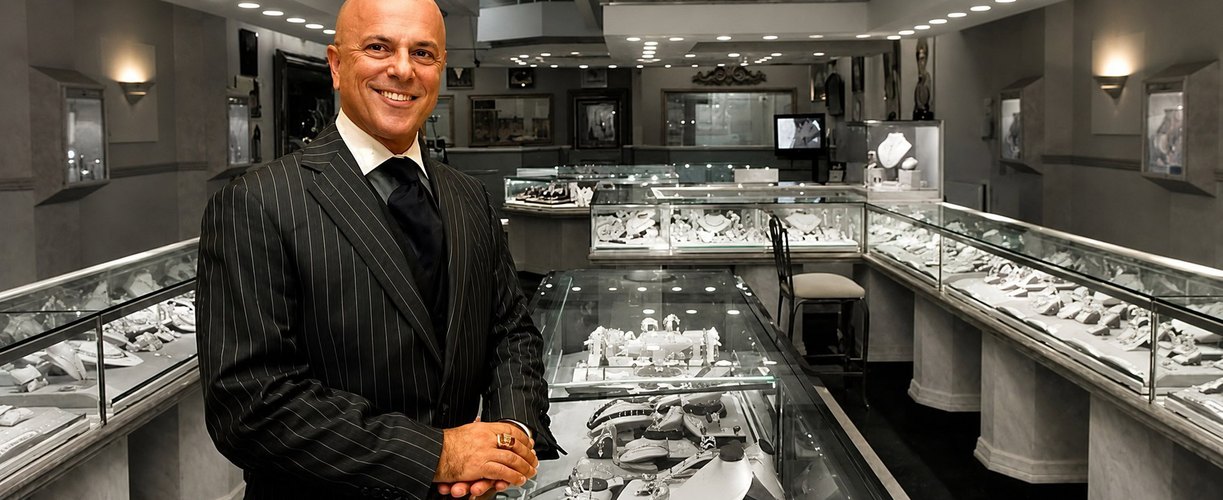
David Stern Jewelers has been in business for over 40 years, family owned since 1970, and the showroom is at 21073 Powerline Rd #37, Boca Raton. We are open Monday to Friday from 9:30am to 5:30pm and Saturday from 10:30am to 4:30pm. Call 561-994-3330 and we will have the piece waiting, or book an appointment for a quieter time.
If this particular piece is not quite right, tell us why. A different stone, a simpler setting, a longer chain: with a piece like this the specification is a starting point, and we would rather find you the right thing than sell you the nearest thing.
Common questions about this heart opal necklace
How large is the opal?
The heart-shaped cabochon opal weighs 4.90 carats. With the thirty-one diamonds in the halo and on the chain, the total gem weight of the necklace is 6.30 carats.
What is play-of-color?
Play-of-color is the shifting pattern of spectral colors inside an opal. It is caused by tiny silica spheres that split light as it passes through the stone. In this opal it shows mainly as green and blue, with flashes of red.
How many diamonds are in the necklace?
There are thirty-one round diamonds, from about 0.015 to 0.05 carats each, recorded as SI1 clarity. Most form the halo around the heart, and two sit in pierced stations on the chain.
Is opal durable enough to wear often?
Opal is softer than most gems, at about 5.5 to 6.5 on the Mohs scale, but a pendant sees far less contact than a ring. Take it off for swimming, exercise and housework, avoid heat and chemicals, and it will wear well for many years.
How should I clean an opal necklace?
Use lukewarm water, a drop of mild soap and a soft cloth, then dry it gently. Never use an ultrasonic or steam cleaner, and avoid sudden changes of temperature.
Is opal an October birthstone?
Yes. Opal is one of the October birthstones, alongside tourmaline, and a traditional gift for the fourteenth wedding anniversary.
Is this an antique?
It is vintage in style, with a milgrain bezel, a diamond halo and pierced diamond stations on the chain. We will tell you everything we know about its history when you see it in person.
Does the necklace come with an appraisal?
Yes. It leaves with a written appraisal describing the metal, the stones and the measurements, with a replacement value your insurer can use.
Do you buy opal jewelry as well as sell it?
Yes. We buy fine jewelry, gold and gemstones in Boca Raton, and we can value a piece you already own while you are here.
Can a similar design be made with a different stone?
Yes. Through our custom design service we can build a comparable halo pendant around another gemstone or a stone you already own, in white, yellow or rose gold.
One last practical note. Because this is a single piece rather than stock, it can sell on any given day, and we do not hold items without a deposit. If you have seen this heart opal necklace here and intend to come in, a phone call first will confirm it is still in the case and save you the trip if it is not.