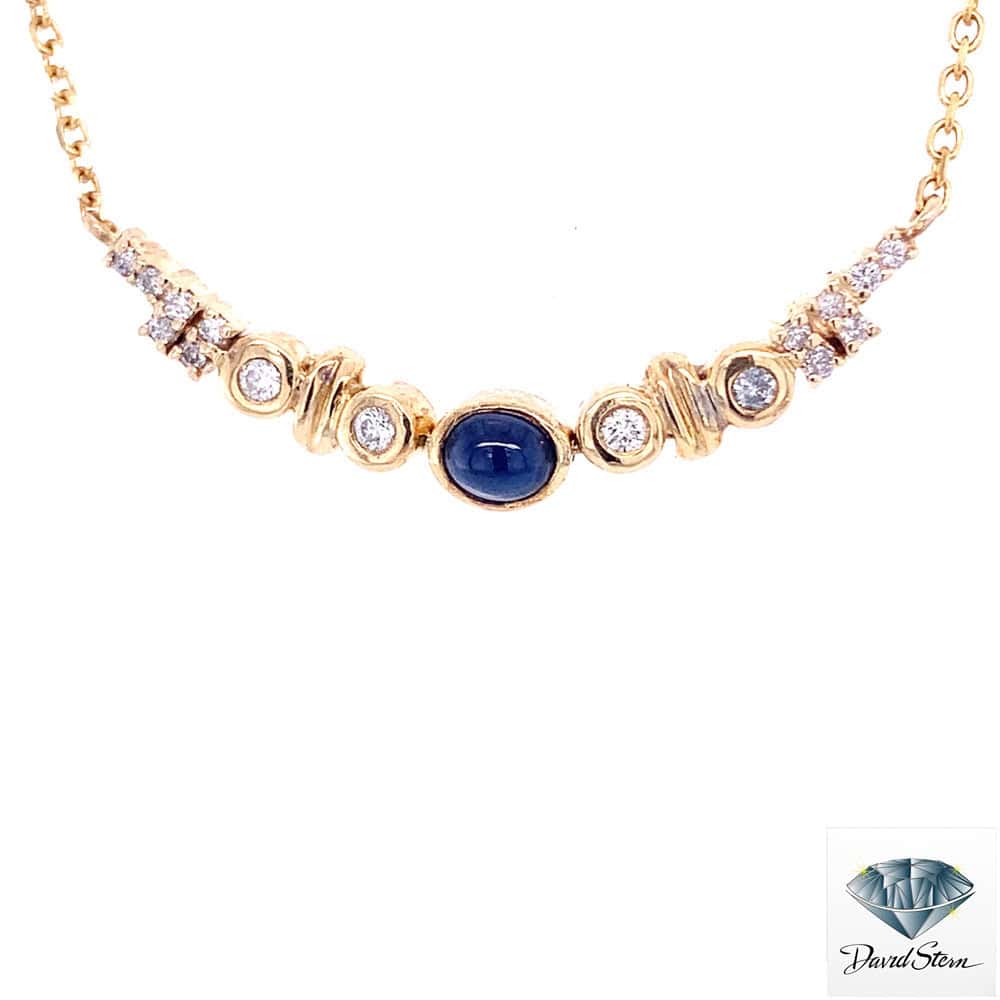
0.35 CT Oval Cabochon Sapphire Fashionable Necklace in 14kt Yellow Gold.
A cabochon sapphire necklace in 14kt yellow gold. A smooth oval cabochon sapphire of deep blue, about 0.15 carats, sits in a gold bezel at the center of a gently curved row of stations: bezel-set diamonds, grooved gold beads and small diamond clusters at each end. Sixteen diamonds, 0.20 carats in total, for 0.35 carats of gemstones in all. The row is fixed to a fine chain at both ends. Includes a written appraisal. See it at our Boca Raton showroom.
PRODUCT DETAILS
- Designed By:
- David Stern Jewelers
- Sub Category:
- Necklaces
- Sku Number:
- dsj_fcj_07700381
STONE DETAILS
- Center Stone:
- Oval Sapphire
- Secondary Stone:
- 0.2 ct tw Round Diamond
- Color And Clarity:
- SI-1
- Total Carat Weight:
- 0.35 ct tw
METAL DETAILS
- Metal Type:
- 14kt Yellow Gold
- Gold Content:
- 58.3% pure
CERTIFICATION
- Appraised By:
- David Stern, G.I.A. Gemologist
- Appraisal Included:
- Yes, complimentary

Free Jewelry Appraisal with $2500 Purchase
David Stern Jewelers guarantees every piece of jewelry we sell, which is why we include a free jewelry appraisal with every item purchased.
DESCRIPTION
This cabochon sapphire necklace sets a smooth, domed oval sapphire at the center of a gently curved row of gold stations, flanked by bezel-set diamonds and finished with small diamond clusters at each end, in 14kt yellow gold. The sapphire and sixteen diamonds total 0.35 carats. Everything below describes this exact piece, which you can see at our Boca Raton showroom.
The cabochon sapphire necklace at a glance
Here is what this cabochon sapphire necklace is made of, as recorded for this piece.
At the center is an oval cabochon sapphire of about 0.15 carats, a deep blue, held in a smooth yellow gold bezel.
On each side are two round diamonds, each in its own round bezel, separated by grooved gold beads. At each end of the row sits a small cluster of prong-set diamonds before the chain begins.
The record lists sixteen diamonds in all, from about 0.01 to 0.03 carats, 0.20 carats in total, graded SI1 clarity. Together with the sapphire, the necklace carries 0.35 carats of gemstones.
The metal is 14kt yellow gold, with a fine cable chain attached to each end of the row, so the stations stay centered at the front of the neck.
Is the 0.35 carats one sapphire?
No, and it is worth being clear. The 0.35 carats is the total weight of all the stones in the necklace, not the weight of the sapphire.
The sapphire is about 0.15 carats. The sixteen diamonds around it add 0.20 carats. Together they make 0.35 carats of gemstones.
That balance is what gives the necklace its character: a deep blue center with sparkle spread along the whole row.
Why a cabochon sapphire
A cabochon is a stone that has been shaped and polished into a smooth dome instead of being cut with flat facets. It is one of the oldest ways to finish a gem, used for centuries before faceting was developed.
On a sapphire, a cabochon shows color in a soft, velvety way. Instead of flashing with sparkle, it glows, with a highlight that rolls across the dome as you move. That makes a cabochon sapphire necklace feel understated and elegant, with a slightly vintage character.
The smooth dome is also very practical. With no sharp facet edges, a cabochon is less likely to chip, and it sits comfortably against the skin.
Sapphire is a variety of corundum and ranks 9 on the Mohs hardness scale, second only to diamond. The Gemological Institute of America describes sapphire's range of blues and how color drives its value.
A short history of the cabochon
The cabochon is the oldest way of finishing a gemstone. Long before cutters learned to grind precise flat facets, stones were shaped and polished into smooth domes, and many of the most famous sapphires and rubies in historic crowns and royal jewels are cabochons.
Faceting became dominant from the seventeenth century onward, but cabochons never disappeared. Jewelers of the Art Nouveau and Arts and Crafts movements loved them for their soft glow, and they remain a favorite for colored stones today.
A cabochon sapphire necklace like this one draws on that long tradition, pairing the oldest style of gem with a modern, wearable design.
Cabochon or faceted sapphire?
A faceted sapphire has flat, angled surfaces that bounce light around inside the stone, creating sparkle. A cabochon has a smooth dome that shows color more softly, with a glowing highlight instead of flashes.
Which you prefer is a matter of taste. Faceted stones feel bright and formal; cabochons feel calm, rich and slightly vintage.
In this necklace, the two work together. The cabochon sapphire provides a deep, velvety center, while the faceted diamonds on either side supply the sparkle. That contrast is what makes a cabochon sapphire necklace so distinctive.
Sapphire color explained
Color is the most important factor in a sapphire's value. Gemologists look at hue, tone and saturation, and the most prized blue sapphires are a strong, pure blue that is neither too pale nor too dark.
The sapphire in this necklace is a deep blue, which a cabochon shows particularly well: the dome concentrates the color toward the center and lets it glow at the edges.
Most sapphires on the market have been heated to improve their color, a permanent and widely accepted practice. The written appraisal records what is known about this stone.
A sapphire station necklace
A station necklace spaces stones or ornaments along its length instead of hanging a single pendant, and a sapphire station necklace uses that rhythm to frame a blue center. Here the stations form a gently curved row across the front of the neckline.
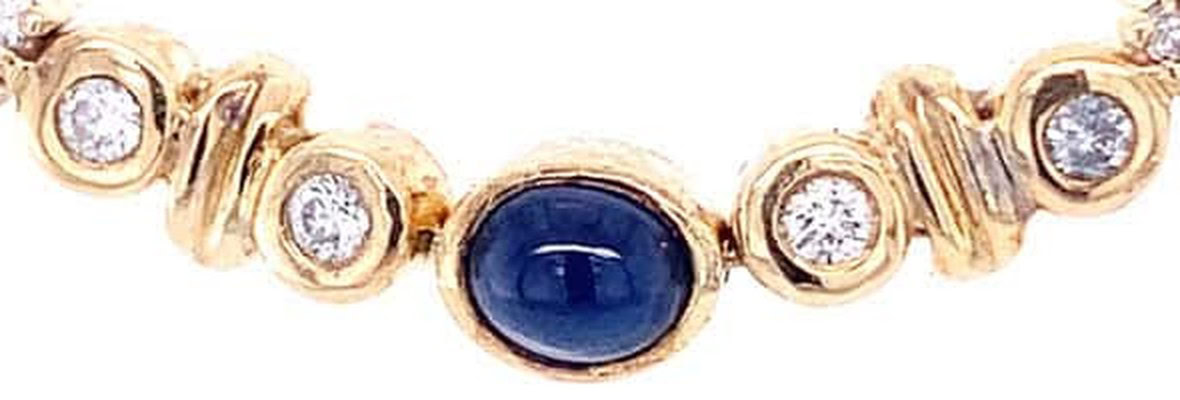
This sapphire station necklace alternates round diamond bezels with grooved gold beads on each side of the sapphire, building a rhythm of gold and sparkle that leads to the blue center.
Because the row is fixed to the chain at both ends, it cannot slide or twist. It sits flat and centered, which makes it one of the most comfortable and practical necklace styles to wear every day.
The small diamond clusters at each end add a final flash of light where the stations meet the chain.
The grooved gold beads between the diamonds are a quiet but important detail. Their ribbed texture catches the light differently from the polished bezels, so the row has depth and rhythm rather than looking flat. It is the kind of handcrafted touch that makes a sapphire station necklace feel considered, and it gives the yellow gold station necklace a subtle richness that you notice more the longer you wear it.
A bezel set diamond necklace
Four of the diamonds, two on each side of the sapphire, are bezel-set: each sits in a smooth round collar of gold that wraps around its edge.
A bezel set diamond necklace has a clean, modern look and is very secure. The gold rim protects each diamond from knocks, and there are no prongs to catch on clothing or hair.
The polished bezels also make each diamond look a little larger, because the bright gold rim reads as part of the stone from a distance.
The remaining diamonds, in the clusters at each end, are prong-set, so they add a livelier sparkle that balances the calm glow of the cabochon.
A dainty sapphire necklace for everyday wear
This dainty sapphire necklace is a delicate piece. The stones are small, the stations are low and the chain is fine, so it sits lightly at the base of the neck.
That makes it a dainty sapphire necklace in the best sense: refined enough for work, pretty enough for evenings, and easy to wear every day.
It suits people who love color but prefer understated jewelry, and it layers beautifully with other fine chains.
Why a yellow gold station necklace
Yellow gold gives this yellow gold station necklace its warmth. The bezels and grooved beads glow against the skin, and the warm metal makes the deep blue of the sapphire look richer by contrast.
A yellow gold station necklace also has a timeless quality. It suits both classic and modern wardrobes, and it pairs easily with other gold jewelry.
14kt yellow gold is 58.3 percent pure gold, alloyed for strength. That strength matters in a necklace with several links and settings, and yellow gold never needs replating.
Why bezel settings last
A bezel wraps a thin wall of gold around the whole edge of a stone. It is one of the most protective settings in jewelry, which is why it is so often used for pieces worn every day.
On a bezel set diamond necklace, the gold rim shields each diamond's edge from knocks and keeps it firmly in place. There are no prongs to bend or snag, and the smooth surface feels comfortable against the skin.
The same protection applies to the sapphire. Its smooth bezel and domed shape make it one of the most durable stones in the whole piece.
Choosing a length
A station necklace looks best when the row sits along or just below the collarbone, where its curve follows the natural line of the neck.
If you often wear higher necklines, a slightly longer chain lets the stations sit below the collar; with open necklines, a shorter length keeps the row neatly framed. Ask us when you visit and we will advise on the best length for how you plan to wear it.
Layering a dainty sapphire necklace
Because the row of stations sits flat and high on the neckline, this is an ideal top layer. Add a longer plain gold chain or a simple pendant below it, and the blue center stays the focus.
A dainty sapphire necklace also looks lovely with a pearl strand or a second fine chain with a single diamond. Keep the metals consistent in yellow gold for a cohesive look.
Worn alone, it is quietly elegant; layered, it adds a note of color to a personal stack.
A September birthstone gift
Sapphire is the birthstone for September and the traditional gift for a 45th wedding anniversary. That makes this necklace a meaningful gift for a September birthday or a sapphire anniversary.
Because it needs no sizing and is light enough to wear every day, it is also one of the easiest pieces of fine jewelry to give with confidence.
How to wear a cabochon sapphire necklace
The curved row sits along the collarbone, so this necklace looks best with open necklines: V-necks, scoop necks and boat necks.
It pairs beautifully with sapphire or diamond studs and a slim gold bracelet for a coordinated look. For a more relaxed style, layer it with a longer plain gold chain.
Because the stones are bezel-set and low, it is a very practical everyday piece. Take it off to sleep and swim, and put it on after perfume and lotion.
Occasions to wear it
This necklace fits almost any part of life. At the office it adds polish without distraction; at dinner the sapphire glows in candlelight; at weddings and celebrations it provides a quiet note of color that complements a dressier outfit.
It is also a natural choice for "something blue" on a wedding day, and a thoughtful gift for bridesmaids or a mother of the bride.
Because it is light and secure, it is equally at home on an ordinary weekday, which is where fine jewelry is enjoyed most.
Pairing with earrings and bracelets
For a coordinated look, pair this cabochon sapphire necklace with sapphire or diamond studs in yellow gold. The matching blue and warm metal tie the look together without feeling overdone.
A slim yellow gold bracelet or a delicate tennis bracelet completes the set. If you prefer a softer mix, pearl studs sit beautifully beside the deep blue of the sapphire.
Keep other pieces simple so the curved row of stations remains the focal point at the neckline.
How to judge a sapphire necklace in person
Start with the sapphire's color. Look at it in daylight and indoor light. A good sapphire stays a rich blue in both, rather than turning gray or inky.
Next, look at the diamonds. They should be evenly bright and sit securely in their bezels and prongs.
Then check that the row of stations lies smoothly along the neckline and that the clasp is easy for you to use. If small clasps are difficult for you, ask us about easier alternatives, because a necklace you can fasten easily is one you will actually reach for.
Caring for your sapphire station necklace
Clean the necklace in warm water with a drop of mild dish soap, brush gently around the bezels and clusters with a soft toothbrush, rinse and pat dry. Our jewelry care guide has more detail.
Store it laid flat or hung so the fine chain does not tangle, and keep it apart from harder jewelry that could scratch the gold. We offer complimentary cleaning and inspection for jewelry bought from our store.

Seeing this cabochon sapphire necklace in Boca Raton
Sapphire color is best judged in person. You are welcome to try this cabochon sapphire necklace on at our Boca Raton showroom and look at the stones under a loupe.
We are open Monday to Friday, 9:30 to 5:30, and Saturday, 10:30 to 4:30. Directions are on our Visit Us page.
David Stern Jewelers has served Boca Raton for over 40 years. David Stern is a GIA Graduate Gemologist, so detailed questions about the sapphire and diamonds can be answered on the spot.

Appraisal and insurance
This necklace includes a written jewelry appraisal by David Stern, which describes the sapphire, the diamonds and the gold and gives a replacement value for insurance.
More sapphire jewelry
Browse all our necklaces, or see our oval sapphire necklace and sapphire flower necklace.
Questions about this cabochon sapphire necklace
How many carats are the stones in this cabochon sapphire necklace?
The sapphire is about 0.15 carats and the sixteen diamonds total 0.20 carats, for 0.35 carats of gemstones in all.
Is the 0.35 carats one sapphire?
No. It is the total weight of all the stones. The sapphire is about 0.15 carats; the diamonds make up the rest.
What is a cabochon?
A cabochon is a gem shaped and polished into a smooth dome rather than cut with facets. It shows color with a soft, velvety glow and is less likely to chip.
What is a station necklace?
A station necklace spaces stones or ornaments along its length. Here, bezel-set diamonds and gold beads form a curved row on either side of the sapphire.
How are the diamonds set?
Four diamonds near the sapphire are bezel-set in round gold collars; the rest sit in small prong-set clusters at each end of the row.
Will the necklace slide around?
No. The row of stations is fixed to the chain at both ends, so it stays centered at the front of the neck.
Is sapphire durable?
Yes. Sapphire is corundum, 9 on the Mohs scale, second only to diamond, and the cabochon shape makes it even more resistant to chipping.
How should I clean it?
Soak it briefly in warm water with a drop of mild soap, brush gently with a soft toothbrush, rinse and pat dry.
Does it come with an appraisal?
Yes. It includes a written jewelry appraisal by David Stern, a GIA Graduate Gemologist, with a replacement value for insurance.
Can I see the necklace before I buy it?
Yes. It is at our Boca Raton showroom. We are open Monday to Friday, 9:30 to 5:30, and Saturday, 10:30 to 4:30.
Is a cabochon sapphire better than a faceted one?
Neither is better; they look different. A faceted sapphire sparkles, while a cabochon glows with a soft, velvety color. Cabochons are also less likely to chip.
Is the sapphire treated?
Most sapphires on the market are heated to improve their color, a permanent and widely accepted practice. The written appraisal records what is known about this stone.
Is this a good gift for a September birthday?
Yes. Sapphire is the birthstone for September and the traditional 45th anniversary gift, and a necklace needs no sizing.