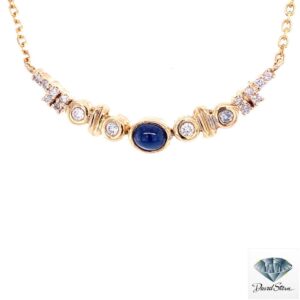
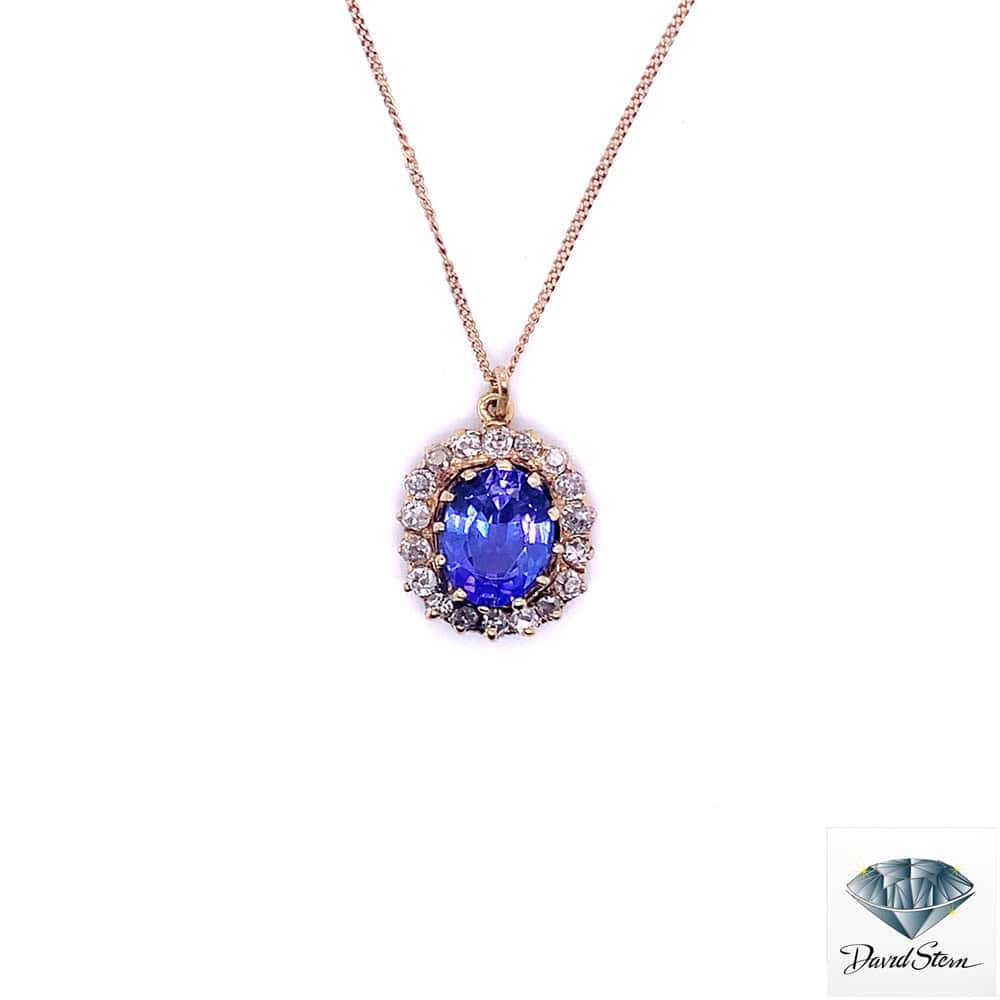
3.50 CT Oval Faceted Tanzanite Vintage Necklace in 14kt Yellow Gold
A one-of-a-kind tanzanite necklace in 14kt yellow gold, centered on a 2.50 carat oval faceted tanzanite in a vivid violet-blue. Twenty European cut diamonds of about 0.05 carats each form a classic vintage-style halo, roughly 1 carat of diamonds, for 3.50 carats of total gem weight. It comes with a written appraisal for insurance and can be seen in person at our Boca Raton showroom.
PRODUCT DETAILS
- Designed By:
- David Stern Jewelers
- Sub Category:
- Necklaces
- Sku Number:
- dsj_fcj_07700016
STONE DETAILS
- Center Stone:
- Oval Tanzanite
- Secondary Stone:
- 1 ct tw Round European Cut Diamond
- Color And Clarity:
- SI-2/I1
- Total Carat Weight:
- 3.5 ct tw
METAL DETAILS
- Metal Type:
- 14kt Yellow Gold
- Gold Content:
- 58.3% pure
CERTIFICATION
- Appraised By:
- David Stern, G.I.A. Gemologist
- Appraisal Included:
- Yes, complimentary

Free Jewelry Appraisal with $2500 Purchase
David Stern Jewelers guarantees every piece of jewelry we sell, which is why we include a free jewelry appraisal with every item purchased.
DESCRIPTION
This tanzanite necklace is a one-of-a-kind piece in 14kt yellow gold, built around a 2.50 carat oval faceted tanzanite in a halo of twenty European cut diamonds. The diamonds total about 1 carat, bringing the total gem weight to 3.50 carats. It is a single piece rather than a production item, and what follows describes the exact vintage tanzanite necklace you will see in our Boca Raton showroom.
The 2.50 carat oval tanzanite
The center stone is an oval faceted tanzanite of 2.50 carats. That is a well-proportioned size for a pendant: large enough to show the stone's color from across a room, small enough to sit neatly at the neckline and be worn every day.
The color is a vivid violet-blue, the shade that made tanzanite famous. The Gemological Institute of America explains that tanzanite is a blue to violet variety of the mineral zoisite, and that the most valued stones show a deep, saturated color rather than a pale lavender one. This stone sits firmly at the saturated end.
Tanzanite is also strongly pleochroic, which means it shows different colors from different directions. Tilt this tanzanite necklace and you will see the stone shift between blue and violet, with occasional flashes of purple at the edges. No photograph captures that movement, which is one reason tanzanite is best seen in person.
Tanzanite comes from a single small area in the Merelani Hills of northern Tanzania, near Mount Kilimanjaro, and it was only identified as a gem in 1967. Its limited source is part of its appeal: every tanzanite in the world comes from the same few square miles.
A tanzanite and diamond necklace in a classic halo
What turns a colored stone into a finished tanzanite and diamond necklace is the halo around it. Twenty diamonds of about 0.05 carats each circle the oval, roughly 1 carat of diamonds in total, and they frame the tanzanite with a ring of white light.
The diamonds are European cut, an older style of round diamond with a smaller table, a taller crown and larger, broader facets than a modern round brilliant. Instead of the fine, needle-like sparkle of a modern cut, European cut diamonds throw bigger, softer flashes of light, which gives the halo its warm, candlelit look.
The diamonds are recorded as SI2 to I1 clarity. In a halo of small old-cut stones that is typical: the broad facets and the setting hide small inclusions well, and what you see when the piece is worn is an even ring of sparkle rather than individual stones.
Together, the violet-blue center and the white halo make a tanzanite and diamond necklace with strong contrast. The diamonds make the tanzanite look deeper, and the tanzanite makes the diamonds look whiter.
Why this is a vintage tanzanite necklace
This vintage tanzanite necklace takes its character from a design tradition much older than the stone itself. The oval cluster, a colored center ringed with diamonds, has been a favorite of fine jewelers since the nineteenth century, and pairing it with European cut diamonds gives it an authentic old-world look.
It is worth being precise about what vintage means here. Tanzanite was only discovered in 1967, so the piece is vintage in its style, its diamond cut and its classic cluster setting, rather than an antique from the era of those diamond cuts. We are happy to tell you everything we know about the piece when you see it.
Vintage-style jewelry has a quality that modern production pieces often lack. The halo is set stone by stone, and the proportions follow a design that has been refined over generations.
A tanzanite halo pendant in 14kt yellow gold
The mounting is 14kt yellow gold, which is 58.5 percent pure gold alloyed for strength. Violet-blue and warm yellow sit on opposite sides of the color wheel, so gold makes the tanzanite look bluer and richer. That warmth also suits the soft light of the European cut diamonds.
14kt gold is a practical choice for a tanzanite halo pendant. It is harder than 18kt, which matters for the twenty small prongs holding the diamonds and the claws holding the center stone. Yellow gold needs no rhodium plating, so its color never wears away.
The pendant hangs from a simple bail on a fine gold chain, so it moves freely and settles flat at the neckline. The overall size is compact, which makes this tanzanite halo pendant easy to wear alone or alongside other fine chains.
How this tanzanite necklace wears
This tanzanite necklace is sized for real life. It sits comfortably at the collarbone with an open neckline, a crew neck or a V-neck, and it is equally at home with a blouse at work or a dress for the evening.
Violet-blue is one of the most flattering colors to wear near the face. It suits cool and warm skin tones alike, and it pairs easily with navy, gray, white, black and jewel tones.
We will fit it on you in the showroom so you can see exactly where the pendant falls. If you are unsure about chain length, ask us to measure it with you; a small change moves the stone from the collarbone to just above a neckline.
A December birthstone necklace
Tanzanite is one of the birthstones for December, alongside turquoise and zircon, and GIA's guide to the December birthstones covers all three. Among them, tanzanite is the one with the richest color, which makes this a natural December birthstone necklace for someone who wants more than a small stone on a chain.
Tanzanite is also a traditional gift for the twenty-fourth wedding anniversary. A tanzanite and diamond necklace with a classic halo is a meaningful way to mark either occasion.
Because the design is so classic, a December birthstone necklace like this does not date. It is the kind of piece that is worn for years and then passed down.
Where tanzanite comes from
Every commercial tanzanite comes from a mining area of only a few square miles in the Merelani Hills of northern Tanzania. The stone was identified there in 1967 and introduced to the wider jewelry market shortly afterward, when it was named for the country that produces it.
That single source makes tanzanite unusual among fine gems. Sapphire, for comparison, is mined in many countries on several continents. Tanzanite supply depends on one small deposit, and production there has varied considerably over the decades.
The rough crystals are often brownish when they come out of the ground. Gentle heating turns them the violet-blue color people know, and the result is stable and permanent. Cutters then orient each stone carefully, because the direction of the cut decides whether the finished gem faces up bluer or more violet.
For the buyer, the practical point is simple. A well-cut stone with deep, even color, like the oval in this piece, represents the better end of what the mines produce, and it is worth taking time over in the showroom.
How to judge a tanzanite necklace in person
Start with color. Look for a deep, even violet-blue across the stone, without pale or grayish areas. Richer color is rarer and more valuable, and a well-saturated 2.50 carat stone is a good size to judge it.
Next, look at the stone in more than one light. Tanzanite tends to look bluer under daylight and cool light and more violet under warm incandescent light. Both are normal; what you want is a stone that looks attractive in both. We are happy to take the piece to the window so you can compare.
Then look at clarity. Faceted tanzanite of good quality is usually clean to the eye. Tilt the stone slowly and watch the light move through the facets; you want brightness across the whole face, not dark or dead areas.
Finally, look at the workmanship. Check that each diamond sits level in the halo, that the prongs are even and that the back of the mounting is finished as carefully as the front. That is where a well-made vintage tanzanite necklace separates itself from a mass-produced one.
Tanzanite compared with other blue and violet gemstones
Tanzanite is not the only blue or violet gem, and it helps to know where it sits. Blue sapphire is much harder, at 9 on the Mohs scale, but a sapphire with this depth of color at 2.50 carats usually costs considerably more. Amethyst is purple rather than violet-blue, and iolite is lighter and less saturated.
Tanzanite gives you a vivid, distinctive color at a size and price that fine sapphire rarely matches. The trade-off is hardness: tanzanite sits at about 6 to 7 on the Mohs scale, so it asks for a little more care. The International Gem Society gives a good overview of how it compares.
Choosing a tanzanite necklace as a gift
A tanzanite necklace is one of the easier fine jewelry gifts to get right. It does not depend on a ring size, the color flatters almost everyone, and a compact halo pendant suits both everyday and occasion wear. The questions worth asking are simple: does the person wear yellow gold, and do they like classic designs?
If the answer to both is yes, a vintage tanzanite necklace like this one will sit naturally with the rest of their jewelry. If it is a December birthday, the stone carries its own meaning as well.
We are glad to help you decide. Bring a photo of what they usually wear, and we will tell you honestly whether this piece suits them or whether something else from the case would be the better choice.
Caring for a tanzanite halo pendant
Clean your tanzanite halo pendant with warm water, a drop of mild soap and a soft brush, then rinse and dry with a lint-free cloth. Do not use an ultrasonic or steam cleaner on tanzanite; the vibration and heat can damage it. Our jewelry care guide goes through the process step by step.
Avoid sudden changes of temperature and knocks against hard surfaces. Tanzanite is softer than sapphire and diamond, so take the necklace off for the gym, gardening or housework.
Store the necklace on its own, ideally flat in a lined box or pouch. Diamonds are much harder than tanzanite and can scratch it, so letting this piece tangle with other jewelry is the easiest way to mark the center stone.
Put it on last and take it off first. Perfume, hairspray and lotion leave a film that dulls the stones, and a necklace worn after getting dressed stays brighter for longer.
Bring it in once a year and we will clean it professionally and check every prong at no charge. On a halo of twenty diamonds, a loose setting is something you want found at the bench rather than discovered at home.

Appraisal, documentation and what you receive
Every tanzanite necklace at this level leaves with a written appraisal describing the metal, the stones, the measurements and a stated replacement value for insurance. That document is what your insurer will ask for, and it is worth updating every few years as gold and gem prices move. Our jewelry appraisals page explains how we do it.
You can see our full range of necklaces alongside this one, and our diamond and gemstone education pages set out how grading actually works. If you would like a piece altered, or something built around a stone you already own, we do that too through our design service.

See this tanzanite necklace in Boca Raton
Photographs of tanzanite are unreliable. Screens push violet-blue toward pure blue or purple, and the stone changes color with the light and the angle. A tanzanite necklace is worth seeing in person, which is why we would rather you came in and looked at it than bought it sight unseen.
David Stern Jewelers has been in business for over 40 years, family owned since 1970, and the showroom is at 21073 Powerline Rd #37, Boca Raton. We are open Monday to Friday from 9:30am to 5:30pm and Saturday from 10:30am to 4:30pm. Call 561-994-3330 and we will have the piece waiting, or book an appointment for a quieter time.
If this particular piece is not quite right, tell us why. A larger stone, white gold instead of yellow, a longer chain: with a piece like this the specification is a starting point, and we would rather find you the right thing than sell you the nearest thing.
Common questions about this tanzanite necklace
How large is the tanzanite?
The center stone is an oval faceted tanzanite of 2.50 carats. With the twenty diamonds in the halo, about 1 carat in total, the total gem weight of the necklace is 3.50 carats.
What is a European cut diamond?
A European cut is an older style of round diamond with a smaller table, a taller crown and broader facets than a modern round brilliant. It gives bigger, softer flashes of light, which is why it is prized in vintage and vintage-style jewelry.
Is tanzanite durable enough for everyday wear?
Tanzanite is about 6 to 7 on the Mohs scale, so it is softer than sapphire or diamond. A pendant sees far less contact than a ring, so it wears well as a necklace, but take it off for sports and housework and avoid ultrasonic and steam cleaners.
Is the tanzanite treated?
Almost all tanzanite on the market is gently heated to bring out its violet-blue color. It is a stable, permanent and widely accepted treatment. Ask us in the showroom and we will tell you everything we know about this stone.
Why does the tanzanite look different colors?
Tanzanite is strongly pleochroic, meaning it shows different colors from different viewing directions, and it also looks bluer in daylight and more violet in warm light. That shifting color is one of its most distinctive qualities.
Is tanzanite a December birthstone?
Yes. Tanzanite is one of the December birthstones, with turquoise and zircon, and a traditional twenty-fourth anniversary gift, which makes this a meaningful December birthstone necklace or anniversary present.
Is this an antique necklace?
It is vintage in style, with European cut diamonds in a classic cluster setting. Tanzanite was only discovered in 1967, so it is not an antique from the era those diamond cuts come from. We will tell you everything we know about the piece in person.
Can the chain length be changed?
In most cases, yes. Ask us to measure it with you. We can advise on the right length for the necklines you wear most, and alterations are handled in-house.
Does the necklace come with an appraisal?
Yes. It leaves with a written appraisal describing the metal, the stones and the measurements, with a replacement value your insurer can use.
Can a similar design be made in white gold?
Yes. Through our custom design service we can build a comparable halo pendant in white or rose gold, or around a different gemstone, including a stone you already own.
One last practical note. Because this is a single piece rather than stock, it can sell on any given day, and we do not hold items without a deposit. If you have seen this tanzanite necklace here and intend to come in, a phone call first will confirm it is still in the case and save you the trip if it is not.