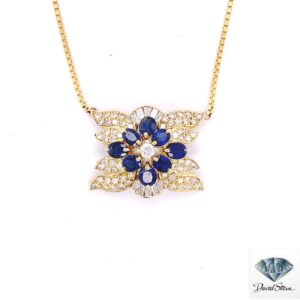
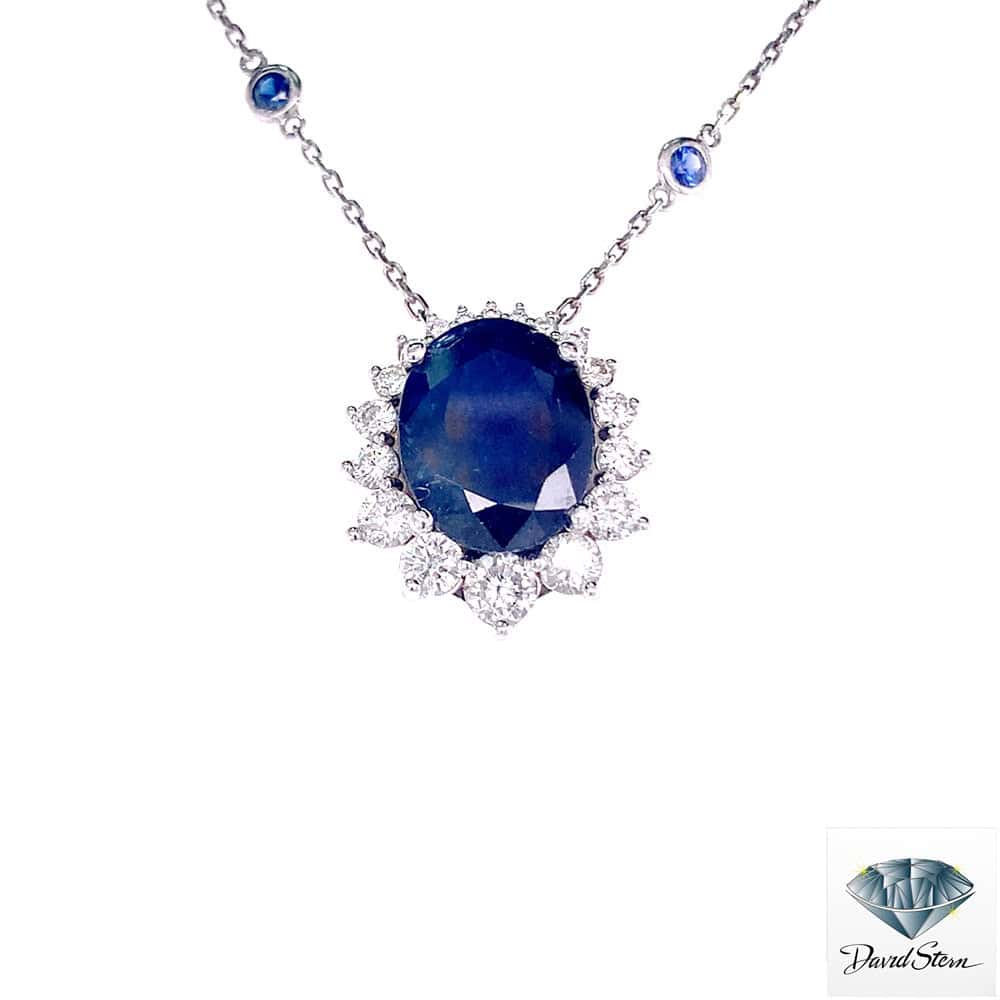
8.70 CT 14mm x 11mm Oval Sapphire Necklace in 14kt White Gold
A one-of-a-kind couture piece: a single 8.70 carat oval faceted blue sapphire, 14mm x 11mm, set in 14kt white gold and framed by eighteen graduating diamonds running from 0.25 down to 0.01 carats, with ten accent sapphires. Total gem weight is approximately 10.2 carats.
Sapphire is corundum and sits at 9 on the Mohs hardness scale, second only to diamond, which makes a stone of this size practical to actually wear. Photographs of saturated blue are unreliable, so we would rather you saw it in person. Free appraisal and fitting at our Boca Raton showroom.
PRODUCT DETAILS
- Designed By:
- David Stern Jewelers
- Sub Category:
- All Jewelry
- Sku Number:
- dsj_fcj_07700199
STONE DETAILS
- Center Stone:
- 14mm x 11mm Oval Sapphire
- Secondary Stone:
- 1.2 ct tw Round Diamond
- Color And Clarity:
- H-I
- Total Carat Weight:
- 10.2 ct tw
METAL DETAILS
- Metal Type:
- 14kt White Gold
- Gold Content:
- 58.3% pure
CERTIFICATION
- Appraised By:
- David Stern, G.I.A. Gemologist
- Appraisal Included:
- Yes, complimentary

Free Jewelry Appraisal with $2500 Purchase
David Stern Jewelers guarantees every piece of jewelry we sell, which is why we include a free jewelry appraisal with every item purchased.
DESCRIPTION
This sapphire necklace is a one-of-a-kind couture piece built around a single 8.70 carat oval faceted blue sapphire, set in 14kt white gold and framed by eighteen graduating diamonds. This is a one-off sapphire and diamond necklace rather than a production run item; there is one of it, and what follows describes the exact piece you will be shown in our Boca Raton showroom.
The 8.70 carat oval sapphire
The center stone measures 14mm x 11mm and weighs 8.70 carats. That is a substantial oval by any standard, and at those proportions it reads as a deliberate centerpiece rather than an accent. The color is blue, which remains the most sought-after hue in the sapphire family and the one most buyers picture when they picture a sapphire at all.
Sapphires are corundum, and the Gemological Institute of America places corundum at 9 on the Mohs hardness scale. Only diamond is harder. That matters more for a necklace than people expect: a pendant takes knocks against desks, seatbelts and countertops that a ring on a protected finger never sees, and a stone that resists scratching will still look like this in twenty years.
The cut is an oval facet arrangement rather than a cabochon, so the stone returns light instead of simply glowing. The International Gem Society notes that oval cuts are among the most flattering shapes for colored gemstones: they hold brilliance well while reading longer and slimmer than a round of the same weight, which is exactly what you want sitting at the base of the throat.
A sapphire and diamond necklace, in detail
Calling this a sapphire and diamond necklace is accurate in both directions. Beyond the center stone there are ten accent sapphires of roughly 0.05 carats each, and eighteen round brilliant diamonds graduating from 0.25 carats down to 0.01 carats, totaling approximately 1.2 carats. Total gem weight across the piece is about 10.2 carats.
The diamonds are graded H-I in color. In a white gold mounting alongside a saturated blue center stone, H-I sits in a useful place: near-colorless to the eye in normal wear, without the price step that D-F commands for a difference nobody notices once the stones are set next to a sapphire.
Graduating the diamonds is a design decision rather than a cost one. Running from 0.25 down to 0.01 carats draws the eye inward along the line of the piece toward the sapphire, instead of competing with it. Uniform stones would have flattened that effect.
The 14kt white gold necklace setting
A 14kt white gold necklace is 58.3% pure gold, alloyed for strength and finished to a bright white. For a piece carrying a stone of this size, 14kt is the sensible choice over 18kt: it is meaningfully harder, so prongs hold their shape longer and the mounting resists the small deformations that loosen stones over years of wear.
White metal also does something specific for blue. Yellow gold warms a sapphire and pushes it slightly green; white gold reads neutral and lets the blue stay blue. Combined with near-colorless diamonds, the setting stays out of the way of the stone it exists to hold.
How this oval sapphire necklace wears
An oval sapphire necklace of this scale is a statement piece, and it behaves like one. Against an open neckline it needs nothing else; the elongated oval and the graduated diamond line do the work. With a collar or a high neck it will fight the fabric, so this is a piece for evening wear, for occasions, and for the kind of daily wear where you want one thing to be noticed rather than several.
Because blue sapphire is a traditional gift for the fifth and the forty-fifth wedding anniversary, pieces at this level are often bought as anniversary gifts rather than as impulse purchases. They are also a common choice for a milestone birthday where something inheritable is the point.
Chain length and clasp on this 14kt white gold necklace can be adjusted before you take it home. Bring the neckline you intend to wear it with if you have one in mind; a two-inch difference in drop changes how a pendant of this size sits more than most people expect.
How to judge a blue sapphire necklace in person
Most of what makes one blue sapphire necklace better than another cannot be read off a specification sheet. Carat weight and dimensions tell you how big the stone is; they tell you nothing about how it looks. When you see this piece, look at three things in order: color, the way the stone handles light, and how cleanly it is set.
Color in sapphire is judged on hue, tone and saturation. Hue is the blue itself, and the most valued stones sit in a pure blue with only a slight violet edge rather than a green one. Tone is how light or dark the blue is; a stone that is too dark reads almost black by candlelight, and one that is too light reads washed out in daylight. Saturation is the strength of the color, and it is the factor that most separates an ordinary sapphire from a memorable one.
Light handling is the second test. Turn the pendant slowly under an ordinary room light and watch the face of the oval. A well cut sapphire shows color across the whole stone. A poorly cut one shows a pale, see-through patch in the middle, called a window, or dark dead areas toward the ends, called extinction. Oval cuts are especially prone to a dark band across the middle, so it is worth looking for rather than assuming.
Setting quality is the last test, and it matters more on a sapphire and diamond necklace than on a solitaire because there are so many stones to hold. Look at the prongs around the eighteen diamonds and the ten accent sapphires under magnification: each should be even, smooth and sitting down over the stone. We will put a loupe in your hand and show you exactly what to look for.
Sapphire compared with other blue gemstones
Several gemstones are sold as blue alternatives to sapphire, and it helps to know where they differ before you compare prices. Tanzanite shows a beautiful violet-blue, but it sits at about 6.5 on the Mohs scale and cleaves easily, which makes it a delicate choice for a pendant that will be worn often. Blue topaz is harder, at 8, and far less expensive, but it rarely has the depth of color a fine sapphire carries.
Lab-grown sapphire is chemically the same corundum as a natural stone and just as hard, but it is produced to order and has little resale value. Natural blue sapphire is rarer, holds its value better over decades, and is the stone the whole tradition of sapphire jewelry is built on. Sapphire is also the birthstone for September, which makes a blue sapphire necklace a natural choice for a September birthday.
If you are comparing this oval sapphire necklace with a piece built around one of these other stones, bring both questions to the showroom. We would rather explain the differences honestly than have you discover them later.
Caring for a sapphire necklace
Sapphire is hard but not indestructible, and a hard stone can still chip on an edge if struck at the wrong angle. Take the necklace off before the gym, before gardening, and before swimming; chlorine attacks the alloys in white gold over time even though it will not touch the sapphire.
Warm water, a drop of dish soap and a soft brush will clean a sapphire necklace at home. Avoid ultrasonic cleaners unless a jeweler has checked the piece first: ultrasonics can loosen small accent stones, and there are twenty-eight of them here. Store it flat and separately, because a sapphire at Mohs 9 will happily scratch every other gemstone in the box.
Bring it in once a year and we will check the prongs and re-polish the mounting at no charge. Stones are lost through worn prongs far more often than through dramatic accidents, and a two-minute inspection under magnification catches that.

Appraisal, documentation and what you receive
Every blue sapphire necklace at this price point leaves with a written appraisal describing the metal, the stones, the measurements and a stated replacement value for insurance. That document is what your insurer will ask for, and it is worth updating every few years as metal and gem prices move.
You can see our full range of necklaces alongside this one, and if you are weighing this against another stone our diamond and gemstone education pages set out how the grading actually works. If you would like a piece altered, or something built around a stone you already own, we do that too through our design service.
See this sapphire necklace in Boca Raton
Photographs of an oval sapphire necklace with a saturated blue stone are unreliable. Screens vary, lighting varies, and an 8.70 carat oval looks different in daylight than it does under a display lamp. A sapphire necklace at this level is worth seeing in person before deciding, which is why we would rather you came in and looked at it than bought it sight unseen.
David Stern Jewelers has been in business for over 40 years, family owned since 1970, and the showroom is at 21073 Powerline Rd #37, Boca Raton. We are open Monday to Friday from 9:30am to 5:30pm and Saturday from 10:30am to 4:30pm. Call 561-994-3330 and we will have the piece out of the case and waiting when you arrive, or book an appointment if you would prefer a quieter time to look at it properly.
If this particular sapphire necklace is not quite right, tell us what is wrong with it. A different stone shape, a longer drop, yellow gold instead of white: with a piece like this the specification is a starting point, and we would rather find you the right thing than sell you the nearest thing.
Common questions about a blue sapphire necklace
Is 8.70 carats large for a sapphire?
Yes. Most sapphire jewelry sold at retail uses center stones between one and three carats. At 8.70 carats and 14mm x 11mm this is several times that, which is why the piece is built as couture rather than as part of a line. Sapphire is also denser than diamond, so a sapphire of a given carat weight looks slightly smaller than a diamond of the same weight; at this size the difference is academic.
What drives the price of a blue sapphire necklace?
Color first, then size, then clarity and cut. Saturation and tone matter more than any single grade: a vivid, evenly saturated blue commands a premium over a stone that is too dark or too pale, regardless of carat weight. After the stone, the mounting matters, and eighteen graduated diamonds plus ten accent sapphires represent real setting labor on top of the material.
Are the sapphires treated?
The overwhelming majority of sapphires on the market are heat treated, which is a stable, permanent and universally disclosed practice. We will tell you exactly what we know about any stone before you buy it, in writing, and we will not guess where we do not know.
Can the piece be resized or restyled?
The chain length is adjustable and the pendant can be rehung. Larger changes, such as moving the sapphire into a different mounting, are possible and are quoted separately after we look at the piece with you.
Do you buy sapphire jewelry as well as sell it?
We do. If you are trading up, or settling an estate that includes a sapphire and diamond necklace or similar pieces, we will make you a written offer on the same visit.
Is a sapphire necklace practical for everyday wear?
Sapphire is one of the hardest gemstones, so the stone itself stands up to daily wear well. The practical limit on a piece this size is style rather than durability: an 8.70 carat oval with a diamond surround is a statement piece, and most owners keep it for evenings, occasions and days when they want it to be the one thing people notice.
What does H-I diamond color mean?
Diamond color is graded on a scale from D, which is completely colorless, down toward Z. H and I sit in the near-colorless range, where any warmth is very hard to see once the diamonds are set, and especially hard to see beside a saturated blue sapphire in a white gold mounting.
Is sapphire the birthstone for September?
Yes. Blue sapphire is the traditional birthstone for September, and it is also the traditional gift for the fifth and forty-fifth wedding anniversaries, which is why a blue sapphire necklace is so often bought for one of those dates.
Will the 14kt white gold change color over time?
White gold is usually finished with a thin rhodium plating that gives it its bright white surface. Over years of wear that finish can soften and let a little of the natural warmth of the gold show through. Refinishing restores it, and we can look at the mounting whenever you bring the necklace in for its check.
Does the necklace come with an appraisal?
Yes. Every purchase over $2,500 includes a free written jewelry appraisal describing the metal, the stones and their measurements, with a stated replacement value you can give to your insurer.
How should I insure a sapphire necklace?
Most homeowner and renter policies limit what they pay for jewelry unless an item is scheduled separately. Give your insurer the written appraisal and ask them to list the necklace on its own, then have the appraisal updated every few years as gold and gemstone prices change.
Can I return the necklace if it is not right?
Yes. Purchases carry a 15-day return window, and delivery is free. That said, with a sapphire necklace at this level we would always rather you saw it in the showroom first, so that the decision is made in front of the real stone instead of a photograph.
Can you find a similar sapphire necklace in a different size or metal?
Often, yes. If the idea of this piece is right but the size, shape or metal is not, tell us what you want to change. We can look for a stone that suits you better or build a sapphire necklace to order through our design service.
Is a sapphire necklace a good investment?
It is better to think of it as something that holds value than as an investment. Fine natural sapphires have kept their value well over long periods, and the gold and diamonds carry value of their own, but any piece of jewelry is bought at a retail price and sold at a lower one. Buy a sapphire necklace because you want to wear it and hand it on; the fact that it keeps meaningful value is a benefit rather than the reason.
One last practical note. Because this is a single piece rather than stock, it can sell on any given day, and we do not hold items without a deposit. If you have seen it here and intend to come in, a phone call first will confirm it is still in the case and save you the trip if it is not.