1.00ct Lab Grown Ruby and Diamond Cocktail Ring
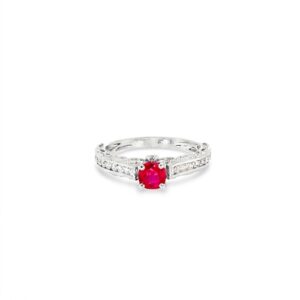
A lab grown ruby cocktail ring in 18kt white gold. A 1.00 carat round lab-grown ruby in a vivid red sits at the center of a starburst cluster of natural diamonds, with more diamonds down the openwork shoulders: 1.35 carats in total, G color, for 2.35 carats of gemstones in all. At 8 grams of 18kt gold it has real presence on the hand. Includes a written appraisal. Try it on at our Boca Raton showroom.
PRODUCT DETAILS
- Designed By:
- David Stern Jewelers
- Sub Category:
- Rings
- Sku Number:
- dsj_fj_07700082
STONE DETAILS
- Center Stone:
- Round Ruby
- Secondary Stone:
- 1.35ct Round Diamond
- Color And Clarity:
- G
- Total Carat Weight:
- 2.35ct tw
METAL DETAILS
- Metal Type:
- 18kt White Gold
- Gold Content:
- 75% pure
CERTIFICATION
- Appraised By:
- David Stern, G.I.A. Gemologist
- Appraisal Included:
- Yes, complimentary

Free Jewelry Appraisal with $2500 Purchase
David Stern Jewelers guarantees every piece of jewelry we sell, which is why we include a free jewelry appraisal with every item purchased.
DESCRIPTION
This lab grown ruby cocktail ring centers a 1.00 carat round lab-grown ruby in a starburst cluster of round diamonds, on openwork shoulders set with more diamonds, in 18kt white gold. The diamonds weigh 1.35 carats together, for 2.35 carats of gemstones in all, and the ring weighs 8 grams. Everything below describes this exact ring, which you can see and try on at our Boca Raton showroom.
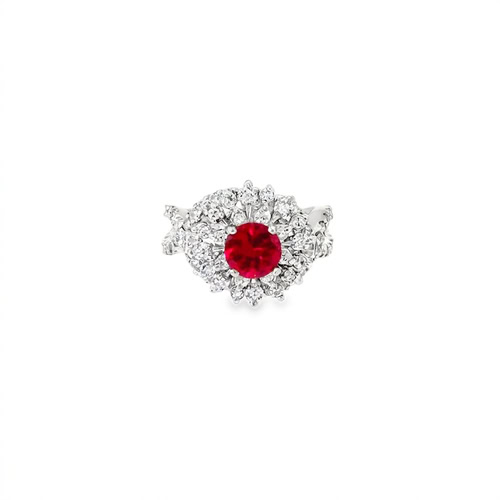
The lab grown ruby cocktail ring at a glance
Here are the specifications of this lab grown ruby cocktail ring, as recorded for this piece.
At the center is a round lab-grown ruby of 1.00 carat, a vivid, saturated red, held in prongs that have a warm yellow tone against the white gold around them.
Framing it is a cluster of round brilliant cut diamonds arranged like the rays of a star, with more diamonds running down each openwork shoulder. Together they weigh 1.35 carats and are graded G color, a near-colorless grade.
The mounting is 18kt white gold and the ring weighs 8 grams, which gives it a solid, substantial feel on the finger. It can be sized to fit.
In short, this lab grown ruby cocktail ring is a bold red center in a bright white frame: a genuine cocktail ring, made to be noticed.
The ruby in this ring is lab-grown
We say that plainly, and at the top, because it matters. The center stone in this lab grown ruby cocktail ring is a laboratory-grown ruby, not a mined one.
A lab-grown ruby is a real ruby. It has the same chemical composition, the same crystal structure and the same hardness as a mined ruby. The difference is where it formed: in a laboratory rather than in the earth.
Federal guidance requires a laboratory-grown stone to be described that way, and we would rather you know exactly what you are buying. The written appraisal records what is known about this stone.
The diamonds in the cluster are a separate matter: they are natural diamonds, 1.35 carats in total.
What a lab created ruby ring offers
The first thing a lab created ruby ring offers is color. Mined rubies with a strong, even red are rare and expensive, and many affordable natural rubies are pale, brownish or heavily included. A lab created ruby can be grown with the vivid red that people picture when they think of ruby.
The second is size for the money. A 1.00 carat mined ruby with a color like this one would cost many times more than the whole of this ring.
The third is consistency. In a lab created ruby ring, the stone is clean and evenly colored, with none of the dark patches or visible inclusions that are common in mined material at this price.
What a lab created ruby ring does not offer is rarity. Lab-grown rubies have been produced commercially for more than a century, and they are not scarce. Buy this ring because the color is beautiful and the setting is well made, not as a store of value.
How big is a 1 carat ruby ring?
A 1 carat ruby ring sounds smaller than it looks here, because the cluster does a great deal of work. On its own, a 1.00 carat round ruby measures roughly 6 millimeters across; framed by the diamond starburst, the head of this ring covers a good part of the finger.
Ruby is denser than diamond, so a 1.00 carat ruby is slightly smaller face-up than a 1.00 carat diamond of the same cut. In a cluster design that hardly matters: the ruby provides the color, and the diamonds provide the size.
That is the appeal of a 1 carat ruby ring built this way. You get the presence of a much larger ring, with the red center kept in proportion so the color stays rich rather than spread thin.
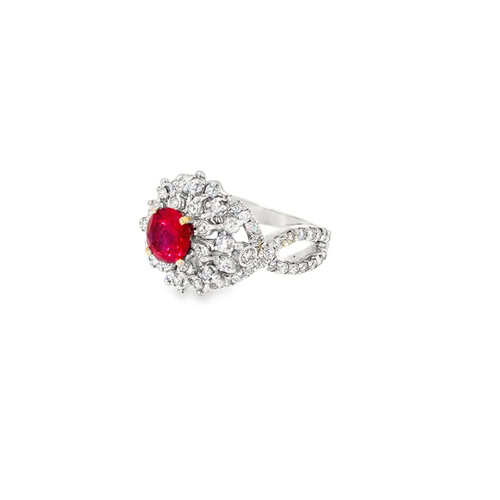
A diamond cluster ruby ring
The design here is a cluster, and it is worth looking at closely. Rather than a single even halo, the diamonds around the ruby are set at varying heights and angles, radiating outward like a star.
That arrangement does two things in a diamond cluster ruby ring. It makes the head of the ring much larger than the center stone alone, and it catches light from many directions at once, so the white frame stays lively as the hand moves.
The shoulders continue the theme. Each side is an open, twisting band set with diamonds, so the ring sparkles from the side as well as from above and the metal never looks heavy.
With 1.35 carats of G color diamonds across the cluster and shoulders, a diamond cluster ruby ring like this carries more diamond weight than the ruby itself. That is what turns a colored stone ring into a cocktail ring.
An 18kt white gold ruby ring
18kt gold is 75 percent pure gold, a higher proportion than the 14kt used in most jewelry. In an 18kt white gold ruby ring, that means a denser, more substantial piece: this one weighs 8 grams.
White metal is the natural choice around a red stone. It stays neutral, so nothing competes with the ruby for warmth, and the near-colorless diamonds look bright and white against it.
White gold is usually plated with rhodium for a bright white finish. Over years of wear the plating can soften, and we can re-plate an 18kt white gold ruby ring in store to restore the finish.
One detail worth noticing: the prongs holding the ruby have a warm yellow tone. Yellow metal at the center is a traditional touch in red-stone rings, because it gives the ruby a warm edge and keeps the stone from looking cold against all that white.
Why ruby and diamond work together
Red and white is one of the oldest pairings in jewelry, and there is a reason it keeps coming back. Diamonds have no color of their own, so they frame a red stone without competing with it, and the contrast makes both look stronger.
There is a practical side too. A single red stone on a plain band can look flat under indoor light, because color alone does not sparkle. Surround it with diamonds and the ring catches light from every direction, so it stays alive across a room.
The proportions here favor the diamonds: 1.35 carats of them around a 1.00 carat ruby. That balance is what makes this a cocktail ring rather than a simple solitaire, and it is why the ring reads as bright rather than dark.
About ruby
Ruby is corundum, the same mineral as sapphire. Red corundum is called ruby; corundum of any other color is sapphire. It ranks 9 on the Mohs hardness scale, second only to diamond, which makes it one of the most durable gems you can wear.
That applies to lab-grown rubies as well. Because a laboratory-grown ruby is chemically and structurally the same material, it is just as hard and just as suitable for a ring worn often.
The Gemological Institute of America describes ruby as one of the most valued of all colored gems, prized above all for the intensity of its red.
Ruby is the birthstone for July and the traditional gift for a 40th wedding anniversary, so a ruby ring works as a birthday, anniversary or milestone gift.
Wearing a ruby cocktail ring
A lab grown ruby cocktail ring is a ring worn for effect: large, colorful and unmistakable. This one fits the description, with a red center, a wide diamond cluster and 8 grams of 18kt gold behind it.
Worn on the right hand, a lab grown ruby cocktail ring like this becomes the focal point of an outfit. Keep the rest simple, diamond studs or a slim white gold chain, and let the ring carry the look.
Red is a strong color to dress around, and it is easier than people expect. It looks striking against black, navy, white and gray, and it is a natural choice for evening, for the holidays and for any occasion that calls for one confident piece.
It also works on the left hand as an anniversary or dress ring, and because ruby is hard enough for regular wear, it does not have to be saved for special occasions.
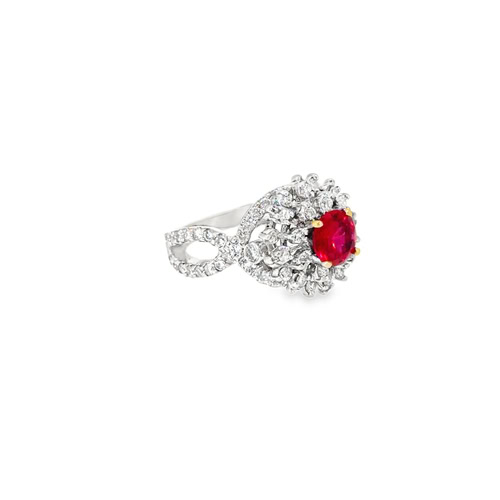
How the ring is set
The ruby sits in prongs at the center of the cluster, raised slightly so light can enter the stone from the sides as well as the top.
Around it, each diamond is held in its own prongs rather than in a channel. Prong setting lets light reach more of every stone, which is why the cluster reads as bright white rather than as a solid block of metal.
The shoulders are pierced, with open spaces between the twisting diamond-set bands. That openwork keeps a large ring comfortable: it lightens the look, lets light through from underneath and stops the shoulders from feeling bulky against the neighboring fingers.
From the side you can see how the head sits above the finger. It is raised enough to let light in, but not so tall that it catches on everything.
Choosing a lab grown ruby cocktail ring
When you compare a ring like this, start with the color of the ruby. A good red is strong and even, without a brownish or orange cast, and it should hold its color in dim light as well as in daylight.
Next, look at the diamonds. In a cluster, the stones should be evenly matched in size and color, and each should sit level in its prongs, with no gaps or dark spots in the arrangement.
Then consider the scale. A lab grown ruby cocktail ring with a cluster head sits wide on the finger, so it is worth seeing how it looks on your own hand before you decide.
Finally, check the fit and the balance. An 18kt ring of 8 grams has real weight, which most people find pleasant, but it should sit level and feel steady rather than spinning on the finger.
Who a lab grown ruby cocktail ring suits
A lab grown ruby cocktail ring suits someone who wants color first. If you already own diamond studs and a plain band and want one piece that is unmistakably yours, a strong red center does that in a way another white stone cannot.
It also suits anyone buying for July. Ruby is the July birthstone, and a cluster ring like this makes a more memorable birthday gift than a small solitaire at the same price.
And it suits people who would rather spend on the setting than on rarity. Here the money has gone into 18kt gold, 1.35 carats of natural diamonds and a well-made cluster head, with a lab-grown center providing the color.
Caring for your ruby ring
Ruby is hard and forgiving, so the care is simple. Clean the ring in warm water with a drop of mild dish soap, brush gently under the cluster and around the prongs with a soft toothbrush, rinse and pat dry. Our jewelry care guide has more detail.
A lab grown ruby cocktail ring collects lotion and soap behind the cluster stones, and that film dulls the sparkle long before anything else goes wrong. Regular cleaning keeps both the ruby and the diamonds bright.
Take the ring off for the gym, gardening and heavy housework, and have the prongs checked from time to time. A cluster has many small prongs, and a snagged one is easier to fix early. We offer complimentary cleaning and inspection for jewelry bought from our store.

Seeing this lab grown ruby cocktail ring in Boca Raton
Red is a color that photographs unpredictably, and a saturated ruby is one of the hardest stones to capture. You are welcome to try this lab grown ruby cocktail ring on at our Boca Raton showroom and see the color in daylight and under the lights.
We are open Monday to Friday, 9:30 to 5:30, and Saturday, 10:30 to 4:30. Directions are on our Visit Us page.
David Stern Jewelers has served Boca Raton for over 40 years. David Stern is a GIA Graduate Gemologist, so detailed questions about the ruby and the diamonds can be answered on the spot.
Sizing, appraisal and insurance
This ring can be sized to fit. The diamonds run partway down the shoulders and the lower band is plain, so there is gold to work with, and we confirm before any work is done.
It includes a written jewelry appraisal by David Stern, which describes the ruby, the diamonds and the gold and gives a replacement value for insurance.
More ruby jewelry
See our round ruby engagement ring, our ruby cluster cocktail ring, or browse all our rings.
Questions about this lab grown ruby cocktail ring
Is the ruby in this ring natural or lab-grown?
It is lab-grown. A laboratory-grown ruby is a real ruby with the same chemistry, crystal structure and hardness as a mined one; the difference is that it was grown in a laboratory. The diamonds in the cluster are natural.
What stones are in this lab grown ruby cocktail ring?
A 1.00 carat round lab-grown ruby at the center, framed by round diamonds in the cluster and along the shoulders, 1.35 carats in total. Together they make 2.35 carats of gemstones.
Is the 2.35 carats one ruby?
No. It is the total weight of all the stones. The ruby is 1.00 carat and the diamonds add 1.35 carats.
What quality are the diamonds?
The round diamonds are graded G color, a near-colorless grade, so they look bright and white against the red center.
Is a lab created ruby ring worth buying?
If you want a strong, even red at a sensible price, yes. A lab created ruby offers color and size that would cost far more in mined material. It is not rare, though, so buy it for how it looks rather than as an investment.
Is a lab-grown ruby durable?
Yes. Ruby is corundum, 9 on the Mohs scale, second only to diamond, and a lab-grown ruby is the same material, so it is equally hard and well suited to a ring worn often.
What metal is the ring?
The mounting is 18kt white gold, which is 75 percent pure gold, and the ring weighs 8 grams. The prongs holding the ruby have a warm yellow tone.
Why does white gold need re-plating?
White gold is usually finished with a thin rhodium plating for a bright white surface. It can soften over years of wear, and we can re-plate the ring in store.
Can the ring be resized?
Yes. The diamonds run partway down the shoulders and the lower band is plain, so there is gold to work with. We confirm before any work is done.
Is ruby a birthstone?
Yes. Ruby is the birthstone for July and the traditional gift for a 40th wedding anniversary.
Can this be worn as an engagement ring?
It can. Ruby is hard enough for daily wear and a red center with a diamond cluster makes a striking engagement ring, though many people wear a ring like this on the right hand instead.
Does the ring come with an appraisal?
Yes. It includes a written jewelry appraisal by David Stern, a GIA Graduate Gemologist, with a replacement value for insurance.
Can I see the ring before I buy it?
Yes. It is at our Boca Raton showroom. We are open Monday to Friday, 9:30 to 5:30, and Saturday, 10:30 to 4:30.