14kt White Gold Royal Blue Sapphire and Diamond Ring
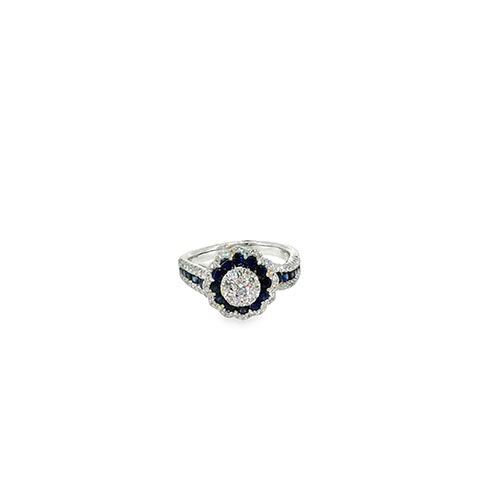
A royal blue sapphire ring in 14kt white gold. A cluster of round diamonds forms the center, ringed by royal blue sapphires set like petals and finished with a scalloped outline of smaller diamonds; the shoulders carry channel-set sapphires edged with pave. The sapphires total 1.00 carat and the diamonds 0.55 carats, for 1.55 carats in all, in a 6 gram mounting listed at size 6. Includes a written appraisal. Try it on at our Boca Raton showroom.
PRODUCT DETAILS
- Designed By:
- David Stern Jewelers
- Sub Category:
- Rings
STONE DETAILS
- Center Stone:
- 0.55ct Round Diamond
- Secondary Stone:
- 1.00ct Round Sapphire
- Total Carat Weight:
- 1.55ct
METAL DETAILS
- Metal Type:
- 14kt White Gold
- Metal Color:
- White Gold
- Gold Weight:
- 6 Grams
- Gold Content:
- 58.3% pure
CERTIFICATION
- Appraised By:
- David Stern, G.I.A. Gemologist
- Appraisal Included:
- Yes, complimentary

Free Jewelry Appraisal with $2500 Purchase
David Stern Jewelers guarantees every piece of jewelry we sell, which is why we include a free jewelry appraisal with every item purchased.
Out of stock
DESCRIPTION
This royal blue sapphire ring sets a cluster of round diamonds at its center, rings it with royal blue sapphires laid out like petals, and finishes the outline with a scalloped row of smaller diamonds. The sapphires weigh 1.00 carat in total and the diamonds 0.55 carats, for 1.55 carats of gemstones in all, in a mounting of 14kt white gold weighing 6 grams. Everything below describes this exact ring, which you can see and try on at our Boca Raton showroom.
The royal blue sapphire ring at a glance
Here are the specifications of this royal blue sapphire ring, as recorded for this piece.
The sapphires are round and royal blue, weighing 1.00 carat in total. They are divided between the petal halo around the center and the channels running down both shoulders.
The diamonds are round and weigh 0.55 carats in total. They form the cluster at the center, the scalloped outline around the sapphire petals, and the pave edging on either side of the shoulder channels.
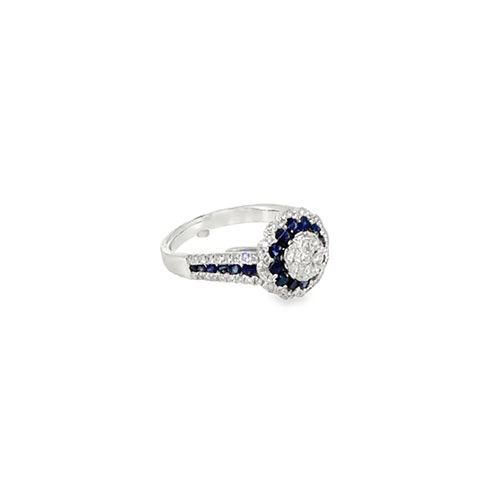
The mounting is 14kt white gold and the ring weighs 6 grams. Our record lists it at size 6 and lists David Stern Jewelers as the designer. The lower half of the band is plain, so it can be sized.
In short, this sapphire flower ring reads as one bold blue-and-white flower on the hand, built from many small stones rather than one large one.
How this sapphire flower ring is built
Look at this sapphire flower ring face-on and the design resolves into three rings of stone, working outward from the middle.
At the center sits a tight cluster of round diamonds set close together in a circular head. From a normal viewing distance the cluster reads as a single bright round stone, which is the point of the arrangement.
Around that center runs a ring of round royal blue sapphires, bead-set and rising slightly, each one reading as a petal. This is the part of the design that gives the sapphire flower ring its name and its outline.
Around the sapphires runs a scalloped row of small round diamonds that follows the petal shape rather than a plain circle. The scalloping is what keeps the head from looking like a simple disc.
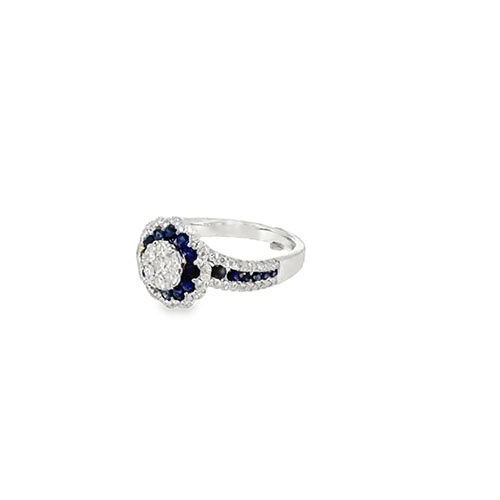
The shoulders of this royal blue sapphire ring carry the motif down the band: a channel of round sapphires along the middle of each shoulder, with a row of small pave diamonds on both edges of the channel. The band then tapers to a plain, comfortable lower half.
What royal blue means in a sapphire
Royal blue is a trade description for a vivid, saturated blue with a slight violet cast, sitting at the darker end of what most people picture when they think of sapphire. It is one of the two descriptions, alongside cornflower, that the trade uses most often for fine blue sapphire.
The sapphires in this royal blue sapphire ring are described that way in our record, and the photographs show the tone clearly: deep and strongly colored rather than pale, with enough life to read as blue rather than as black under normal room light.
Color in sapphire is judged on hue, tone and saturation together, which GIA explains in its guide to sapphire quality. A stone can be very dark and still be dull if the saturation is low; the stones here hold their color.
Set against white metal and surrounded by diamonds, a royal blue reads even stronger. The contrast is the whole idea behind a blue sapphire halo ring: white brightens blue, and blue makes white look whiter.
A sapphire and diamond cluster ring, stone by stone
It helps to be precise about what a sapphire and diamond cluster ring actually contains, because the recorded weights describe totals rather than any one stone.
The 1.00 carat figure is the combined weight of every sapphire in the ring: the petals around the center and the stones channel-set in both shoulders. No single sapphire is a carat.
The 0.55 carat figure is the combined weight of every diamond: the center cluster, the scalloped outer row and the pave along the shoulders. Again, no single diamond is anywhere near that weight.
Added together they give the 1.55 carats of gemstone recorded for this sapphire and diamond cluster ring. That is the honest way to read a cluster piece, and it is worth knowing before you compare it with a solitaire quoted at the same total weight.
Our record does not state a color or clarity grade for the diamonds, so we do not publish one. What we can say is what the photographs show: the small stones are bright and evenly matched, which is what matters visually in a cluster.
Why a blue sapphire halo ring looks larger than its weight
A blue sapphire halo ring is a way of buying presence rather than weight, and this piece is a clear example of the effect.
The center cluster plus the sapphire petals plus the diamond outline together make a head roughly the size of a much larger single stone. On the hand it covers the finger the way a substantial solitaire would, at a fraction of the cost of one stone that size.
The scalloped edge helps as well. A plain round halo has a hard outline that the eye measures immediately; a scalloped one breaks that line, so the head reads as a shape rather than as a circle of a particular diameter.
The trade-off is honest and worth stating. A cluster does not have the single deep flash of one large stone, and it has more edges and settings to keep clean. What it gives you instead is size, color and detail for the money.
The diamond cluster at the center
The center of this sapphire cluster ring is not one diamond. It is a group of small round diamonds set tightly together in a single round head, an arrangement the trade has used for well over a century.
Set well, as it is in this sapphire cluster ring, the effect is a bright round center with more sparkle than a single stone of the same diameter, because there are many more facet edges catching light at slightly different angles.
The reason to choose this over a solitaire is simple arithmetic. A single round diamond of the same face-up size would cost several times what this entire sapphire cluster ring costs, and would leave nothing in the budget for the sapphires.
If you want to understand how a single diamond would be priced instead, our guide to the 4Cs of diamonds walks through cut, color, clarity and carat weight and how they interact.
14kt white gold in this setting
The mounting is 14kt white gold, which is the right choice for this royal blue sapphire ring for a practical reason as much as an aesthetic one.
White metal is what makes a royal blue sapphire ring work. Yellow gold next to a deep blue pushes the stone toward green in the eye; white metal leaves the blue alone and lets the diamonds do their job.
14kt gold is 58.3 percent pure gold, alloyed with harder metals. That alloy is more scratch-resistant than 18kt and holds small bead settings and pave well, which matters in a ring with this many individual stones.
At 6 grams this sapphire and diamond cluster ring has real substance in the hand without being heavy. The plain lower band is deliberate: it gives a sizer clean metal to work with.
About sapphire as a stone
Sapphire is corundum, the same mineral as ruby, colored blue by traces of iron and titanium. Any corundum that is not red is called sapphire, which is why sapphires also come in pink, yellow, green and colorless.
It is a hard stone. Sapphire is 9 on the Mohs scale, behind only diamond and moissanite among stones used in jewelry, which is why sapphire has been a practical choice for rings worn daily for centuries, and why the stones in this royal blue sapphire ring will take everyday wear.
Heat treatment is the most common and most widely accepted treatment in sapphire, used to improve color and clarity, and the great majority of blue sapphire on the market has been heated. Our record does not state whether these stones were heated, so we do not claim either way.
Sapphire is the birthstone for September and the traditional gift for a 45th anniversary, which GIA covers in its notes on the September birthstone.
Federal rules on how gemstones may be described are set out in the FTC Jewelry Guides, and they are why we describe weights as totals and say nothing we cannot support.
Sapphire compared with other blue stones
People shopping for a blue ring usually compare a few stones, and the differences are practical rather than a matter of taste alone.
Blue topaz is far cheaper and far softer at 8 on the Mohs scale, and its blue is lighter and less saturated. It does not hold up to daily wear the way sapphire does.
Tanzanite is a beautiful violet-blue but is only 6 to 7 on the Mohs scale and has a cleavage direction, which makes it a poor choice for a ring worn every day. We sell tanzanite, and we say the same thing about it every time.
Lab-grown sapphire is chemically identical to mined sapphire and costs far less; where we sell one, we say so plainly. The sapphires in this royal blue sapphire ring are not described as laboratory-grown in our record.
As an engagement or anniversary ring
A sapphire and diamond cluster ring like this one suits several occasions, and there is no rule about which.
As an engagement ring this sapphire and diamond cluster ring is an alternative to a diamond solitaire that costs less and looks like more, with a color that makes it recognizably the wearer's own. Blue sapphire engagement rings have a long history and are not a modern novelty.
As an anniversary ring this blue sapphire halo ring fits naturally at the 45th, the traditional sapphire year, and it works just as well for any year where the point is a piece that gets worn rather than stored.
As a right-hand ring it is perhaps the easiest choice of all. A blue sapphire halo ring carries no expectation about what it signifies, and it pairs with plain bands on the other hand without competing.
Who this sapphire cluster ring suits
Some pieces are easy to place, and this one is. It suits somebody who wants color rather than another white stone, and who would rather have visible scale and detail than a single small solitaire.
It suits somebody who wears jewelry rather than keeps it, which is what this sapphire flower ring was built for. Sapphire at 9 on the Mohs scale and 14kt white gold is a combination that tolerates daily life.
It suits somebody who likes a design with something to look at. The petal outline, the scalloped edge and the shoulder channels reward being looked at closely, which is not true of every ring.
Wearing and sizing this royal blue sapphire ring
A raised cluster head sits up off the finger, which looks good and has practical consequences worth knowing before you buy.
It will catch on knitwear and on the inside of pockets if you are careless, and it is the reason we suggest taking any raised ring off before the gym, gardening or anything with grit in it.
Stacking works if the band beside it is plain. A second ring with its own stones will rub against the pave edging on the shoulders, and over time that wears settings on both rings.
The plain lower half of the band is what a sizer needs. Rings with stones all the way around can only be sized within narrow limits; this one has clean metal to cut and rejoin, so it has more range in both directions.

Caring for a sapphire and diamond cluster ring
A sapphire cluster ring with this many small stones needs slightly more attention than a solitaire, and the routine is not difficult.
Clean it with warm water, a drop of dish soap and a soft toothbrush, working the brush behind the head where lotion and skin oil collect. That is where a cluster goes dull, and rinsing alone will not reach it.
Sapphire and diamond both tolerate an ultrasonic cleaner, but bead and pave settings are the weak point in any cluster, not the stones. We would rather check the ring first and clean it here.
Have the settings checked once a year. A small stone loosens before it falls out, and a jeweler running a probe over the beads will find it while it is still an easy fix. We do that check free for pieces bought from us.
Take it off before swimming pools and hot tubs. Chlorine attacks the alloys in gold over time, which loosens settings, and that is a slow problem people rarely connect to the cause.
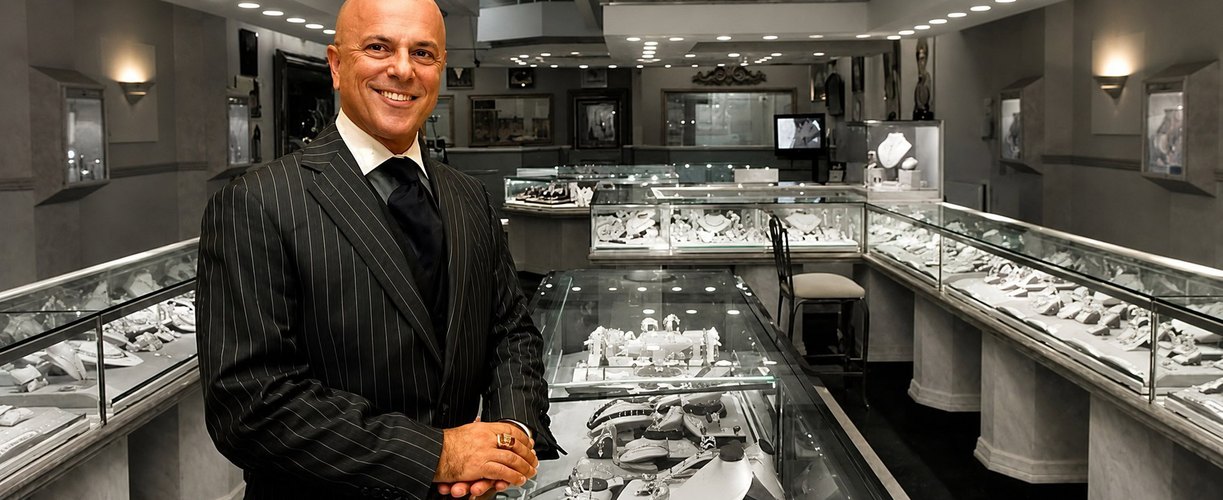
Seeing this royal blue sapphire ring in Boca Raton
Blue is the hardest color to judge from a photograph. Screens differ, lighting differs, and a saturated blue is exactly the color that photographs least reliably.
That matters more for a royal blue sapphire ring than for a diamond piece. We would rather you looked at these stones in daylight and under the showroom lights and decided for yourself whether the tone is what you want.
You are welcome to walk in during showroom hours, or to schedule an appointment if you would rather have a gemologist set aside time. Our hours and directions are on the Visit Us page.
Appraisal, sizing and insurance
Every piece we sell at this level comes with a written appraisal describing the metal, the stones and the recorded weights, which is the document your insurer will ask for.
Sizing is handled here. The plain lower band makes this a straightforward adjustment, and we will tell you before any work starts if a size change would affect the setting.
If you need a valuation later, for insurance renewal or for an estate, our jewelry appraisals are carried out in house by GIA-trained staff rather than sent away.
More sapphire and diamond jewelry
This royal blue sapphire ring is one piece; the sapphires we carry vary a good deal in color, cut and setting, and it is worth seeing a few together.
Our oval sapphire halo ring is the opposite approach: one large oval sapphire with a diamond halo, for somebody who wants a single stone rather than a cluster.
The sapphire cabochon ring shows sapphire cut without facets, which gives a softer, deeper blue with a different character entirely.
You can browse everything currently in the case on our rings page, or see the wider selection under engagement rings.
Questions about this royal blue sapphire ring
Is the center of this sapphire cluster ring one diamond?
No. The center is a tight cluster of small round diamonds set together in a single round head, which from normal viewing distance reads as one bright stone. The 0.55 carat figure is the combined weight of every diamond in the ring, including the outer scalloped row and the shoulder pave.
How much does the largest sapphire weigh?
Our record gives 1.00 carat as the total weight of all the sapphires in the ring, both the petals around the center and the stones channel-set in the shoulders. It does not break that figure down per stone, so we do not publish a weight for any single sapphire.
What does royal blue mean?
Royal blue is a trade description for a vivid, saturated blue with a slight violet cast, at the darker end of the sapphire range. It is a description of appearance rather than a graded measurement, and it is the term our record uses for these stones.
Are the sapphires natural or laboratory-grown?
Our record describes them as sapphires and does not identify them as laboratory-grown. Where we sell a laboratory-grown stone we say so plainly, in the product title and in the description, because federal rules require that disclosure.
Have the sapphires been heat treated?
Our record does not state whether these stones were heated, so we make no claim either way. Heat is the most common and most widely accepted treatment in sapphire, and the great majority of blue sapphire on the market has been heated.
Can this royal blue sapphire ring be resized?
Yes, within the usual range. The lower half of the band is plain metal with no stones in it, which is what a sizer needs in order to cut and rejoin cleanly. It is listed at size 6, and we will tell you before starting if a particular change would affect the setting.
Is a sapphire hard enough for everyday wear?
Sapphire is 9 on the Mohs scale, behind only diamond and moissanite among stones used in jewelry, so the stone itself handles daily wear well. The thing to watch in a cluster is the settings rather than the stones, which is why we suggest a check once a year.
Would this work as an engagement ring?
Yes. A sapphire and diamond cluster ring is a long-established alternative to a diamond solitaire, and blue sapphire engagement rings have a history going back well over a century. It costs less than a solitaire of the same face-up size and is more distinctive.
Why does it look bigger than 1.55 carats?
Because the head is built from a center cluster, a ring of sapphire petals and a scalloped diamond outline, which together cover far more of the finger than a single 1.55 carat stone would. That is the point of a cluster design, and it is where the value sits.
How should I clean it?
Warm water, a drop of dish soap and a soft toothbrush, paying attention to the underside of the head where oils collect. Avoid chlorine and take it off for anything abrasive. We will clean and check it here whenever you are passing.
Does it come with an appraisal?
Yes. A written appraisal describing the metal, the stones and the recorded weights is included, which is the document an insurer will ask for when you schedule the piece on a policy.
Can I see it before deciding?
Yes, and with a blue stone we would encourage it. Colour photographs of saturated blue are unreliable across different screens, and both the tone and the scale of the head are easier to judge in person at our Boca Raton showroom.
Do you have other sapphire rings?
Yes. We carry sapphires in several cuts and settings, including a large oval with a diamond halo and a cabochon-cut piece with a softer, deeper blue. The selection in the case changes, so it is worth asking what is currently available.