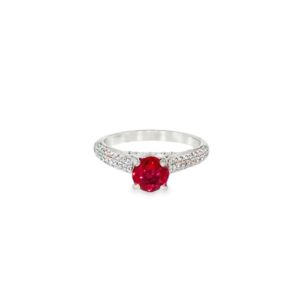
14kt White Gold Lab-Grown Ruby Solitaire Ring
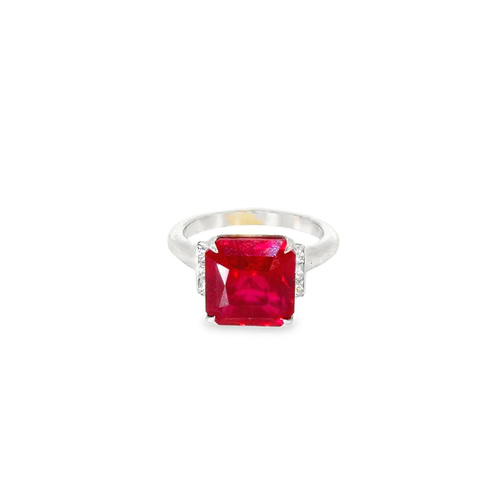
A lab grown ruby solitaire ring in 14kt white gold. A 9.17 carat lab-grown ruby in a vivid red, a large square stone with cut corners, is held in corner prongs with small pavé panels of natural diamonds on either side, 0.30 carats and H color, for 9.47 carats of gemstones in all. The band is plain and slim and the ring weighs 7.5 grams, so almost nothing competes with the stone. Includes a written appraisal. Try it on at our Boca Raton showroom.
PRODUCT DETAILS
- Designed By:
- David Stern Jewelers
- Sub Category:
- Rings
- Sku Number:
- dsj_ruby_07700076
STONE DETAILS
- Center Stone:
- Cushion Ruby
- Secondary Stone:
- 0.30 ct Round Diamond
- Color And Clarity:
- H
- Total Carat Weight:
- 9.47 ct tw
METAL DETAILS
- Metal Type:
- 14kt White Gold
- Gold Content:
- 58.3% pure
CERTIFICATION
- Appraised By:
- David Stern, G.I.A. Gemologist
- Appraisal Included:
- Yes, complimentary

Free Jewelry Appraisal with $2500 Purchase
David Stern Jewelers guarantees every piece of jewelry we sell, which is why we include a free jewelry appraisal with every item purchased.
DESCRIPTION
This lab grown ruby solitaire ring centers a 9.17 carat lab-grown ruby, a large square stone with cut corners in a vivid red, on a slim band of 14kt white gold. Small panels of natural diamonds sit on either side of the stone, adding 0.30 carats, for 9.47 carats of gemstones in all. The ring weighs 7.5 grams. Everything below describes this exact ring, which you can see and try on at our Boca Raton showroom.
The lab grown ruby solitaire ring at a glance
Here are the specifications of this lab grown ruby solitaire ring, as recorded for this piece.
At the center is a lab-grown ruby of 9.17 carats in a strong, saturated red. It is a large square stone with cut corners, held in prongs at each corner, and set square to the finger rather than at an angle.
On either side of it sits a small block of pavé-set natural diamonds, 0.30 carats in total, graded H color. They read as two neat white shoulders against the red rather than as a halo.
The mounting is 14kt white gold, and the ring weighs 7.5 grams. The band is plain and slim, so it can be sized to fit.
In short, this lab grown ruby solitaire ring is a single enormous red stone on a quiet band. Almost nothing competes with the ruby, which is the whole idea.
The ruby in this ring is lab-grown
We say that plainly, and near the top, because it matters. The center stone in this lab grown ruby solitaire ring is a laboratory-grown ruby, not a mined one.
A lab-grown ruby is a real ruby. It is corundum, with the same chemical composition, the same crystal structure and the same hardness as a mined ruby. The only difference is where it formed: in a laboratory rather than in the earth.
Federal guidance requires a laboratory-grown stone to be described that way, and we would rather you know exactly what you are buying. The written appraisal records what is known about this stone.
The diamonds beside it are a separate matter: they are natural diamonds, 0.30 carats in total.
Why a 9 carat lab grown ruby is possible at all
A 9 carat lab grown ruby with an even, saturated red is a stone you can actually buy. A mined ruby of the same size, color and clarity would be a museum-level rarity, priced far beyond a ring like this.
That is the honest case for lab-grown corundum. Ruby has been grown in laboratories since the early twentieth century, and the process is well understood, so a 9 carat lab grown ruby can be produced with the color and clarity that nature almost never delivers at this size.
What you gain is scale and color. A 9 carat lab grown ruby gives you a stone roughly 11 millimeters across, which is the kind of presence usually reserved for important estate jewelry.
What you do not gain is rarity. Lab-grown rubies are not scarce, and they do not appreciate. Buy this ring because the stone is beautiful and the size is extraordinary for the money, not as a store of value.
A large lab grown ruby ring
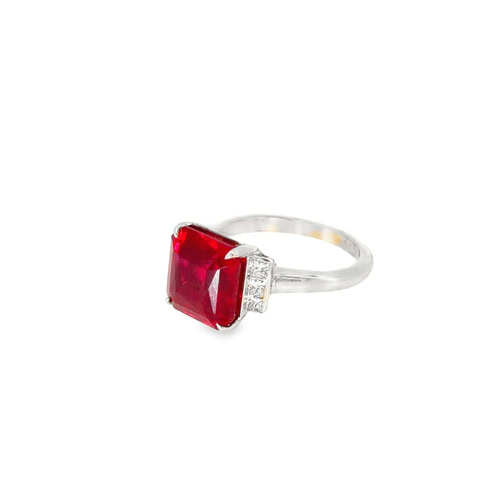
Scale is the point of this lab grown ruby solitaire ring. A large lab grown ruby ring covers much of the finger between the knuckles, and the square outline makes it look larger still than a round stone of the same weight would.
The proportions are deliberate. The band is slim, the diamond shoulders are small and the metal around the stone is kept to a minimum, so the ruby occupies almost the entire top of the ring. A heavier mounting would have made it look smaller.
Ruby is also a dense gem, denser than diamond, which means a 9.17 carat ruby faces up a little smaller than a 9 carat diamond would. Even so, a large lab grown ruby ring at this weight is unmistakable across a room.
Set square to the finger, the stone reads as a clean geometric block of color. It is a modern look, closer to contemporary design than to a traditional cluster or halo.
Cut corners and step facets
Look closely at the stone and you will see that the corners are cut off and the facets run in broad parallel bands across the top rather than in the many small triangles of a brilliant cut.
That style of faceting shows color rather than sparkle. A brilliant cut chops light into flashes; broad facets act more like windows, so the eye sees a deep, even field of red. For a colored stone of this size, that is usually the better choice.
Cut corners have a practical purpose too. A sharp ninety degree corner is the most vulnerable point on any square stone, and removing it protects the gem and gives the prongs a flat surface to grip.
The prongs sit on those cut corners, so the edges of the stone stay clear and the red runs uninterrupted from side to side.
The diamond shoulders
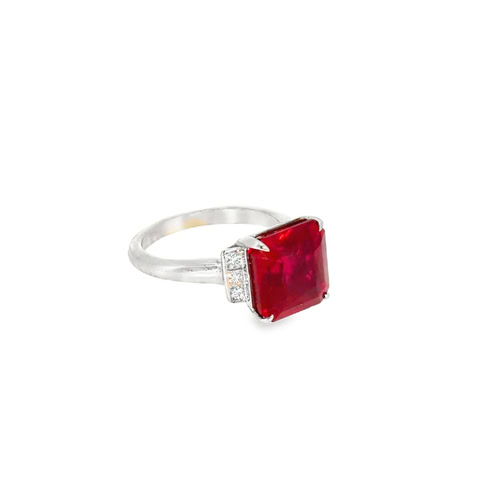
Rather than surrounding the ruby with a halo, this ring places two small blocks of pavé diamonds directly against its sides. Each block is a tight grid of small round diamonds set flush into white gold.
That choice does something specific. A halo would have drawn a bright outline around the stone and made the whole head read as one large unit; two compact panels instead frame the ruby like a pair of brackets and leave its outline sharp.
The diamonds are graded H color, a near-colorless grade. Against a strongly saturated red they look clean and white, and at 0.30 carats they add sparkle without ever competing with the center stone.
From the side you can see how neatly the panels tuck under the ruby's corners, bridging the wide stone and the slim band.
A ruby statement ring
This is a ruby statement ring in the most literal sense: one enormous stone, a plain band and nothing else asking for attention.
A ruby statement ring works best when the rest of your jewelry stays quiet. Diamond studs, a slim white gold chain and a bare other hand are all it needs.
Red carries well against black, navy, cream and white, and it suits evening as naturally as it suits a plain shirt in daylight. Because the mounting is simple, a ruby statement ring like this does not look formal; it looks modern.
Worn on the right hand, a lab grown ruby solitaire ring like this is a dress ring. Worn on the left, it becomes something else entirely, which brings us to the next question.
As a lab grown ruby engagement ring
A lab grown ruby engagement ring is an increasingly common choice, and this ring would make a striking one. A single large colored stone on a plain white band has the shape of a classic solitaire, with red in place of white.
Ruby is one of the best colored gems for daily wear. It is corundum, 9 on the Mohs hardness scale, second only to diamond, and a lab-grown ruby is the same material, so it is equally hard. Cut corners and corner prongs protect the most vulnerable parts of the stone.
The practical consideration is size rather than durability. A stone of this scale sits high and wide on the finger, so it is worth trying on for a few minutes to see how it feels against neighboring fingers before committing to it for daily wear.
If you would like this style as a lab grown ruby engagement ring in a smaller stone, or with a matched band, we can talk through the options in the showroom.
About ruby
Ruby is corundum, the same mineral as sapphire. Red corundum is called ruby; corundum of any other color is sapphire. At 9 on the Mohs scale it is one of the hardest gems used in jewelry.
Color is what makes a ruby. The most prized reds are strong and pure, without brown or orange in them, and they hold that color under both daylight and indoor light. The Gemological Institute of America describes ruby as one of the most valued of all colored gems for exactly that reason.
Rubies have been grown in laboratories since the early twentieth century, longer than almost any other synthetic gem. The material is identical to mined ruby; only the growth environment differs, and identifying it takes laboratory equipment rather than a loupe.
Ruby is the birthstone for July and the traditional gift for a 40th wedding anniversary, so a ruby ring works as a birthday or anniversary piece as well as a statement in its own right.
How lab-grown rubies are made
There is no mystery to the process, and knowing it makes the stone easier to understand. The first commercially successful method, flame fusion, was perfected in France at the turn of the twentieth century: powdered alumina with a trace of chromium is dropped through a very hot flame and crystallizes into a boule of ruby.
Later methods grow corundum more slowly. In flux growth, the ingredients dissolve in a molten flux and crystallize over months; in hydrothermal growth, they dissolve in hot water under pressure, much as they would deep in the earth. Slower methods produce stones that look closer to mined material.
In every case the result is corundum coloured red by chromium, exactly like a mined ruby. The chemistry and hardness of a 9 carat lab grown ruby are identical to those of a mined one; only the growth conditions differ.
That is why identifying a lab-grown ruby needs laboratory equipment. A jeweler with a loupe can sometimes see telltale curved growth lines or gas bubbles, but the reliable test is done with instruments, not by eye.
Who a large lab grown ruby ring suits
A large lab grown ruby ring suits someone who wants presence above provenance. If the size and the color are what you love about a ring, a lab-grown stone gives you both at a scale mined material rarely reaches.
It suits July birthdays and 40th anniversaries, where ruby carries traditional meaning and a 9 carat stone makes the occasion unmistakable.
And it suits people who prefer simple settings. There is no cluster here and no halo, just one stone, two small diamond panels and a plain band, which is a harder look to get right than it appears.
Choosing a large ruby ring
When you compare a ring like this, start with the red. Look at the stone in daylight and under warm indoor light, and check that the color stays strong in both rather than going dark or dull.
Next, look at how evenly the color runs across the stone. In a large step-cut gem you see straight into the middle of it, so any unevenness shows more than it would in a smaller brilliant cut.
Then consider the proportions on your hand. A stone roughly 11 millimeters across looks very different on a slim finger than on a broad one, and the only way to judge that is to try it.
Finally, check the prongs and the band. On a wide stone and a slim shank, the join between the head and the band does the hard work, and it should feel solid rather than springy.
Caring for your ruby ring
Ruby is hard and forgiving, so care is simple. Clean the ring in warm water with a drop of mild dish soap, brush gently behind the stone and around the diamond panels with a soft toothbrush, rinse and pat dry. Our jewelry care guide has more detail.
A lab grown ruby solitaire ring traps lotion and soap under the stone, and that film dulls the color long before anything else goes wrong. Cleaning behind the ruby makes more difference to how it looks than anything else you can do.
Take the ring off for the gym, gardening and heavy housework, and have the corner prongs checked from time to time. On a stone this wide, a snagged prong is much easier to fix early.
We offer complimentary cleaning and inspection for jewelry bought from our store.

Seeing this lab grown ruby solitaire ring in Boca Raton
Red photographs unpredictably, and a stone of this size even more so. You are welcome to try this lab grown ruby solitaire ring on at our Boca Raton showroom and see the color in daylight and under the lights.
We are open Monday to Friday, 9:30 to 5:30, and Saturday, 10:30 to 4:30. Directions are on our Visit Us page.
David Stern Jewelers has served Boca Raton for over 40 years. David Stern is a GIA Graduate Gemologist, so detailed questions about the ruby and the diamonds can be answered on the spot.
Sizing, appraisal and insurance
This ring can be sized to fit. The band is plain and slim, so sizing is straightforward, and we confirm before any work is done.
It includes a written jewelry appraisal by David Stern, which describes the ruby, the diamonds and the gold and gives a replacement value for insurance.
More ruby jewelry
See our lab grown ruby cocktail ring, our round ruby engagement ring, or browse all our rings.
Questions about this lab grown ruby solitaire ring
Is the ruby natural or lab-grown?
It is lab-grown. A laboratory-grown ruby is a real ruby with the same chemistry, crystal structure and hardness as a mined one; the difference is that it was grown in a laboratory. The diamonds beside it are natural.
What stones are in this lab grown ruby solitaire ring?
A 9.17 carat lab-grown ruby at the center, with small pavé panels of natural diamonds on either side, 0.30 carats in total. Together they make 9.47 carats of gemstones.
Is the 9.47 carats one ruby?
No. It is the total weight of all the stones. The ruby is 9.17 carats and the diamonds add 0.30 carats.
How big is a 9 carat lab grown ruby?
Roughly 11 millimeters across. Ruby is denser than diamond, so it faces up slightly smaller than a diamond of the same weight, but a stone this size covers much of the finger.
Would a natural ruby this size cost more?
Far more. A mined ruby of 9 carats with this color and clarity would be a rarity priced well beyond this ring, which is the main reason people choose a large lab-grown stone.
What quality are the diamonds?
The pavé diamonds are graded H color, a near-colorless grade, so they look clean and white against the red center.
Is a lab-grown ruby durable?
Yes. Ruby is corundum, 9 on the Mohs scale, second only to diamond, and a lab-grown ruby is the same material, so it is equally hard and well suited to a ring worn often.
Can this be a lab grown ruby engagement ring?
It can. A single large stone on a plain band has the shape of a classic solitaire, and ruby is hard enough for daily wear. The thing to test is the scale: try it on for a few minutes first.
Why are the corners of the stone cut off?
A sharp square corner is the most vulnerable point on any stone. Cutting the corners protects the gem and gives the prongs a flat surface to grip.
What metal is the ring?
The mounting is 14kt white gold and the ring weighs 7.5 grams. White gold is usually rhodium plated, and we can re-plate it in store when the finish softens.
Can the ring be resized?
Yes. The band is plain and slim, so sizing is straightforward. We confirm before any work is done.
Is ruby a birthstone?
Yes. Ruby is the birthstone for July and the traditional gift for a 40th wedding anniversary.
Can I see the ring before I buy it?
Yes. It is at our Boca Raton showroom. We are open Monday to Friday, 9:30 to 5:30, and Saturday, 10:30 to 4:30.