14kt. white gold all-diamond necklace with 0.28ct total wt. of diamonds
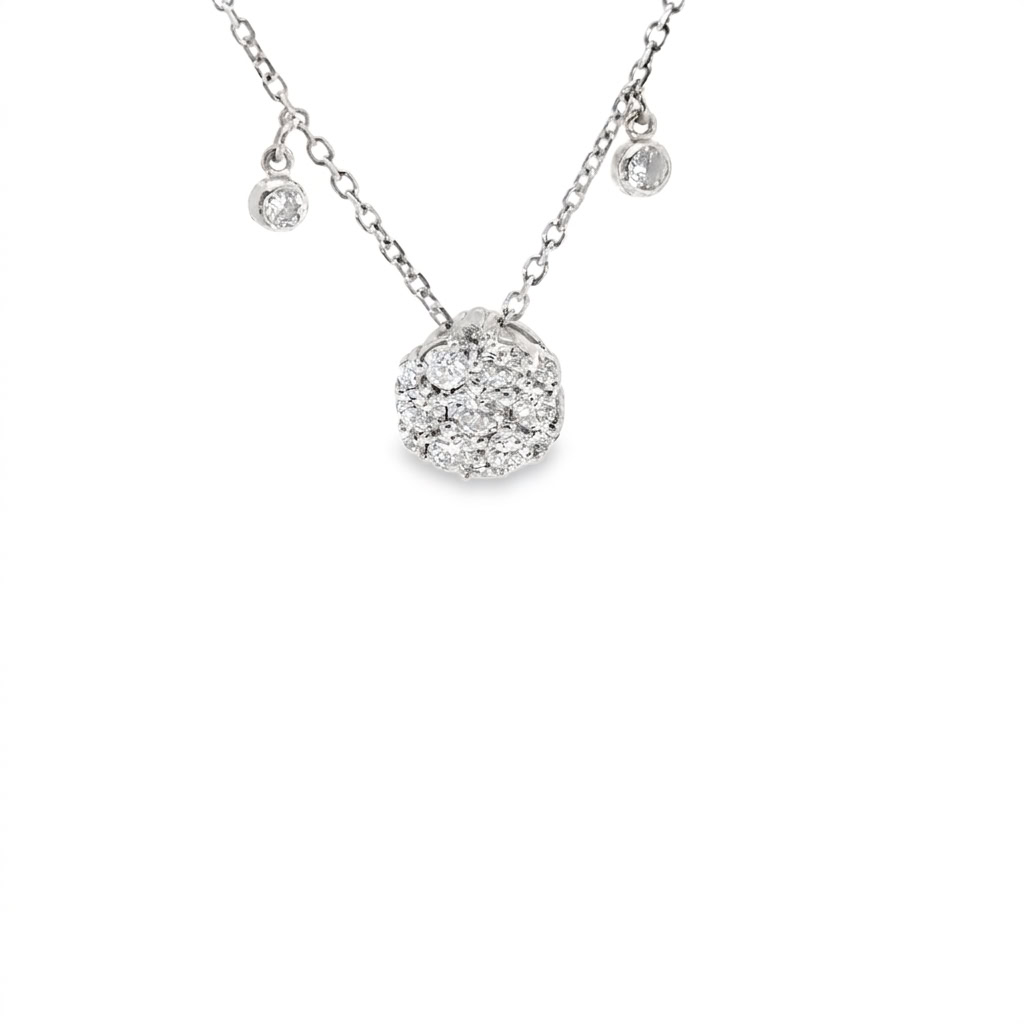
A diamond cluster necklace in 14kt white gold. A round pavé set pendant gathers a 0.20 carat center diamond inside two rings of smaller stones, and a bezel-set diamond hangs from the chain on either side of it. Seventeen diamonds in all, 1.28 carats together, graded H to I color and SI1 clarity, on a fine 16 inch cable chain. The necklace weighs 5 grams and was designed by David Stern Jewelers. See it at our Boca Raton showroom.
PRODUCT DETAILS
- Designed By:
- David Stern Jewelers
- Sub Category:
- Necklaces, Pendants
- Sku Number:
- dsj_07700382
- Chain:
- 16 Inches
STONE DETAILS
- Center Stone:
- 0.20 Round Diamond
- Secondary Stone:
- 1.08ct Round Diamond
- Color And Clarity:
- H/I, SI-1
- Total Carat Weight:
- 1.42ct
METAL DETAILS
- Metal Type:
- 14kt White Gold
- Metal Color:
- White Gold
- Gold Weight:
- 5grams
- Gold Content:
- 58.3% pure
CERTIFICATION
- Appraised By:
- David Stern, G.I.A. Gemologist
- Appraisal Included:
- Yes, complimentary

Free Jewelry Appraisal on Every Order
David Stern Jewelers guarantees every piece of jewelry we sell, which is why we include a free jewelry appraisal with every item purchased.
DESCRIPTION
This diamond cluster necklace centers a round pavé disc of diamonds on a fine 16 inch chain of 14kt white gold, with a small bezel-set diamond hanging on either side of it. There are seventeen diamonds in all, 1.28 carats together, and the necklace weighs 5 grams. It was designed by David Stern Jewelers. Everything below describes this exact piece, which you can see and try on at our Boca Raton showroom.
This diamond cluster necklace at a glance
Here are the specifications of this diamond cluster necklace, as recorded for this piece.
The pendant is a round cluster of round brilliant cut diamonds. At its center sits a single diamond of 0.20 carats, ringed by larger accent stones and then by an outer round of smaller ones, so the face of the pendant reads as one continuous dome of light.
Two further diamonds hang from the chain, one on each side of the pendant, each held in its own small bezel.
Counting every stone, there are seventeen diamonds weighing 1.28 carats in total. They are graded H to I color, within the near-colorless range, and SI1 clarity.
The chain is 16 inches of fine 14kt white gold cable, and the whole necklace weighs 5 grams.
What makes a diamond cluster necklace
A cluster is a group of small diamonds set close together so that they work as a single shape, and that is the whole idea behind a diamond cluster necklace. Done well, a diamond cluster necklace gives you the visual weight of a much larger stone for a fraction of what that stone would cost.
The arithmetic is the reason. Diamond prices rise steeply with size, because large rough is rare: a single one-carat diamond costs far more than five diamonds of a fifth of a carat each, even though the carat weight is identical. A cluster spends the budget on spread instead of on rarity.
What you get in exchange is a different kind of sparkle. One large stone returns light in broad, slow flashes. A diamond cluster necklace like this one breaks the same light into many smaller flashes that move independently, so the pendant shimmers rather than winks as you turn.
The trade-off is honest and worth stating: a cluster is not a solitaire, and a jeweler will always see the difference from a foot away. At conversational distance, most people will not.
The pavé set pendant
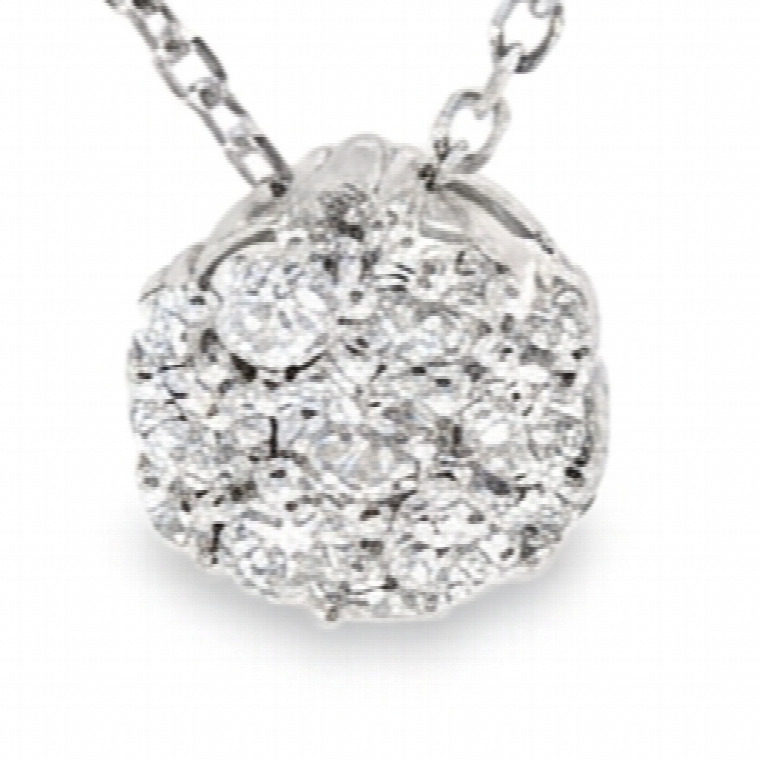
Look closely at the pendant and you can see how it is built. The 0.20 carat center stone sits slightly proud, a ring of larger accents surrounds it, and a final outer round of small diamonds carries the setting down to its edge.
Each stone is held by tiny beads of white gold raised from the metal between them, which is what pavé means: the surface is paved with diamonds, with as little metal showing as the stones allow.
Because the rows step down toward the rim, the pendant is gently domed rather than flat. That curve is deliberate. It catches light from more angles than a flat disc would, and it is why the cluster still reads as bright when you are looking at it from below, which is how a necklace is usually seen.
Pavé work of this kind is judged on evenness. The stones should sit level with one another, the beads should be regular, and the outline should be a true circle. Under a loupe at our counter you can check all three.
The two bezel-set drops
The detail that lifts this above a plain cluster pendant is the pair of small diamonds hanging from the chain, one to each side of the center.
They are bezel set, which means each is wrapped in a continuous rim of white gold rather than held by prongs. At this size that is the sensible setting: there is nothing to snag, and a bezel protects the edge of a small stone completely.
Because they hang from the chain rather than being fixed to it, the drops move independently as you do. The result is a necklace that keeps catching light at the edges of the pendant instead of going still when you stop moving.
They also break the symmetry just enough to make the piece look designed rather than assembled. A single cluster on a chain is a familiar object; a cluster flanked by two swinging diamonds is not.
A 1.28 carat diamond necklace
The seventeen diamonds in this piece weigh 1.28 carats together. That is the figure to compare when you are shopping, and it is worth understanding what it does and does not mean.
It does not mean there is a 1.28 carat stone here. It means the total weight of every diamond in the necklace, the pendant and both drops included, comes to 1.28 carats.
A 1.28 carat diamond necklace built as a cluster and one built around a single 1.28 carat solitaire are very different objects at very different prices. The cluster gives you more surface covered in diamond; the solitaire gives you one stone with a certificate and a resale market.
For most people buying a necklace to wear rather than to trade, the cluster is the better value, which is why this construction has been a staple of fine jewelry for more than a century.
A 16 inch diamond necklace
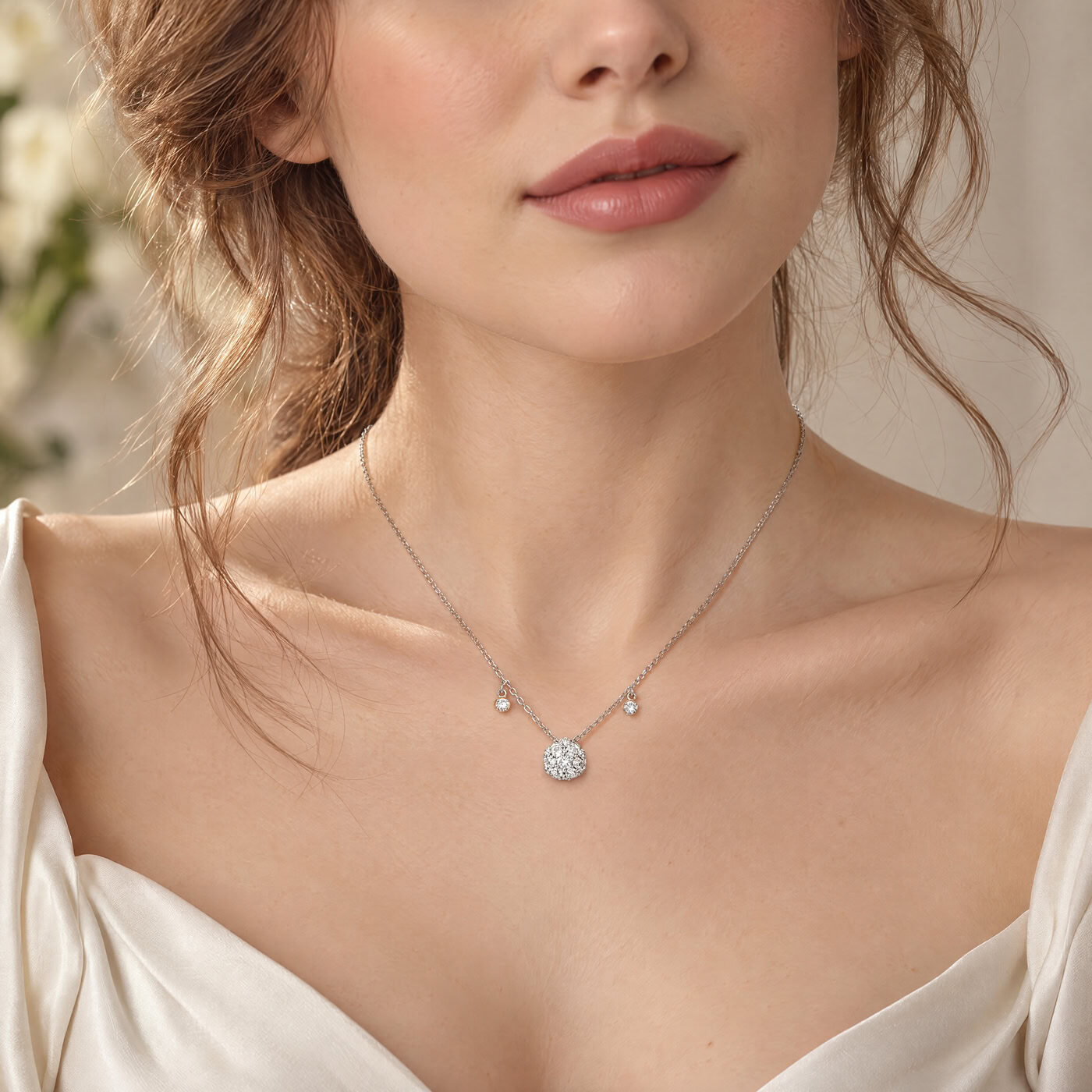
Chain length changes a necklace more than people expect, and this white gold cluster necklace hangs on 16 inches of chain.
A 16 inch diamond necklace sits at the base of the throat, just above the collarbone. On most adults that is the shortest of the standard lengths that still falls below the hollow of the neck rather than hugging it like a choker.
That position suits a cluster pendant particularly well. The pendant sits high enough to be seen above a crew neck or a buttoned shirt, and it stays in the open rather than disappearing into a neckline.
It is also the easiest length to layer. A 16 inch diamond necklace worn with an 18 or 20 inch chain gives you clear separation between the two, with no tangling and no competition between pendants.
If 16 inches sits higher than you like, tell us when you visit. Adding length to a cable chain is routine work.
H to I color and SI1 clarity
Diamond color runs from D, completely colorless, down to Z, with a visible tint. H and I sit in the near-colorless band. Set in white metal and viewed face-up, they look white; the faint warmth that separates them from a D grade is visible mainly when a stone is loose and seen from the side.
Our guide to diamond color shows the whole scale, and the Gemological Institute of America explains how grades are assigned under controlled light.
Clarity describes the small internal features almost every natural diamond contains. SI1 means slightly included: the inclusions are found under 10x magnification rather than with the eye.
In a cluster these grades matter less than they would in a solitaire, and that is not a dodge. Inclusions and faint body color are hardest to see in small stones, and a pavé surface is read as a whole rather than stone by stone. H to I and SI1 is where the money stops buying anything you can see, which is the right place to stop. Our guide to the diamond 4Cs covers how the four grades work together.
A white gold cluster necklace
White metal is the right frame for near-colorless diamonds, and that is most of the argument for a white gold cluster necklace. A warm metal reflects its own color into the stones around it; white gold stays neutral and lets them look as white as they are.
14kt gold is 58.3 percent pure gold, alloyed for strength. That firmness matters here more than it would in a ring, because the setting holds seventeen small stones: the beads of a pavé surface have to stay exactly where the setter put them.
White gold is usually finished with a thin rhodium plating for a bright white surface. Over years of wear that plating softens, most noticeably on a chain where links rub against each other and against skin. We can re-plate a white gold cluster necklace in store to bring the finish back.
At 5 grams this white gold cluster necklace is light for its visual size, which is what you want in a piece intended for daily wear.
A cluster pendant necklace for every day
This is a cluster pendant necklace rather than an occasion piece, and the distinction is in the scale. The pendant is substantial enough to be noticed and small enough to be worn with a T-shirt, which is what makes a 16 inch diamond necklace of this kind so easy to live with.
It works under a collar, over a sweater and against bare shoulders, and because the chain is fine the pendant is what people see rather than the metal carrying it.
A cluster pendant necklace is also one of the easiest gifts to get right. There is no finger to size, no stone color to guess at and no style commitment: a round cluster of white diamonds on a white gold chain suits almost anyone who wears jewelry at all.
For an anniversary, a milestone birthday or a first significant piece of diamond jewelry, this is the kind of necklace that gets worn rather than saved.
How to wear it
Worn alone with a plain neckline, this diamond cluster necklace does the work by itself. Keep earrings small and let the pendant sit in the open.
Layered, put it at the top of the stack. A 16 inch chain above an 18 or 20 inch chain gives each piece room, and the cluster reads as the focal point.
A cluster pendant necklace also pairs naturally with diamond studs. If you own a pair, this necklace is the obvious companion piece: same stones, same metal, nothing to clash.
For evening, add a tennis bracelet or a line bracelet rather than a second necklace. The pendant and the drops already give the neckline all the movement it needs.
Cluster or solitaire?
If you are choosing between this and a single-stone pendant at a similar price, the question is what you want the necklace to be.
A solitaire is one stone with its own grading report and its own resale market. It is the piece you buy when the diamond itself is the point, and at this budget it will be noticeably smaller than the face of this pendant.
A diamond cluster necklace spends the same money on spread. You get a larger bright shape at the throat, more movement as you turn, and a piece that photographs well, but no single stone to certify.
Neither answer is wrong. People who want a diamond cluster necklace usually want the look at the neckline; people who want a solitaire usually want the stone. We keep both in the case, and the fastest way to decide is to hold them side by side.
Caring for a pavé diamond necklace
Diamond attracts oil, and a pavé surface holds it better than any other setting. Lotion, perfume and the natural oils of the skin collect in the spaces between small stones, and that film is almost always the reason a cluster stops looking bright.
Soak the necklace in warm water with a drop of mild dish soap, brush the pendant gently with a soft toothbrush, paying attention to the back of the setting as well as the front, then rinse and pat dry. Our jewelry care guide has more detail.
Check the two drops from time to time. They hang from small jump rings, and those are the parts most worth a glance when you clean the piece.
Store your diamond cluster necklace flat or hung rather than loose in a drawer, where a fine chain knots and diamonds scratch other jewelry. We offer complimentary cleaning and inspection for jewelry bought from our store, and a professional clean restores a pavé surface far more thoroughly than home cleaning can.
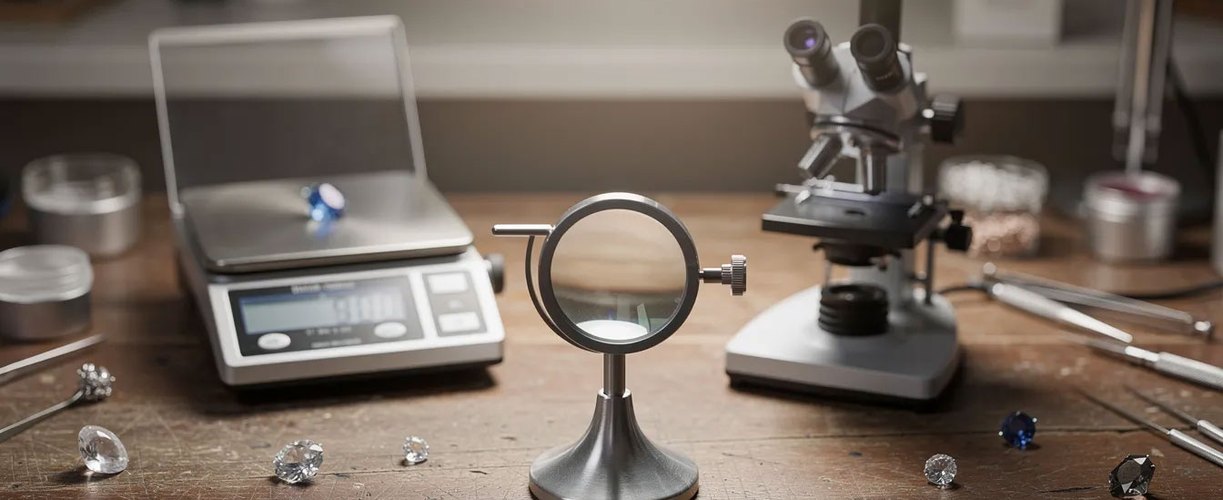
Seeing this diamond cluster necklace in Boca Raton
A pavé cluster photographs as a bright blur. In person it resolves into individual stones, and the difference between an ordinary cluster and a well-set one is obvious the moment you see them together.
You are welcome to try this diamond cluster necklace on at our Boca Raton showroom, look at the pendant under a loupe and compare it with other necklaces at the same weight.
We are open Monday to Friday, 9:30 to 5:30, and Saturday, 10:30 to 4:30. Directions are on our Visit Us page.
David Stern Jewelers has served Boca Raton for over 40 years. David Stern is a GIA Graduate Gemologist, so detailed questions about the diamonds can be answered on the spot.

Appraisal and insurance
Most homeowners and renters policies cover jewelry only to a low limit unless a piece is scheduled separately, and scheduling usually requires a written appraisal.
We offer jewelry appraisals in store. An appraisal describes the diamonds, the gold and the setting, and gives a replacement value an insurer can work from.
More diamond necklaces
Browse all our necklaces, or the full range of pendants.
Questions about this diamond cluster necklace
How many diamonds are in this necklace?
Seventeen in total, weighing 1.28 carats together. Fifteen of them form the pavé cluster pendant, and two more hang from the chain in individual bezels on either side of it.
Is there a 1.28 carat diamond in it?
No. The 1.28 carats is the combined weight of all seventeen diamonds. The largest single stone is the 0.20 carat diamond at the center of the cluster.
What does cluster mean?
A cluster is a group of small diamonds set close together so they read as one larger shape. It gives a pendant the visual size of a much bigger stone at a fraction of the price.
What is pavé setting?
The stones are held by tiny beads of gold raised from the metal between them, so the surface looks paved with diamonds and very little metal shows.
What are the diamond grades?
The diamonds are graded H to I color, within the near-colorless range, and SI1 clarity, meaning inclusions found under magnification rather than with the eye.
Will I see the inclusions?
No. At SI1 and at these sizes the inclusions are identified under 10x magnification; on the neck they are not visible.
What are the two small diamonds on the chain?
They are bezel-set drops, one on each side of the pendant. Each hangs from a small jump ring so it moves independently, which keeps the necklace catching light at the edges.
How long is the chain?
16 inches, which sits at the base of the throat just above the collarbone. We can add length to the cable chain if you prefer it lower.
What metal is it?
14kt white gold, which is 58.3 percent pure gold, and the necklace weighs 5 grams. White gold is usually rhodium plated, and we can re-plate it in store when the finish softens.
Can I wear it every day?
Yes. Diamond is the hardest natural material and the setting is built for regular wear. Clean it when it looks dull and have the drops glanced at when you do.
How do I clean a pavé necklace?
Soak it in warm water with a drop of mild dish soap and brush the pendant gently with a soft toothbrush, front and back, then rinse and pat dry. Pavé holds oil more than any other setting, so this is worth doing often.
Does it layer with other necklaces?
Yes, and it is a good length for it. Worn at 16 inches above an 18 or 20 inch chain, each piece has room and the cluster stays the focal point.
Can I see it before I buy it?
Yes. It is at our Boca Raton showroom. We are open Monday to Friday, 9:30 to 5:30, and Saturday, 10:30 to 4:30.