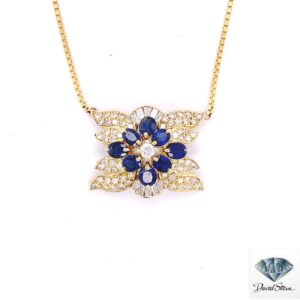
1.80 CT Pear Faceted Sapphire Necklace in 18kt White Gold
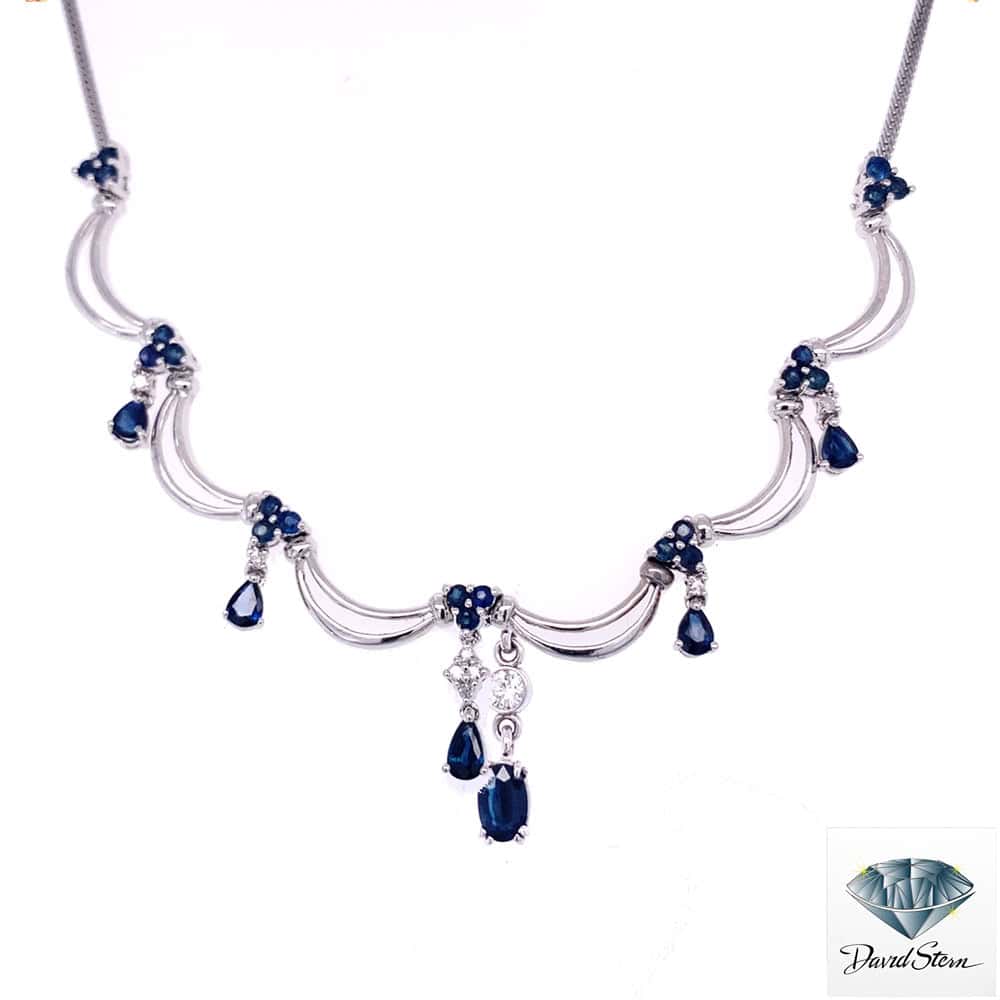
A one-of-a-kind pear sapphire necklace in 14kt white gold, designed as a festoon. Open double-wire swags link seven clusters of round blue sapphires, with pear-shaped sapphire drops hanging beneath and a longer center drop finished by an oval sapphire. About twenty-six sapphires, roughly 1.80 carats in total, with small diamond accents. It comes with a written appraisal for insurance and can be seen in person at our Boca Raton showroom.
PRODUCT DETAILS
- Designed By:
- David Stern Jewelers
- Sub Category:
- All Jewelry
- Sku Number:
- dsj_fcj_07700367
STONE DETAILS
- Center Stone:
- Pear Sapphire
- Secondary Stone:
- 0.05 ct tw Round Diamond
- Color And Clarity:
- SI-2
- Total Carat Weight:
- 1.8 ct tw
METAL DETAILS
- Metal Type:
- 14kt White Gold
- Gold Content:
- 58.3% pure
CERTIFICATION
- Appraised By:
- David Stern, G.I.A. Gemologist
- Appraisal Included:
- Yes, complimentary

Free Jewelry Appraisal with $2500 Purchase
David Stern Jewelers guarantees every piece of jewelry we sell, which is why we include a free jewelry appraisal with every item purchased.
DESCRIPTION
This pear sapphire necklace is a one-of-a-kind festoon design in 14kt white gold. Double crescent links swing from one sapphire cluster to the next, and from each junction hangs a pear-shaped blue sapphire drop, with a longer center drop finished by an oval sapphire. About 1.80 carats of sapphire in all, with small diamond accents, and what follows describes the exact piece you will see in our Boca Raton showroom.
A sapphire festoon necklace, link by link
A festoon is a necklace built from graceful swags, like garlands draped between points. In this sapphire festoon necklace, each swag is a pair of curved white gold wires, set one inside the other so the links look light and open rather than solid and heavy.
Where the swags meet, a cluster of three small round sapphires sits like a knot in the garland. Seven of those clusters run across the front of the necklace, spacing the design evenly from one side of the neck to the other.
The effect is a sapphire festoon necklace that follows the curve of the collarbone. Rather than a single pendant at the center, the color is spread across the whole front of the neckline, which is exactly what a festoon is designed to do.
Festoon necklaces have a long history in fine jewelry, going back to the garland styles of the eighteenth and nineteenth centuries. This one keeps the idea but reads as clean and modern, thanks to the simple open wirework and the cool white gold.
The form suits colored stones particularly well. Where a single pendant shows one stone at one point, a festoon lets a jeweler repeat the same color at regular intervals, so the eye travels around the neckline from cluster to drop to cluster. Many small, well-matched stones give a steady rhythm of blue rather than one isolated flash. It is also a design that rewards close inspection: the way each swag meets its cluster, and how evenly the drops fall, tells you a great deal about how carefully a piece was made. Those details are worth studying in person, and we are always happy to take the time.
The pear sapphire drops
Hanging beneath the clusters are pear-shaped sapphires, faceted teardrops that swing freely as you move. The pear shape is what gives this teardrop sapphire necklace its movement: the rounded end catches the light, and the point draws the eye downward.
At the center of the pear sapphire necklace, the design goes one step further. Two drops hang side by side, one finished with a pear sapphire and one with an oval sapphire beneath a small bezel-set diamond. That longer center drop anchors the necklace and gives it a clear focal point.
Across the whole piece there are about twenty-six sapphires, roughly 1.80 carats in total. They are a deep, saturated blue, well matched from one end of the necklace to the other, which is harder to achieve across many stones than it is with one.
The Gemological Institute of America describes the most valued blue sapphires as a strong, pure blue that is neither too light nor so dark that it looks inky. The stones in this sapphire drop necklace sit comfortably in that range.
A sapphire and diamond drop necklace
Small diamonds are set above several of the drops, with a brighter bezel-set diamond on the center drop. They are accents rather than the main event of this sapphire drop necklace, recorded as SI2 clarity, and their job is to put a flash of white light between the blue stones.
That touch of white is what makes this a sapphire and diamond drop necklace rather than a plain sapphire piece. The diamonds brighten the design at exactly the points where the eye lands, just above each swinging drop.
Sapphire is corundum, which sits at 9 on the Mohs hardness scale, second only to diamond. That makes sapphire one of the most practical colored gems for a necklace with this many exposed stones: the drops will brush against clothing and skin every time you wear it, and sapphire stands up to that far better than softer gems.
Why 14kt white gold suits blue sapphires
This pear sapphire necklace is made in 14kt white gold, which is 58.5 percent pure gold alloyed with white metals for strength. White gold keeps blue sapphires cool and crisp, and it lets the diamond accents read as bright white rather than warm.
14kt gold is also the practical choice for a festoon design. It is harder than 18kt, which matters for the thin double wires of each swag and the many small prongs holding the sapphire clusters and drops. Like most white gold it is finished with rhodium plating, which can be refreshed at the bench whenever it wears.
The necklace continues into a textured white gold chain at the back, which lies smoothly against the neck and complements the polished swags at the front.
How this pear sapphire necklace wears
A festoon sits on the collarbone and spreads across the neckline, so it looks best with an open neckline: a scoop, a boat neck, a strapless or off-the-shoulder dress. It is a pear sapphire necklace for occasions when you want the jewelry to frame the face.
It is not only an evening piece, though. Because the swags are light and open, it wears comfortably for hours, and with a simple black or white top it is just as effective at a daytime event.
We will fit it on you in the showroom so you can see exactly how the swags follow your neckline. Festoon designs are more sensitive to fit than a simple pendant, so it is worth trying on before you decide.
A sapphire drop necklace with meaning
Sapphire is the birthstone for September, and GIA's guide to the September birthstone covers its long association with wisdom, loyalty and royalty. For a September birthday, a sapphire drop necklace like this is a natural and generous gift.
Sapphire is also a traditional gift for the forty-fifth wedding anniversary. A necklace set with twenty-six sapphires marks a milestone with far more presence than a single stone on a chain.
Because blue sapphire is such a classic color, a piece like this does not date. It is worn for decades and then handed down.
How to judge a sapphire festoon necklace in person
Start with color. In a sapphire drop necklace with many stones, look for the sapphires to match: the same depth of blue in the clusters, the drops and the center oval, with none noticeably lighter, darker or greener than the rest.
Next, look at movement. The drops should hang straight and swing freely, and the swags should curve evenly on both sides. Lay the necklace flat and it should be symmetrical from the center out.
Then look at the settings. Each cluster should sit level, every prong should be even, and the joints between the swags should move smoothly without catching.
Finally, look at the back. A well-made sapphire festoon necklace is finished as carefully behind as in front, because that is the side that rests against your skin.
Pear sapphire compared with other blue gemstones
Sapphire is not the only blue gem, and it helps to know where it sits. Tanzanite is a violet-blue and softer, at around 6.5, so drops would need more care. Blue topaz is bright but lighter and softer. Iolite is a violet-blue gem that is much less durable.
For a design with many exposed stones, sapphire's hardness and deep, lasting blue make it the natural choice. The International Gem Society gives a good overview of how sapphire compares with other blue stones.
Choosing a teardrop sapphire necklace as a gift
A teardrop sapphire necklace is one of the easier fine jewelry gifts to get right. It does not depend on a ring size, blue suits almost every skin tone, and a festoon flatters most necklines. The questions worth asking are simple: does the person wear white metal, and do they wear open necklines?
If the answer to both is yes, this is a piece that will be worn to the occasions that matter. If it is a September birthday, the stones carry their own meaning as well.
We are glad to help you decide. Bring a photo of what they usually wear, and we will tell you honestly whether this piece suits them or whether something simpler from the case would be the better choice.
Why pear-shaped sapphires make the best drops
The pear is the classic shape for a drop, and there are practical reasons for that. A pear hangs naturally point-down, so it settles into place instead of spinning, and its tapered outline echoes the line of a swinging pendant. In a teardrop sapphire necklace the shape does as much work as the stone.
Pear-shaped sapphires also return light well. The broad rounded end gives a large, bright face of color, and the facets toward the point concentrate that color into a deeper tip. As the drops move, that contrast between the lighter body and the darker point is what makes them seem to flicker.
Finally, the pear flatters the wearer. A row of small teardrops leads the eye downward along the neckline, which lengthens the neck in the same way a V-neck does. That is why the teardrop sapphire necklace has remained a favorite for formal jewelry for so long.
What sets this sapphire and diamond drop necklace apart
Most sapphire necklaces are a single stone on a chain. This one is a complete design: seven clusters, a row of swinging drops, a longer center drop and open white gold swags linking everything together. It is a sapphire and diamond drop necklace built to be worn as the main piece, not as an accent.
It also spreads its value across many well-matched stones rather than concentrating it in one. That makes it forgiving in wear: any single stone can be checked, tightened or replaced at the bench without changing the design.
And because it is a one-of-a-kind piece, you will not see it on anyone else. This is the only one in our case.
Caring for a sapphire festoon necklace
Clean your sapphire festoon necklace with warm water, a drop of mild soap and a soft brush, working gently around the clusters and drops where dust collects. Rinse and dry with a lint-free cloth. Our jewelry care guide goes through the process step by step.
Store it flat in a lined box, laid out in its natural curve. Folding or piling a festoon can bend the swags and tangle the drops, and keeping it apart from other pieces stops the stones from scratching softer jewelry.
Put it on last and take it off first. Perfume, hairspray and lotion leave a film that dulls both the sapphires and the diamonds.
Bring it in once a year and we will clean it professionally and check every prong and joint at no charge. On a piece with this many small stones, a loose setting is something you want found at the bench rather than discovered at home.

Appraisal, documentation and what you receive
Every sapphire necklace at this level leaves with a written appraisal describing the metal, the stones, the measurements and a stated replacement value for insurance. That document is what your insurer will ask for, and it is worth updating every few years as gold and gem prices move. Our jewelry appraisals page explains how we do it.
You can see our full range of necklaces alongside this one, and our diamond and gemstone education pages set out how grading actually works. If you would like a piece altered, or something built around a stone you already own, we do that too through our design service.
See this pear sapphire necklace in Boca Raton
Photographs of blue stones are unreliable. Screens push blue toward purple or black, and a festoon's movement cannot be captured in a still image. A piece like this is worth seeing in person, which is why we would rather you came in and tried it on than bought it sight unseen.
David Stern Jewelers has been in business for over 40 years, family owned since 1970, and the showroom is at 21073 Powerline Rd #37, Boca Raton. We are open Monday to Friday from 9:30am to 5:30pm and Saturday from 10:30am to 4:30pm. Call 561-994-3330 and we will have the piece waiting, or book an appointment for a quieter time.
If this particular piece is not quite right, tell us why. A single drop instead of many, yellow gold instead of white: with a piece like this the specification is a starting point, and we would rather find you the right thing than sell you the nearest thing.
Common questions about this pear sapphire necklace
What is a festoon necklace?
A festoon necklace is made of graceful swags draped between points, like a garland, often with drops hanging from each junction. It sits on the collarbone and spreads color across the whole neckline rather than concentrating it in one pendant.
How many sapphires are in the necklace?
There are about twenty-six sapphires, roughly 1.80 carats in total: clusters of three small round sapphires at each junction, pear-shaped sapphire drops beneath them, and an oval sapphire on the center drop.
Are there diamonds in the necklace?
Yes. Small diamond accents are set above several of the drops, with a bezel-set diamond on the center drop. They are recorded as SI2 clarity and add flashes of white light between the blue stones.
What metal is the necklace made in?
It is made in 14kt white gold, finished with rhodium plating for a bright white color. The plating can be refreshed at the bench whenever it wears.
Is sapphire durable enough for a drop necklace?
Yes. Sapphire is 9 on the Mohs hardness scale, second only to diamond, so the exposed drops stand up well to everyday contact with clothing and skin.
Are the sapphires treated?
Most sapphires on the market are heat treated to improve their color, a stable and widely accepted practice. Ask us in the showroom and we will tell you everything we know about these stones and show them to you under magnification.
Is sapphire the September birthstone?
Yes. Sapphire is the birthstone for September and a traditional gift for the forty-fifth wedding anniversary.
Does the necklace come with an appraisal?
Yes. It leaves with a written appraisal describing the metal, the stones and the measurements, with a replacement value your insurer can use.
Do you buy sapphire jewelry as well as sell it?
Yes. We buy fine jewelry, gold and gemstones in Boca Raton, and we can value a piece you already own while you are here.
Can a similar design be made in yellow gold?
Yes. Through our custom design service we can build a comparable festoon in yellow or rose gold, or with different gemstones, including stones you already own.
One last practical note. Because this is a single piece rather than stock, it can sell on any given day, and we do not hold items without a deposit. If you have seen this pear sapphire necklace here and intend to come in, a phone call first will confirm it is still in the case and save you the trip if it is not.