1.81 CT Pear Sapphire Ring in 18kt White Gold
A one-of-a-kind sapphire ballerina ring in 18kt white gold. A 1.81 carat pear sapphire in a vivid royal blue sits at the center of a flared skirt of twenty-five tapered baguette diamonds, about 1.40 carats graded G color and VS2 clarity, for 3.21 carats of total gem weight. It rises on a raised gallery and split shank, is listed at size 6 and can be sized. It comes with a written appraisal for insurance and can be seen in person at our Boca Raton showroom.
PRODUCT DETAILS
- Designed By:
- David Stern Jewelers
- Sub Category:
- Rings
- Sku Number:
- dsj_fcj_07700059
STONE DETAILS
- Center Stone:
- Pear Sapphire
- Secondary Stone:
- 1.4 ct tw Tapered Baguette Diamond
- Color And Clarity:
- G
- Total Carat Weight:
- 3.21 ct tw
METAL DETAILS
- Metal Type:
- 18kt White Gold
- Gold Content:
- 75% pure
CERTIFICATION
- Appraised By:
- David Stern, G.I.A. Gemologist
- Appraisal Included:
- Yes, complimentary

Free Jewelry Appraisal with $2500 Purchase
David Stern Jewelers guarantees every piece of jewelry we sell, which is why we include a free jewelry appraisal with every item purchased.
DESCRIPTION
This sapphire ballerina ring is a one-of-a-kind piece in 18kt white gold, built around a 1.81 carat pear sapphire in a vivid royal blue. Twenty-five tapered baguette diamonds fan out around it like the layers of a ballerina's tutu, about 1.40 carats of diamonds graded G color and VS2 clarity, for a total gem weight of 3.21 carats. What follows describes the exact ring you will see in our Boca Raton showroom.
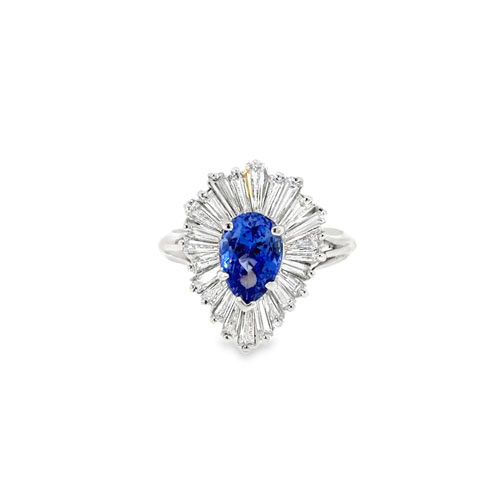
The 1.81 carat pear sapphire
The center stone is a pear-shaped sapphire of 1.81 carats. Its color is a rich, saturated royal blue, bright enough to glow in ordinary room light without turning dark or inky.
The Gemological Institute of America describes the most valued sapphires as a strong, pure blue to slightly violetish blue, and this stone sits squarely in that range. The pear shape, sometimes called a teardrop, combines the rounded brilliance of an oval with a single elegant point.
That shape is what makes a pear sapphire ring so graceful on the hand. The point draws the eye along the finger and makes the hand look longer and slimmer, while the rounded end gives the stone a bright, lively face.
Sapphire is corundum, which sits at 9 on the Mohs hardness scale, second only to diamond. It is one of the best colored stones for a ring you intend to wear often.
What is a ballerina ring
A ballerina ring is a classic design in which a center stone is surrounded by tapered baguette diamonds set at angles, so they flare out like a dancer's tutu. The style became popular in the mid-twentieth century and has remained a favorite of collectors of retro and cocktail jewelry ever since.
What makes a ballerina ring special is movement. Because each baguette is set at a slightly different angle, the diamonds catch light from different directions, and the whole ring seems to shimmer as your hand moves. The effect is quite different from a halo of small round diamonds, which sparkle in a tighter, more uniform way.
This sapphire ballerina ring follows the classic form exactly: a colored center, a full skirt of tapered baguettes and an open, airy setting that lets light pour through the diamonds.
Twenty-five tapered baguette diamonds
The skirt of this ring is made of twenty-five tapered baguette diamonds, about 1.40 carats in total. Tapered baguettes are long, narrow step-cut diamonds that are wider at one end than the other, which lets them fan out neatly around a curved center stone.
The diamonds are graded G color and VS2 clarity. G is in the near-colorless range, so the baguettes look bright and white, and VS2 means any inclusions are very slight and not visible to the naked eye. For accent diamonds in a ring of this style, that is a high standard.
Step-cut baguettes have long, clean facets that produce broad flashes of light rather than fine sparkle. Set around a blue sapphire, they create the crisp contrast that gives this sapphire and baguette diamond ring its drama.
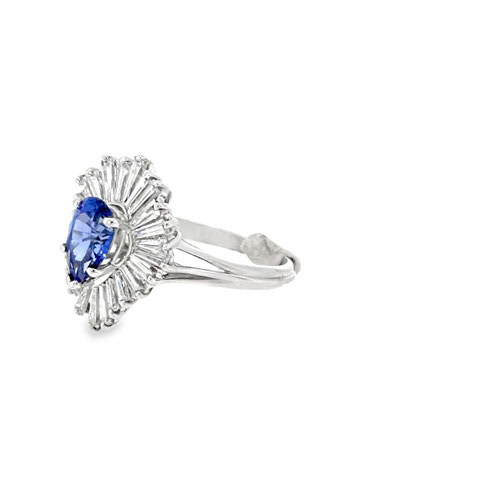
The 18kt white gold mounting
The ring is made in 18kt white gold, which is 75 percent pure gold. 18kt has a rich, substantial feel and takes a fine polish, and white gold keeps the sapphire cool and the diamonds bright. Like most white gold, it is finished with rhodium plating for its white color, which we can refresh whenever it wears.
The baguettes are held in a raised gallery that lifts the skirt away from the finger, and the shank splits into several wires as it approaches the head. That construction gives the ring its height and lets light into the diamonds from below.
The ring is listed at size 6 and about 4.1 grams of gold. It can be sized to fit, and we will check the shank with you first.
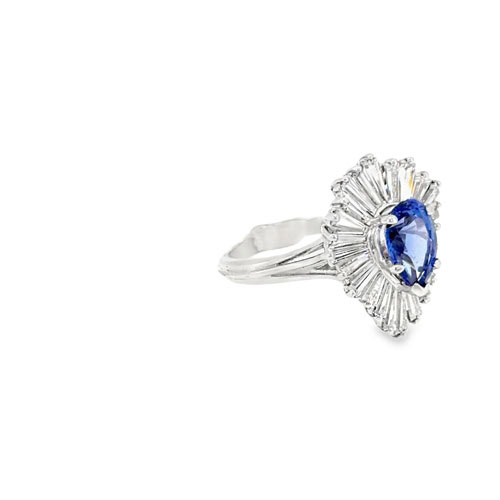
A blue sapphire cocktail ring
The ballerina design grew up alongside the cocktail ring, and this piece works beautifully in that role. As a blue sapphire cocktail ring, it is bold enough to wear to an evening event and elegant enough to become a signature piece you wear every week.
It is typically worn on the right hand or the middle finger, where its height and width have room. Some people also choose a pear sapphire ring like this as an alternative engagement ring, and its sapphire center and diamond skirt make it a memorable choice.
How this pear sapphire ring wears
A pear sapphire ring in a ballerina setting sits higher than a simple solitaire, so it is best suited to occasions and to people who enjoy wearing a statement piece. The pear can be worn point toward the fingertip, which lengthens the finger, or point toward the wrist for a more unusual look.
Blue and white go with almost everything, from navy and white to black and gray. The ring pairs easily with diamond studs, a tennis bracelet or other white metal jewelry.
We will fit it on you in the showroom so you can see how it sits on your hand.
A September birthstone ring
Sapphire is the birthstone for September, and GIA's guide to the September birthstone covers its long association with wisdom, loyalty and royalty. A sapphire ballerina ring is a September birthstone gift with real glamour.
Sapphire is also a traditional gift for the forty-fifth wedding anniversary.
The history of the ballerina style
The ballerina setting took its name from the flared skirts of classical ballet costumes, and it rose to popularity in the 1950s and 1960s, when bold cocktail jewelry was at its height. Jewelers used tapered baguettes, then a fashionable cut, to surround a center stone with a crown of light.
Early examples often used a diamond center, but colored centers soon became just as popular. Sapphire, ruby and emerald all look striking inside a white skirt of baguettes, and blue sapphire in particular became a favorite because of the crisp contrast it creates.
Today the ballerina style is valued both by collectors of mid-century jewelry and by people who simply want a ring with more movement and character than a modern halo. It remains one of the most recognizable ring silhouettes in fine jewelry.
Where sapphires come from
Sapphires are mined in many parts of the world. Sri Lanka has produced them for more than two thousand years, and Myanmar, Thailand, Madagascar, Australia and East Africa are all important sources. Each tends to produce stones with a slightly different character, from soft cornflower blue to deep royal blue.
Ruby and sapphire are the same mineral, corundum. Traces of iron and titanium make corundum blue; chromium makes it red. Every sapphire, whatever its origin, shares the same hardness and durability.
Sapphire through history
Sapphire has been prized for thousands of years as a stone of wisdom and protection. Medieval clergy wore blue sapphires as a symbol of heaven, and European royalty set them into crowns and rings for centuries.
In more recent times, blue sapphire has become one of the most famous engagement ring stones in the world, and its deep, steady blue has never gone out of fashion.
How to judge a ballerina ring in person
Start with the sapphire. Look for an even, vivid blue across the stone, without gray or greenish areas, and check that the point of the pear is intact and protected by its prong.
Next, look at the baguettes. They should be well matched in color and clarity, and they should fan out evenly on all sides with no gaps or stones sitting at odd angles. On a ballerina ring, symmetry is everything.
Then check the settings. Each baguette should be held firmly, and none should rock when gently touched with a fingernail.
Finally, look at the shank. It should be round and even, with no thin spots where the split wires meet the head. That is where a well-made ballerina ring shows its quality.
Pear sapphire compared with other shapes
Oval and round sapphires are the most common in rings. The pear is rarer and more distinctive: it has the brilliance of an oval, the drama of a point and a romantic outline that suits the ballerina style particularly well.
The International Gem Society gives a good overview of how sapphires are cut and valued.
What sets this sapphire and baguette diamond ring apart
Many ballerina rings use small or lower-quality baguettes. This one uses twenty-five matched tapered baguettes graded G color and VS2 clarity, about 1.40 carats in total, around a well-colored 1.81 carat pear sapphire, all in 18kt white gold.
The result is a sapphire and baguette diamond ring with both quality and presence. And because it is a single piece, you will not see it on anyone else. This is the only one in our case.
Choosing a sapphire ballerina ring as a gift
A ring is a personal gift, and the most important question is size. We can size it after purchase, so if you are buying it as a surprise, bring a ring the person already wears on the same finger and we will measure it.
The other question is style. If the person loves glamorous, retro jewelry and color, a sapphire ballerina ring will suit them perfectly. If they prefer minimal pieces, something quieter from the case may be a better choice, and we will tell you honestly.
Wearing a ballerina ring with other jewelry
Because a ballerina ring is so full, it looks best as the only ring on its hand, or paired with a simple band on a neighboring finger. White metal and diamond pieces complement it naturally: diamond studs, a tennis bracelet or a fine white gold chain.
Blue sapphire also pairs beautifully with pearls, a classic combination from the same era that made the ballerina style famous.
How tapered baguettes are cut and matched
A baguette is a step cut: its facets run in parallel rows along the length of the stone, like steps, rather than radiating from the center like a brilliant cut. That gives baguettes their clean, mirror-like flashes of light.
A tapered baguette narrows from one end to the other, so each stone has to be cut to a precise angle to fit into a curved arrangement. Building a full skirt means cutting and matching many stones of slightly different lengths and tapers, then fitting them together with almost no gap between them. It is patient, exacting work.
Because step cuts show clarity more openly than brilliant cuts, the quality of the baguettes matters. That is why the G color and VS2 clarity of these stones makes such a difference to how bright and even the skirt looks.
Sizing a ring with a split shank
Split shanks spread the weight of a tall head across the finger, but they need care when a ring is resized. The band has to be adjusted below the point where the wires divide, so that the split and the head stay perfectly aligned. Our bench jeweler does this in-house, and we will talk you through it before any work begins.
Caring for a sapphire ballerina ring
Clean the ring with warm water, a drop of mild soap and a soft brush, working gently between the baguettes where lotion and dust collect. Rinse and dry with a lint-free cloth. Our jewelry care guide goes through the process step by step.
Take it off for gardening, gym work and heavy housework. A ballerina ring stands tall, and a hard knock can loosen a baguette.
Bring it in once a year and we will clean it professionally and check every setting at no charge.

Appraisal, documentation and what you receive
Every sapphire ring at this level leaves with a written appraisal describing the metal, the stones, the measurements and a stated replacement value for insurance. That document is what your insurer will ask for, and it is worth updating every few years as gold and gem prices move. Our jewelry appraisals page explains how we do it.
You can see our full range of rings alongside this one, and our diamond and gemstone education pages set out how grading actually works. If you would like a piece altered, or something built around a stone you already own, we do that too through our design service.
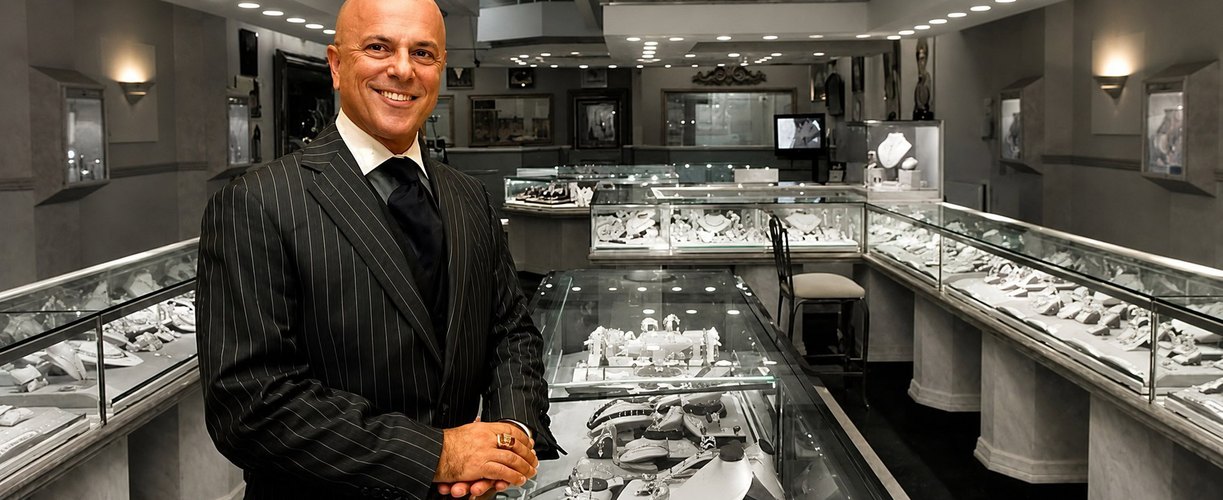
See this sapphire ballerina ring in Boca Raton
Photographs of blue stones are unreliable. Screens push blue toward purple or black, and the shimmer of a baguette skirt cannot be captured in a still image. A ring like this is worth trying on in person, which is why we would rather you came in than bought it sight unseen.
David Stern Jewelers has been in business for over 40 years, family owned since 1970, and the showroom is at 21073 Powerline Rd #37, Boca Raton. We are open Monday to Friday from 9:30am to 5:30pm and Saturday from 10:30am to 4:30pm. Call 561-994-3330 and we will have the ring waiting, or book an appointment for a quieter time.
Common questions about this sapphire ballerina ring
What is a ballerina ring?
A ballerina ring surrounds a center stone with tapered baguette diamonds set at angles, so they flare out like a dancer's tutu. The style became popular in the mid-twentieth century and is prized for the way it shimmers as the hand moves.
How large is the sapphire?
The center stone is a pear-shaped sapphire of 1.81 carats. With the twenty-five baguette diamonds, about 1.40 carats, the total gem weight is 3.21 carats.
What quality are the diamonds?
The twenty-five tapered baguette diamonds are graded G color and VS2 clarity: near-colorless and clean to the naked eye.
What metal is the ring made in?
It is made in 18kt white gold, which is 75 percent pure gold, finished with rhodium plating for a bright white color.
What size is the ring, and can it be resized?
It is listed at size 6 and can be sized by our bench jeweler. We will check the split shank with you first.
Is sapphire durable enough for a ring?
Yes. Sapphire is 9 on the Mohs hardness scale, second only to diamond. Take a tall ballerina ring off for sports and heavy work to protect the baguette settings.
Is the sapphire treated?
Most sapphires on the market are heat treated to improve their color, a stable and widely accepted practice. Ask us in the showroom and we will tell you everything we know about this stone.
Can it be used as an engagement ring?
Yes. Some couples choose a sapphire ballerina ring as an alternative engagement ring. Sapphire is hard enough for daily wear, though the tall setting is best protected during heavy work.
Does the ring come with an appraisal?
Yes. It leaves with a written appraisal describing the metal, the stones and the measurements, with a replacement value your insurer can use.
Is sapphire the September birthstone?
Yes. Sapphire is the birthstone for September and a traditional gift for the forty-fifth wedding anniversary.
One last practical note. Because this is a single piece rather than stock, it can sell on any given day, and we do not hold items without a deposit. If you have seen this sapphire ballerina ring here and intend to come in, a phone call first will confirm it is still in the case and save you the trip if it is not.