8.00CT Lab Grown Diamond Studs 14KT Yellow Gold – IGI Certified
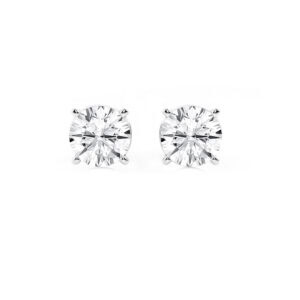
8 carat yellow gold studs: a matched pair of round brilliant lab-grown diamonds, 4.00 carats in each ear, E color and VS2 clarity with cut, polish and symmetry recorded as Excellent, set in 14kt yellow gold four-prong baskets with secure screw-style backs. Each diamond carries an IGI grading report. See them and compare sizes at our Boca Raton showroom.
PRODUCT DETAILS
- Designed By:
- David Stern Jewelers
- Sub Category:
- Earrings, Studs
- Sku Number:
- 4prong-lab-E/VS2-8CT-Yellow
STONE DETAILS
- Center Stone:
- Round Diamond
- Total Carat Weight:
- 8.00 CT TW
METAL DETAILS
- Metal Type:
- 14kt Yellow Gold
- Gold Content:
- 58.3% pure
CERTIFICATION
- Appraised By:
- David Stern, G.I.A. Gemologist
- Appraisal Included:
- Yes, complimentary

Free Jewelry Appraisal with $2500 Purchase
David Stern Jewelers guarantees every piece of jewelry we sell, which is why we include a free jewelry appraisal with every item purchased.
DESCRIPTION
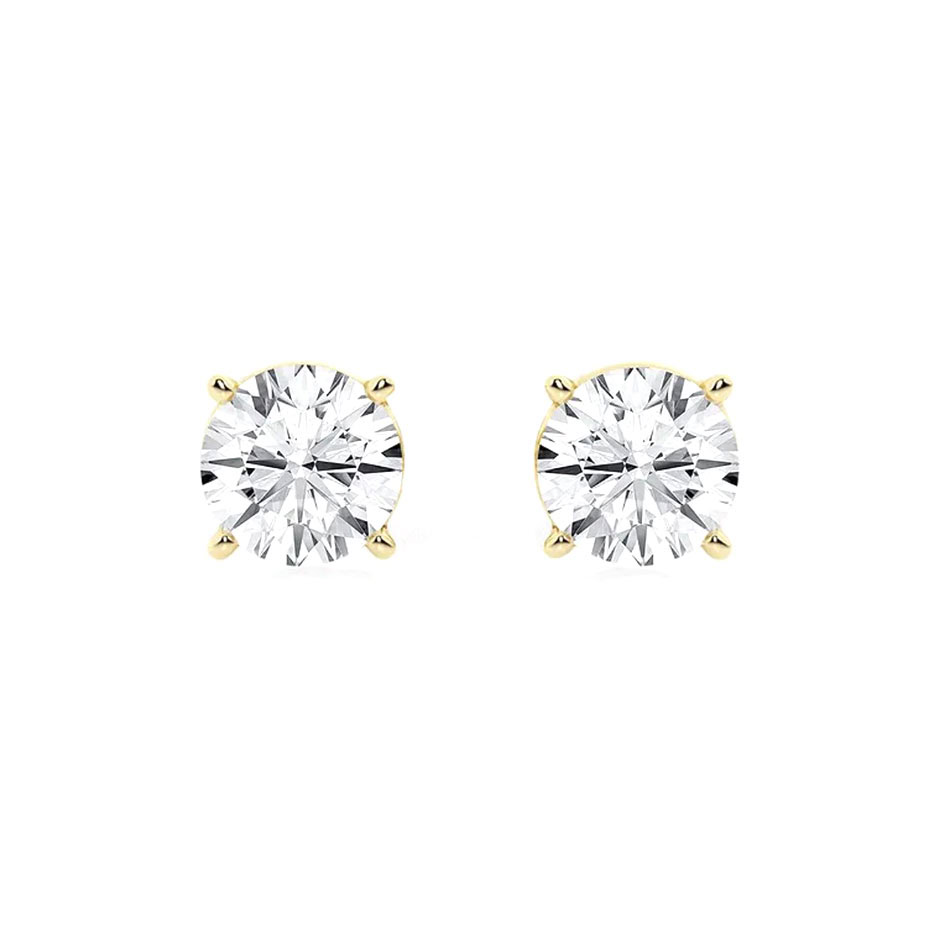
These 8 carat yellow gold studs hold a matched pair of round brilliant lab-grown diamonds, 4.00 carats in each ear, in 14kt yellow gold four-prong baskets. Both diamonds are graded E color and VS2 clarity with Excellent cut, polish and symmetry, and both carry an IGI grading report. Below is everything you need to judge the pair before you see them in our Boca Raton showroom.
8 carat yellow gold studs at a glance
Here are the specifications of these 8 carat yellow gold studs, as recorded for this pair. Total diamond weight is 8.00 carats, made up of two round brilliant lab-grown diamonds of 4.00 carats each.
Color is E, one step below the top of the scale and firmly in the colorless range. Clarity is VS2, which means very small inclusions that are visible only under 10x magnification. Cut, polish and symmetry are all recorded as Excellent, the combination the trade calls Triple Excellent.
The metal is 14kt yellow gold, and each diamond sits in a four-prong basket setting with screw-style backs. Both diamonds are laboratory-grown, and both carry an IGI grading report.
In short, these are bold, bright, well-matched 8 carat yellow gold studs with lab-grown diamonds, one step below the largest pair in the collection and warm where most studs this size are white.
Is the 8 carats one diamond or two?
Two. The 8.00 carats is the total weight of the pair, not the weight of a single stone.
Each earring holds one round lab-grown diamond of 4.00 carats. Two of them make 8.00 carats total weight, which jewelers write as 8.00 ct TW.
When you compare 8 carat yellow gold studs online, always check whether a listing gives the weight per ear or the total weight. The two are easy to confuse, and the difference in size on the ear is dramatic.
How big are 8 ctw lab grown diamond earrings?
A well-cut 4.00 carat round brilliant measures roughly 10 millimeters across. For comparison, a 1.00 carat round is about 6.5 millimeters, a 2.00 carat round about 8 millimeters and a 5.00 carat round about 11 millimeters.
That makes 8 ctw lab grown diamond earrings, four carats in each ear, a statement size that still sits comfortably on most earlobes. They are noticed across a room, but they do not overwhelm a smaller ear the way the largest studs can.
For many buyers, 8 ctw lab grown diamond earrings are the sweet spot at the top of the range: nearly the presence of a five-carat stud, at a noticeably lower price.
If you are unsure which size suits you, the best test is to try several on. This collection comes in 1, 2, 3, 4 and 5 carat per-ear sizes, and comparing them side by side in a mirror settles the question quickly. Our guide to diamond carat weight explains how weight translates into visible size.
Yellow gold statement studs, and why they make sense
Yellow gold statement studs with lab-grown diamonds are one of the clearest cases for choosing lab-grown. A matched pair of four-carat mined diamonds with these grades would be a rare and very expensive purchase. In lab-grown diamonds, the same size and quality is within reach.
That is the reason people choose yellow gold statement studs set with lab-grown diamonds: they want the look of a big, bright, well-matched pair without the price of mined stones of the same size.
Lab-grown diamonds for yellow gold statement studs are also easier to match. Because the stones are grown under controlled conditions, it is simpler to find two diamonds with identical weight, color, clarity and cut, and a close match matters more as the stones get bigger.
What lab grown diamonds are
A lab grown diamond is a real diamond. It is pure carbon arranged in the same crystal structure as a mined diamond, with the same hardness, the same refractive index and the same fire. The difference is only where it formed: in a laboratory over a few weeks, rather than deep in the earth over millions of years.
That is why a jeweler cannot tell a lab-grown diamond from a mined one with a loupe. Identifying a lab grown diamond takes specialized laboratory equipment. The International Gem Society has a clear explanation of how lab-created diamonds are grown and how they compare with mined stones.
We say lab grown plainly and on purpose. Federal guidance requires a laboratory-grown diamond to be described that way, and we would rather you know exactly what you are buying than discover it later.
IGI graded lab grown studs
These are IGI graded lab grown studs: each lab-grown diamond comes with a grading report from the International Gemological Institute, one of the largest independent gem laboratories in the world and the most widely used lab for lab-grown stones.
The report records the carat weight, color, clarity, cut, polish, symmetry and measurements of each diamond, and it identifies the diamond as laboratory-grown. You can check any report number on the IGI website.
For IGI graded lab grown studs of this size, the reports are more than paperwork. They let you confirm the two stones really are matched, and they give an appraiser and an insurer an independent description of each diamond.
When you visit, we will show you both reports alongside the earrings, so you can compare the grades with what you see under the loupe.
14kt yellow gold lab grown earrings: why the metal matters
Most large diamond studs are sold in white gold, which makes 14kt yellow gold lab grown earrings of this size a more distinctive choice. Yellow gold has a warmth that white metal does not, and it flatters most skin tones.
The prongs are the only metal you see from the front, and in yellow gold they frame each diamond with four fine points of warm color. With an E color diamond there is no body tint for the yellow to pick up, so the stones still face up bright white.
14kt yellow gold is 58.3 percent pure gold, alloyed with other metals for strength, so the prongs and posts hold their shape well, which matters when each post carries a four-carat diamond.
Yellow gold is not plated, so there is no rhodium finish to wear away. A professional polish is all 14kt yellow gold lab grown earrings need to look new again.
If you already wear yellow gold, this pair will match your rings, chains and watch. If you mix metals, yellow gold studs are one of the easiest ways to bridge warm and cool pieces.

How four prongs hold a four-carat diamond
Four slim prongs hold each diamond at its girdle, one at each corner, and leave almost the entire stone open to light. Less metal means more sparkle, and the square arrangement of the prongs gives the round diamond a clean, symmetrical frame.
The basket beneath each diamond lifts it slightly away from the earlobe, so light can enter from the sides as well as the top.
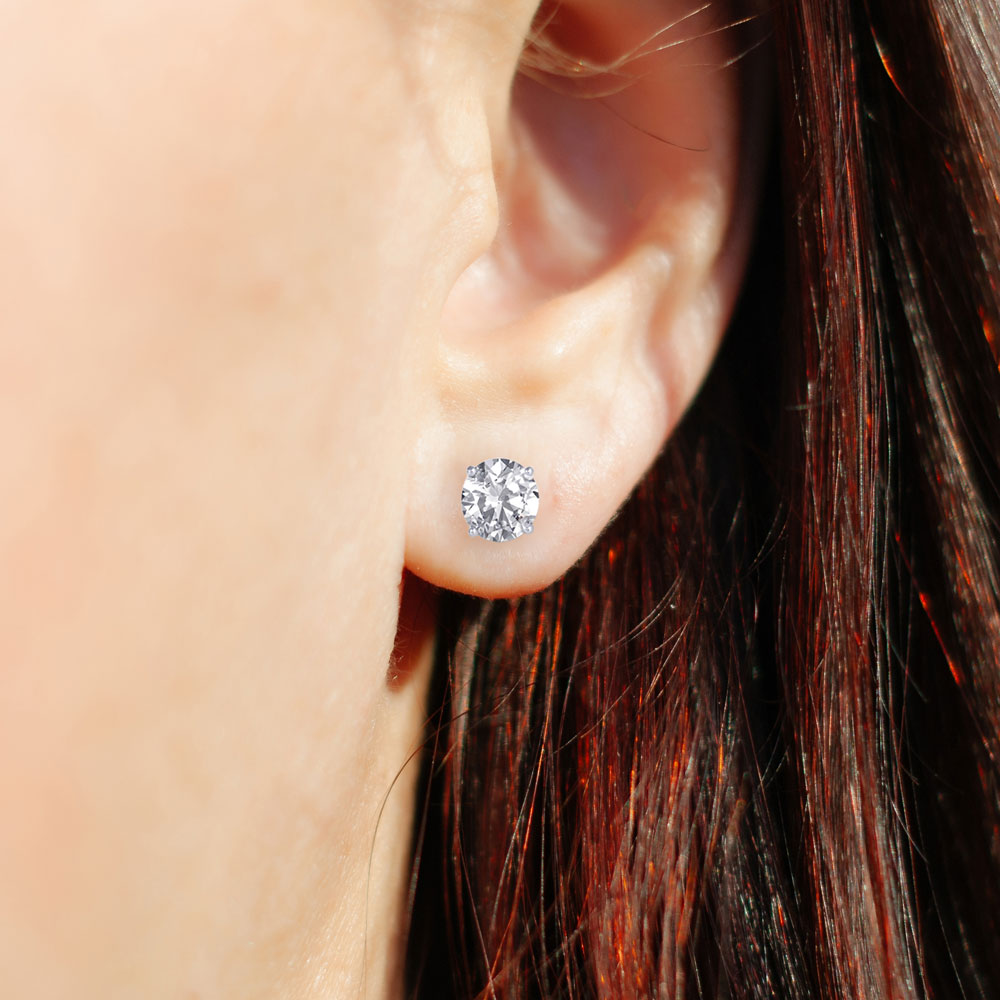
As the side photo shows, the pair is fitted with screw-style backs, which thread onto the post. For a diamond of this size, screw backs are the most secure option, and we recommend them for any stud over a carat.
Heavier stones put more weight on the ear. If you find a four-carat stud tilts forward, ask us about larger discs or support backs that spread the weight across the lobe.
E color and VS2 clarity, explained
Diamond color is graded on a scale from D, completely colorless, to Z, with a light yellow tint. E is the second-highest grade, and to the naked eye an E color diamond is indistinguishable from a D. Our guide to diamond color shows the full scale.
Color matters more as diamonds get larger, because a bigger stone shows more body color. In 8 carat yellow gold studs, an E grade means the stones stay bright white even at this size.
Clarity describes the tiny internal features, called inclusions, that almost every diamond has. VS2 stands for very slightly included. The inclusions in a VS2 diamond are hard to find even under 10x magnification and are not visible to the eye at normal viewing distances.
For a broader overview of how color, clarity, cut and carat work together, see our guide to the diamond 4Cs, or the Gemological Institute of America introduction to diamond quality.
Cut, polish and symmetry
Of the four Cs, cut has the largest effect on sparkle. A well-cut round brilliant has 57 or 58 facets angled to send light back up through the top of the stone, which is where the brilliance and fire come from.
Both diamonds in this pair are recorded as Excellent for cut, polish and symmetry. Polish describes the smoothness of the facet surfaces; symmetry describes how precisely the facets line up with one another.
On large studs, cut quality shows up in a very practical way. Studs are seen at a distance and from every angle as you move, so a diamond that throws light well looks brighter and larger than a poorly cut diamond of the same weight. Our page on diamond cut goes into the grades in more detail.
Why a matched pair matters
Diamond studs are always seen as a pair, so the two stones have to agree with each other. A difference in color, size or cut that would go unnoticed in a single diamond becomes obvious when two stones sit a few inches apart.
These 8 carat yellow gold studs were matched for exactly that reason. Both diamonds are the same weight, the same color grade, the same clarity grade and the same cut grade, so they look the same on each ear.
How to wear 8 carat yellow gold studs
Studs this size work with almost anything. With a white shirt, a camel coat or a simple black dress, 8 carat yellow gold studs become the focal point of the outfit, so keep other jewelry quiet: a slim gold chain, a gold watch or a plain band.
For evening, 8 carat yellow gold studs pair well with a diamond tennis bracelet or a line necklace in yellow gold. Hair worn up or tucked behind the ear shows the stones at their best.
They are also a natural gift for a milestone: a significant birthday, an anniversary or a promotion. A pair of 8 carat yellow gold studs is a gift that will be worn, not stored.
The value of lab grown diamonds
The main reason people choose lab grown diamonds is value. A lab-grown diamond typically costs a fraction of a mined diamond with the same grades, which is what puts 8 carat yellow gold studs within reach at all.
We want to be honest about the other side of that. Lab-grown diamond prices have fallen as production has grown, and lab-grown diamonds do not hold resale value the way mined diamonds historically have. Buy these because you will love wearing them, not for resale.
Seen that way, 8 carat yellow gold studs are a large, beautiful, durable pair of diamonds you can actually wear, rather than keep in a safe.
Seeing these 8 carat yellow gold studs in Boca Raton
Photographs are a good start, but diamonds are best judged in daylight, on your own ear, next to other sizes. You are welcome to see these 8 carat yellow gold studs at our Boca Raton showroom and compare them with other sizes from the same collection.
We are open Monday to Friday, 9:30 to 5:30, and Saturday, 10:30 to 4:30. Directions and parking are on our Visit Us page.
David Stern Jewelers has served Boca Raton for over 40 years. David Stern is a GIA Graduate Gemologist, so detailed questions about how the diamonds were graded can be answered on the spot.
Caring for your diamond studs
Diamond is the hardest natural material, but it attracts oil. Lotion, hairspray and the natural oils of the skin build up on the back of the stone and dull its sparkle long before anything else goes wrong.
To keep the pair bright, soak the earrings in warm water with a drop of mild dish soap, brush gently behind each diamond with a soft toothbrush, rinse, and pat dry. Our jewelry care guide has more detail.
Every few months, check that each backing still threads on firmly and that no prong has been snagged on a sweater or towel. You are welcome to bring the pair into our store for a professional cleaning and a prong check.
Store each earring separately, in a soft pouch or a lined box compartment, so the diamonds cannot scratch each other or other jewelry.

Insuring your diamond studs
A pair of this size is worth insuring. Most homeowners and renters policies cap jewelry coverage at a low amount unless each piece is scheduled separately, and scheduling usually requires a written appraisal.
The IGI reports describe the diamonds, but they do not state a value. An insurance appraisal does. We offer jewelry appraisals in store, describing the diamonds, the gold and the setting in the detail an insurer needs.
More diamond studs from David Stern Jewelers
The same four-prong design comes in 1, 2, 3, 4 and 5 carat per-ear sizes, in both 14kt yellow gold and 14kt white gold. This exact pair is also available as 8 carat lab grown studs in white gold, and for the largest size, see the 10 carat yellow gold studs.
You can browse all our diamond studs, or the full range of earrings.
Questions about these 8 carat yellow gold studs
Are these 8 carat yellow gold studs real diamonds?
Yes. Lab-grown diamonds are real diamonds, with the same chemistry, crystal structure, hardness and sparkle as mined diamonds. They are grown in a laboratory rather than mined, and each diamond in this pair is identified as laboratory-grown on its IGI report.
Is the 8 carats the total for both earrings?
Yes. The pair totals 8.00 carats, which is 4.00 carats in each earring.
How big is a 4 carat diamond stud on the ear?
A well-cut 4.00 carat round brilliant is roughly 10 millimeters across. On most earlobes it is a bold statement stud that still sits comfortably. The best way to judge is to try on several sizes, which you can do in our showroom.
What are the diamond grades?
Both lab-grown diamonds are E color and VS2 clarity, with cut, polish and symmetry recorded as Excellent. The IGI report for each stone lists its exact grades and measurements.
What does IGI certified mean?
Each diamond has been graded by the International Gemological Institute, an independent laboratory. The report records weight, color, clarity, cut, polish, symmetry and measurements, and confirms the diamond is laboratory-grown.
What kind of backs do these earrings have?
Screw-style backs, which thread onto the post and are the most secure option for diamonds of this size. Ask us about support backs if you would like extra lift.
Are 4 prong settings secure for a 4 carat diamond?
Yes. Four well-made prongs hold a round diamond firmly and let in the most light. We recommend a quick prong check every few months, and we are happy to check them for you in store.
Do lab grown diamonds hold their value?
Not in the way mined diamonds historically have. Lab-grown prices have fallen as production has increased, and resale value is limited. We recommend buying them for their beauty and value today.
Will yellow gold make the diamonds look yellow?
No. The diamonds are E color, which is colorless, so there is no body tint for the gold to bring out. The yellow gold prongs frame each stone with a warm line while the diamond faces up bright white.
What other sizes are in this collection?
The same four-prong design comes in 1, 2, 3, 4 and 5 carat per-ear sizes, in 14kt yellow gold and 14kt white gold.
Can I see these earrings before I buy them?
Yes. The pair is in our Boca Raton showroom. We are open Monday to Friday, 9:30 to 5:30, and Saturday, 10:30 to 4:30.
How do I clean my diamond studs at home?
Soak them in warm water with a drop of mild dish soap, brush gently behind each diamond with a soft toothbrush, rinse and pat dry. Avoid harsh chemicals and chlorine.