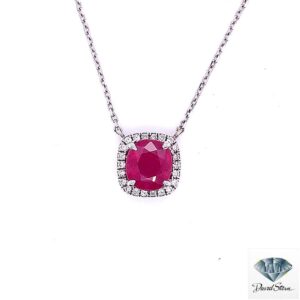
14kt White Gold Lab Grown Ruby Ring
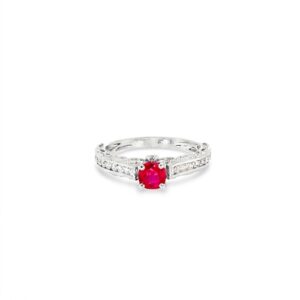
A lab grown ruby ring in 14kt white gold. A 0.80 carat round lab-grown ruby in a strong, even red sits in four prongs, with rows of small natural diamonds graduating down both shoulders: 0.50 carats in total and G color, for 1.30 carats of gemstones in all. At 4 grams it has the silhouette of a classic solitaire with a red center, easy to wear every day. Includes a written appraisal. Try it on at our Boca Raton showroom.
PRODUCT DETAILS
- Designed By:
- David Stern Jewelers
- Sub Category:
- Rings
- Sku Number:
- dsj_fj_07700078
STONE DETAILS
- Center Stone:
- Oval Ruby
- Secondary Stone:
- 0.50ct Round Diamond
- Color And Clarity:
- G
- Total Carat Weight:
- 1.30 ct tw
METAL DETAILS
- Metal Type:
- 14kt White Gold
- Gold Content:
- 58.3% pure
CERTIFICATION
- Appraised By:
- David Stern, G.I.A. Gemologist
- Appraisal Included:
- Yes, complimentary

Free Jewelry Appraisal with $2500 Purchase
David Stern Jewelers guarantees every piece of jewelry we sell, which is why we include a free jewelry appraisal with every item purchased.
DESCRIPTION
This lab grown ruby ring centers a 0.80 carat round lab-grown ruby in four prongs, with natural diamonds set down both shoulders, on a band of 14kt white gold. The diamonds add 0.50 carats, for 1.30 carats of gemstones in all, and the ring weighs 4 grams. Everything below describes this exact ring, which you can see and try on at our Boca Raton showroom.
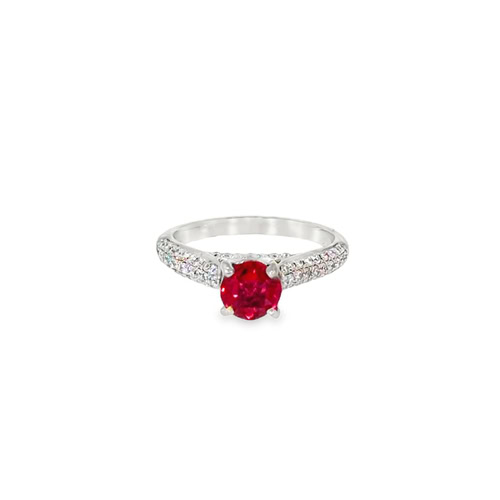
The lab grown ruby ring at a glance
Here are the specifications of this lab grown ruby ring, as recorded for this piece.
At the center is a round lab-grown ruby of 0.80 carats in a strong, even red, held in four prongs and raised slightly above the band.
Down each shoulder runs a row of small round natural diamonds, graduating in size as they approach the center stone. Together they weigh 0.50 carats and are graded G color, a near-colorless grade.
The mounting is 14kt white gold and the ring weighs 4 grams. The lower half of the band is plain, so it can be sized to fit.
In short, this lab grown ruby ring has the shape of a classic solitaire with diamond shoulders, built around a red center instead of a white one.
The ruby in this ring is lab-grown
We say that plainly, and near the top, because it matters. The center stone in this lab grown ruby ring is a laboratory-grown ruby, not a mined one.
A lab-grown ruby is a real ruby. It is corundum, with the same chemical composition, the same crystal structure and the same hardness as a mined ruby. The only difference is where it formed: in a laboratory rather than in the earth.
Federal guidance requires a laboratory-grown stone to be described that way, and we would rather you know exactly what you are buying. The written appraisal records what is known about this stone.
The diamonds on the shoulders are a separate matter: they are natural diamonds, 0.50 carats in total.
What a created ruby ring offers
The first thing a created ruby ring offers is color. Mined rubies with a strong, even red are rare and expensive, and many affordable natural rubies are pale, brownish or heavily included. A created ruby can be grown with the vivid red people picture when they think of ruby.
The second is clarity. In a created ruby ring the stone is clean and evenly colored, without the dark patches or eye-visible inclusions that are common in mined material at accessible prices.
The third is value. The money that would have gone into a small mined ruby can instead go into the setting, which is why this ring carries half a carat of natural diamonds and a well-made white gold mounting.
What a created ruby ring does not offer is rarity. Lab-grown rubies have been produced commercially for more than a century and are not scarce. Buy this ring because the color is beautiful and the setting is well made, not as an investment.
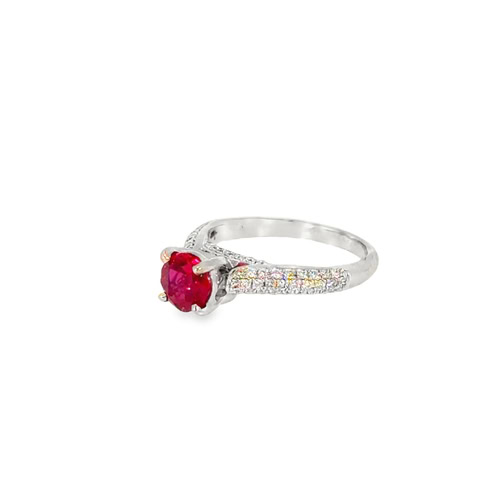
A round lab grown ruby ring
The round brilliant is the most familiar shape in jewelry, and it suits a red stone particularly well. Its facets are arranged to return light from every direction, so a round lab grown ruby ring keeps its color lively as the hand moves rather than going flat in dim light.
At 0.80 carats this ruby measures roughly 5.5 millimeters across. Ruby is denser than diamond, so it faces up slightly smaller than a 0.80 carat diamond would, but on the hand it reads as a well-proportioned center stone rather than an accent.
Four prongs hold it at the girdle, leaving as much of the stone visible as possible. The head is raised just enough for light to enter from the sides, which is what keeps a round lab grown ruby ring bright rather than dark.
Round is also the easiest shape to match later. If you ever want matching earrings or a band, round stones are far simpler to pair than fancy shapes.
A ruby ring with diamond accents
The shoulders are what lift this from a plain solitaire. Each side carries a row of small round diamonds, set close together and graduating in size so they narrow as they run away from the center.
That taper does something specific in a ruby ring with diamond accents: it draws the eye inward along the band and makes the center stone look larger than it would on a plain shank.
The diamonds are natural and graded G color, near-colorless. Against a saturated red they look clean and white, and at 0.50 carats they are a real part of the ring rather than a token sprinkle.
Set in white gold, a ruby ring with diamond accents like this reads as bright and modern. There is no yellow anywhere to warm the red, so the contrast between the stones stays crisp.
A 14kt white gold ruby ring
White metal is the natural partner for a red stone. It stays neutral, so nothing competes with the ruby for warmth, and the near-colorless diamonds look as white as possible against it.
14kt gold is 58.3 percent pure gold, alloyed with other metals for strength. That strength matters in a ring with this many small prongs, because each one has to hold its diamond securely for years of wear. A 14kt white gold ruby ring is a practical choice for something worn often.
White gold is usually finished with a thin rhodium plating for a bright white surface. Over years of wear that plating can soften, and we can re-plate a 14kt white gold ruby ring in store to restore the finish.
At 4 grams the ring is comfortable rather than heavy, which suits a design meant to be worn regularly rather than kept for occasions.
About ruby
Ruby is corundum, the same mineral as sapphire. Red corundum is called ruby; corundum of any other color is sapphire. At 9 on the Mohs hardness scale it is one of the hardest gems used in jewelry, second only to diamond.
That applies to lab-grown rubies as well. Because a laboratory-grown ruby is chemically and structurally the same material, it is just as hard and just as suitable for a ring worn every day.
The Gemological Institute of America describes ruby as one of the most valued of all colored gems, prized above all for the intensity of its red.
Ruby is the birthstone for July and the traditional gift for a 40th wedding anniversary, so a ruby ring works as a birthday, anniversary or milestone gift as well as a piece bought for its own sake.
How lab-grown rubies are made
There is no mystery to the process. The first commercially successful method, flame fusion, was perfected in France at the turn of the twentieth century: powdered alumina with a trace of chromium is dropped through a very hot flame and crystallizes into a boule of ruby.
Later methods grow corundum more slowly. In flux growth the ingredients dissolve in a molten flux and crystallize over months; in hydrothermal growth they dissolve in hot water under pressure, much as they would deep in the earth.
In every case the result is corundum colored red by chromium, exactly as in a mined ruby. Identifying a lab-grown stone takes laboratory equipment rather than a loupe, which is why honest disclosure matters more than any test a jeweler can do at the counter.
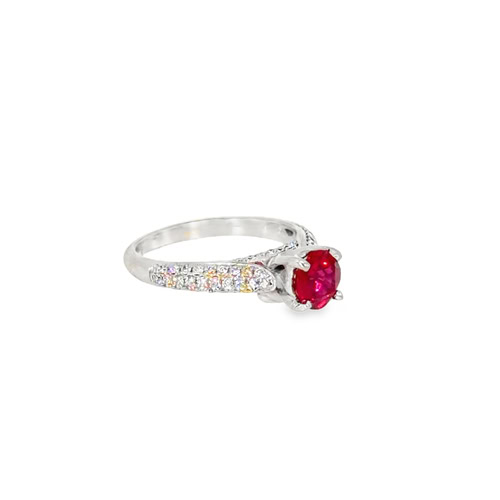
As an engagement or anniversary ring
This design has the silhouette of a classic engagement ring: a raised center stone, diamond shoulders and a plain lower band that sits flat against a wedding band.
Ruby is one of the best colored gems for that role. At 9 on the Mohs scale it resists scratching better than almost anything except diamond, and unlike emerald or opal it has no particular fragility to work around.
A lab grown ruby ring also makes the choice easier on a budget. You get a strong, even red at a size that would be expensive in mined material, and the saving goes into the diamonds and the mounting.
Red has its own meaning, too. Ruby has been associated with love and devotion for centuries, and as the July birthstone and the 40th anniversary gift it carries occasions of its own.
Who this lab grown ruby ring suits
It suits someone who wants color in a familiar shape. This is not a cocktail ring or a cluster; it is a recognizable solitaire profile with a red stone in it, which makes it easy to wear every day.
It suits July birthdays and 40th anniversaries, and it works as a promise or right-hand ring just as well as an engagement ring.
And it suits anyone who would rather spend on the setting than on provenance. Here the money has gone into 0.50 carats of natural diamonds and a well-made white gold mounting, with a lab-grown stone providing the color.
Ruby compared with other red stones
Red gemstones are easy to confuse, and the differences are worth knowing. Garnet is the most common alternative: natural, inexpensive and usually darker, often with a brownish or purplish cast, and softer at around 7 to 7.5 on the Mohs scale.
Red spinel is the historical impostor. Several famous rubies in royal collections turned out to be spinel once gemology could tell them apart. Spinel is beautiful and collectable in its own right, but it is a different mineral and generally softer than corundum.
Synthetic cubic zirconia and glass also appear in inexpensive red jewelry. Neither is a ruby, and neither has corundum's hardness, so they scratch and dull far sooner.
A lab grown ruby ring sits apart from all of these. The stone is genuine ruby, with ruby's hardness and ruby's color, grown rather than mined, which is a different thing entirely from a simulant that merely looks red.
Wearing a lab grown ruby ring
This ring is easy to place. On the left hand it works as an engagement, anniversary or promise ring; on the right it is a colorful everyday piece that still looks considered.
Because the setting is white gold, a lab grown ruby ring like this pairs naturally with white gold, platinum or silver jewelry. If you wear yellow gold elsewhere, the red center keeps the mix from looking accidental.
The profile is low enough to sit under a glove or a sleeve, and a plain wedding band sits flat against the lower shank, so it stacks without fighting.
Choosing a lab grown ruby ring
When you compare rings like this, start with the red. A good ruby color is strong and even, without a brownish or orange cast, and it should hold up in dim light as well as in daylight.
Next, look at the diamonds on the shoulders. They should be evenly matched in size within each row, graduate smoothly toward the center and sit level, with no dark gaps where a stone has dropped low in its setting.
Then check the proportions. On a 0.80 carat center the shoulders should support the stone rather than overwhelm it, and the head should be raised enough to let light in without standing tall enough to catch.
Finally, put it on. Red reads differently against different skin tones, and a ring photographed on white is never quite the ring on your hand.
Caring for your ruby ring
Ruby is hard and forgiving, so care is simple. Clean the ring in warm water with a drop of mild dish soap, brush gently behind the stone and along the diamond rows with a soft toothbrush, rinse and pat dry. Our jewelry care guide has more detail.
Lotion and soap collect behind a raised center stone and under pavé diamonds, and that film dulls the sparkle long before anything else goes wrong. Regular cleaning makes more difference than anything else you can do.
Take the ring off for the gym, gardening and heavy housework, and have the prongs checked from time to time. Small shoulder diamonds are the ones most likely to be knocked loose, and a check takes only a few minutes.
We offer complimentary cleaning and inspection for jewelry bought from our store.

Seeing this lab grown ruby ring in Boca Raton
Red photographs unpredictably, and a saturated ruby is one of the hardest stones to capture. You are welcome to try this lab grown ruby ring on at our Boca Raton showroom and see the color in daylight and under the lights.
We are open Monday to Friday, 9:30 to 5:30, and Saturday, 10:30 to 4:30. Directions are on our Visit Us page.
David Stern Jewelers has served Boca Raton for over 40 years. David Stern is a GIA Graduate Gemologist, so detailed questions about the ruby and the diamonds can be answered on the spot.
Sizing, appraisal and insurance
This ring can be sized to fit. The diamonds run partway down the shoulders and the lower band is plain, so there is gold to work with, and we confirm before any work is done.
It includes a written jewelry appraisal by David Stern, which describes the ruby, the diamonds and the gold and gives a replacement value for insurance.
More ruby jewelry
See our lab grown ruby solitaire ring, our lab grown ruby cocktail ring, or browse all our rings.
Questions about this lab grown ruby ring
Is the ruby natural or lab-grown?
It is lab-grown. A laboratory-grown ruby is a real ruby with the same chemistry, crystal structure and hardness as a mined one; the difference is that it was grown in a laboratory. The diamonds on the shoulders are natural.
What stones are in this lab grown ruby ring?
A 0.80 carat round lab-grown ruby at the center, with rows of small natural diamonds down both shoulders, 0.50 carats in total. Together they make 1.30 carats of gemstones.
Is the 1.30 carats one ruby?
No. It is the total weight of all the stones. The ruby is 0.80 carats and the diamonds add 0.50 carats.
How big is a 0.80 carat ruby?
Roughly 5.5 millimeters across. Ruby is denser than diamond, so it faces up slightly smaller than a diamond of the same weight.
What quality are the diamonds?
The shoulder diamonds are natural and graded G color, a near-colorless grade, so they look bright and white against the red center.
Is a created ruby ring worth buying?
If you want a strong, even red at a sensible price, yes. A created ruby offers color and size that would cost far more in mined material. It is not rare, though, so buy it for how it looks.
Is a lab-grown ruby durable?
Yes. Ruby is corundum, 9 on the Mohs scale, second only to diamond, and a lab-grown ruby is the same material, so it is equally hard and well suited to daily wear.
Can this be an engagement ring?
Yes. It has the silhouette of a classic solitaire with diamond shoulders, and the plain lower band sits flat against a wedding band. Ruby is hard enough for everyday wear.
What metal is the ring?
The mounting is 14kt white gold, 58.3 percent pure gold, and the ring weighs 4 grams. White gold is usually rhodium plated, and we can re-plate it in store when the finish softens.
How are lab-grown rubies made?
Corundum is grown from alumina with a trace of chromium, either through a flame, from a molten flux or in hot water under pressure. The result is the same material as mined ruby.
Can the ring be resized?
Yes. The diamonds run partway down the shoulders and the lower band is plain, so there is gold to work with. We confirm before any work is done.
Is ruby a birthstone?
Yes. Ruby is the birthstone for July and the traditional gift for a 40th wedding anniversary.
Can I see the ring before I buy it?
Yes. It is at our Boca Raton showroom. We are open Monday to Friday, 9:30 to 5:30, and Saturday, 10:30 to 4:30.