
Update, September 2026: this analysis was written in April 2025. The gold price trend it describes kept going. Gold broke $3,500 within days, crossed $4,000 in October 2025, and trades near $4,250 today. See the update section near the end.
Looking to understand the remarkable transformation in precious metals markets? The gold price trend reached a new milestone in late April 2025, with spot gold near $3,424 an ounce, roughly $1,100 higher than a year earlier. While the S&P 500 was down about 12% for the year, gold had gained about 30% over the same stretch, and it traded at roughly double its 2022 level. That is a real shift in how investors view this time-tested asset.
What accounts for this performance? Central banks worldwide have bought more than 1,000 tonnes of gold a year since 2022, a steady move away from traditional currency reserves. At the same time, the International Monetary Fund cut its global growth forecast to 2.8% for 2025, down from 3.3%. That mix of institutional buying and a weakening economic outlook created ideal conditions for gold. Many analysts were calling for $3,500 an ounce within eighteen months as tensions escalated.
This dramatic price movement represents far more than a temporary market fluctuation—it signals a fundamental realignment in investment priorities that demands serious consideration. Throughout this analysis, we’ll examine the powerful forces driving the gold price trend, what this reveals about the psychology of today’s investors, and most importantly, what this significant market shift means for your financial strategy moving forward. The current gold market conditions offer both challenges and opportunities that every informed investor should thoroughly understand.
Gold’s 2025 Price Surge: What the Numbers Reveal
The raw data behind gold’s 2025 performance tells an extraordinary story of market dominance. Month after month, the precious metal has consistently exceeded analyst expectations, establishing unprecedented price milestones throughout the first quarter of the year.
Gold then vs. a year earlier
Over the twelve months to late April 2025, gold rose roughly 45%, from about $2,330 an ounce to more than $3,400, one of the steepest climbs in its modern history. The first quarter of 2025 alone delivered a gain of about 19%, gold’s strongest quarter in decades, and the gold price trend kept accelerating into April.
Gold vs stock market indexes: the Dow and S&P 500
While gold has demonstrated remarkable strength, traditional market indices have struggled considerably. The performance gap between gold and major stock market benchmarks tells a compelling story:
| Asset | Change, January 1 to late April 2025 (approx.) |
|---|---|
| Gold | +30% |
| S&P 500 | -12% |
| Dow Jones Industrial Average | -10% |
A gap that wide opening up in only four months is unusual. It is one of the clearest signs of the gold vs stock market shift this article describes: money leaving shares and moving into an asset that does not depend on corporate earnings.
Gold price trend chart: A visual overview
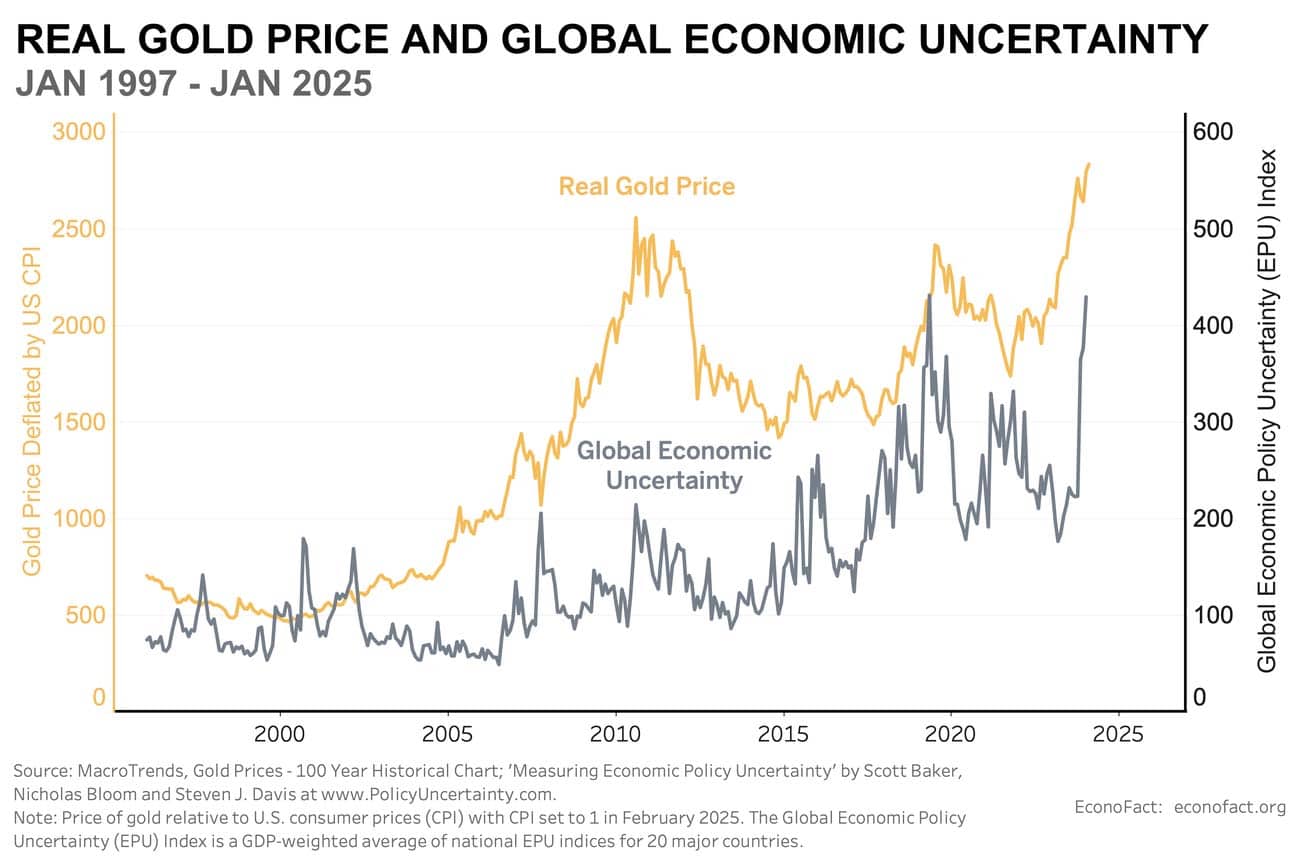
On a chart, the gold price trend since 2022 is a steady climb with short, shallow pauses rather than the violent swings of earlier bull markets. The $2,000 level that capped gold for three years gave way in early 2024, and the $3,000 mark, long treated as a psychological barrier, fell in mid-March 2025 and then acted as support.
The longer view is even more striking. The chart below tracks gold’s price after inflation against a measure of global economic uncertainty since 1997. The two lines tend to move together, and by early 2025 both had pushed to or near record levels.
Why Gold Is Rising: The Forces Behind the Trend
The gold price trend of 2025 stems from a complex combination of economic and geopolitical factors that have fundamentally transformed the precious metals landscape in 2025.
Trump tariffs and gold: trade instability
President Trump’s tariff policies emerged as a primary catalyst for gold’s ascent. In April 2025 he announced a 10% baseline tariff on all imports into the United States, with much higher duties on specific trading partners, including 34% on Chinese goods and 20% on European Union imports. The link between Trump tariffs and gold was immediate.
These reciprocal tariffs have proven “much more aggressive than expected,” triggering asset market selloffs and contributing to dollar weakness. This economic uncertainty has directly benefited gold prices as investors seek stability amid escalating trade tensions. The link between Trump tariffs and gold also has history behind it: gold has served as a hedge against tariff-induced inflation, with past data consistently showing price increases during previous trade disputes.
The dollar index dropped 0.4% following Trump’s tariff announcement, further enhancing gold’s appeal to international investors. Adding to these concerns, China has warned it would not “sit back” and that American tariffs go “against the whole world,” signaling continued trade friction in the months ahead.
Central bank gold buying at record levels
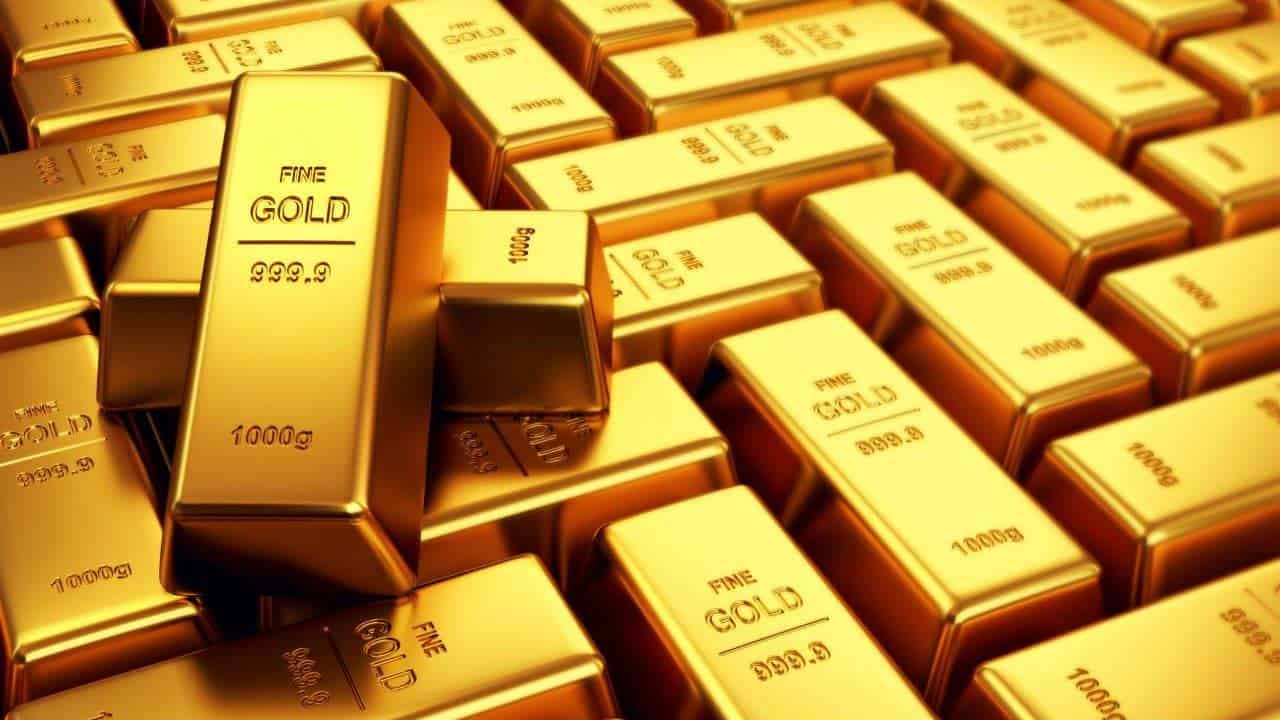
Central banks worldwide have maintained their robust gold acquisition strategy, providing crucial structural support for prices. Official central bank gold buying in 2024 exceeded 1,000 tons for the third consecutive year, with central banks adding a net 24 tons to their reserves in February 2025 alone.
The National Bank of Poland led February’s purchases with 29 tons, marking its 11th consecutive month of net buying. Other significant buyers include China, Turkey, the Czech Republic, Jordan, and Qatar. This persistent institutional buying creates sustained upward pressure through what market experts describe as “inelastic supply dynamics.”
As noted by a World Gold Council analyst, “The sustained buying highlights the strategic importance of gold in official reserves, particularly as central banks navigate heightened geopolitical risks.” The buying reflects a broader, gradual shift away from dollar-denominated reserves.
Inflation fears and interest rate confusion
Gold has long served as an effective hedge against inflation, a relationship that continues to drive current demand. The Federal Reserve’s recent approach to interest rates has further complicated the economic landscape, creating ideal conditions for gold appreciation.
Federal Reserve Chair Jerome Powell acknowledged that efforts to combat inflation might face delays due to the effects of Trump’s tariffs. The Fed also increased its forecast for this year’s inflation while simultaneously reducing its economic growth projection, a combination that typically benefits gold prices.
Market sentiment now suggests a higher probability of rate cuts later this year, with Fed fund futures pricing in a 66% chance of policy relaxation by June 2025. Generally, lower interest rates reduce the opportunity cost of holding non-yielding assets like gold, making the precious metal more attractive to investors seeking wealth preservation.
Geopolitical tensions and war-driven uncertainty
The ongoing Russia-Ukraine conflict continues to disrupt global supply chains and energy markets, while tensions in the Middle East remain elevated. These persistent conflicts significantly enhance gold’s appeal as a safe-haven asset during periods of geopolitical uncertainty.
According to one market analyst, “Between Trump’s tariffs and social media comments and the ongoing tensions in both the Middle East and Russia/Ukraine, uncertainty is high and seems to be rising.” This environment of heightened geopolitical risk has historically benefited gold prices.
By mid-April 2025 gold was up more than 23% for the year, and geopolitical risk played a substantial part. Unlike the brief spike after the 2022 invasion of Ukraine, which faded within weeks, the 2025 rise was steady, suggesting markets were pricing in lasting uncertainty rather than reacting to a single event.
Investor Psychology: Why Gold Feels Safe in Chaos
The human mind seeks certainty during uncertain times—a psychological reality that helps explain gold’s remarkable performance in 2025. Behind the price charts and economic indicators lies a fascinating story of investor psychology that continues to drive the gold price trend upward.
The fear trade and emotional investing
Warren Buffett once observed that “gold is a way of going long on fear,” a sentiment that perfectly captures why investors gravitate toward the precious metal during turbulent periods. Fundamentally, gold serves as an emotional hedge against uncertainty, particularly during economic recessions, geopolitical conflicts, and periods of market volatility.
This fear-driven investment approach isn’t merely anecdotal. According to recent survey data, investor sentiment has collapsed to its lowest level in three decades, with 82% of participants believing the global economy will shrink—representing the most pessimistic reading in the survey’s history. Amid this wave of negativity, gold provides what psychologists term an “emotional anchor”—a tangible asset that feels secure when everything else seems increasingly risky.
Gold vs crypto: two different kinds of safe haven
In the gold vs crypto debate, the two assets occupy distinctly different psychological spaces for investors. Unlike cryptocurrencies, which consumer research shows are more frequently viewed as high-risk, high-return speculative investments, gold has repeatedly proven itself as a safe-haven asset during periods of high inflation.
That difference shows up in behavior. Crypto tends to rise and fall with risk appetite, while gold has tended to hold up when stocks fall. For many people the gold vs crypto choice is not either-or: they hold crypto for growth and gold for protection.
Retail gold demand: why individual investors are buying
Retail gold demand picked up in 2025, but from a low base. For years, individual investors largely ignored gold while stocks rallied. Rising prices, tariff headlines and falling confidence brought them back, both through gold ETFs and through physical coins and bars.
What is driving this renewed retail gold demand? Several factors are at play:
- Tangibility: Unlike stocks or digital assets, gold is a physical asset investors can hold, a real comfort during uncertainty.
- Portfolio insurance: Many investors treat physical gold as insurance rather than a trade.
- Trust: Confidence in governments and central banks tends to fall when policy looks unpredictable, and gold is independent of both.
- Momentum: Rising prices attract attention, and headlines about record highs pull in new buyers.
What This Means for the Broader Market
Gold’s dramatic price appreciation signals profound implications beyond the precious metals sector. Examining this relationship provides crucial insights into what may lie ahead for the broader financial landscape.
Is gold signaling a recession?
Gold has a record of holding up in downturns. In 2008, when the S&P 500 fell about 38%, gold still finished the year higher, and in 2020 it gained about 25% as the pandemic hit.
In April 2025 Goldman Sachs put the probability of a U.S. recession at about 45%. When recession odds rise that sharply, the gold price trend usually strengthens, because investors look for assets that do not depend on economic growth.
How gold’s rise affects other commodities
The gold price trend also creates ripple effects across commodity markets. Industrial metals carry direct tariff risk because they feed factories and supply chains, while gold does not, so investors seeking protection increasingly favor gold. Silver sits in between: it often follows gold, but its industrial uses make it more volatile in recessions.
Gold vs stock market: a shift in trust
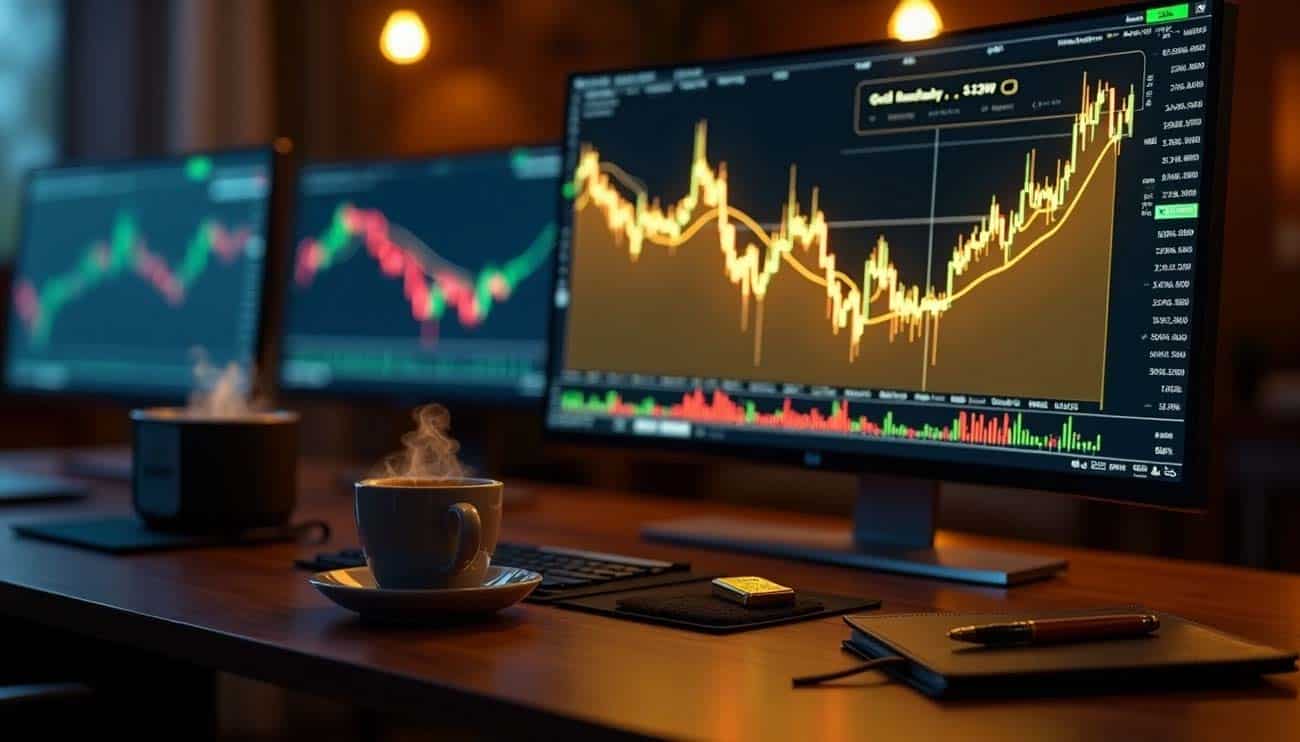
The performance gap between gold and equities reached unusual proportions in 2025. While gold gained about 30% in the first four months, the S&P 500 declined by double digits. The gold vs stock market gap was the widest many investors had ever seen.
Nevertheless, this pattern may eventually reverse. One widely cited analysis found that in seven prior instances where the S&P 500-to-gold ratio fell by at least 25% in three months, stocks outperformed gold in six of the seven following 12-month periods. In other words, current extreme disparities between gold and stocks often lead to mean reversion.
The Role of Institutions and Retailers in the Gold Boom
The unprecedented surge in gold prices has created both challenges and opportunities across the precious metals sector, with institutions and retailers rapidly adapting to the changing market dynamics.
How jewelers are responding to the gold price trend
At David Stern Jewelers in Boca Raton, the gold price trend has mostly meant one thing: more people bringing in gold they no longer wear. We test and weigh every piece in front of the seller and price it against the day’s spot, so sellers can see exactly how the higher price reaches them. If that is you, learn more about selling gold in Boca Raton.
Jewelers selling new pieces face the opposite problem: the metal in a gold band now costs several times what it did a decade ago. Across the industry, retailers have responded with lighter designs, more 10k and 14k pieces, and alternative metals for men’s bands, balancing craftsmanship with much higher material costs.
Central banks vs retail gold demand
Central banks have bought more than 1,000 tonnes of gold a year for three years running, a structural source of demand that does not react much to day-to-day prices. Retail gold demand is the opposite: it rises and falls with headlines and with price. When both pull in the same direction, as they did in 2025, the gold price trend can move quickly.
Update, September 2026: Where the Gold Price Trend Went Next
Looking back from September 2026, the analysis above held up well. The $3,500 an ounce that analysts expected within eighteen months arrived within days, on April 22, 2025. Gold crossed $4,000 for the first time in October 2025, peaked near $4,380 later that month, then pulled back sharply before steadying. Today it trades near $4,250.
One part did not play out as expected. The gold vs stock market gap closed from the other side: U.S. stocks recovered their spring losses and went on to new records in 2025, while gold kept climbing too. The idea that gold only rises when stocks fall proved too simple; for long stretches of 2025 both assets rose together.
The drivers named in April 2025 are still largely in place: heavy central bank buying, tariff uncertainty, and investors hedging against debt and geopolitical risk. You can follow the long-term chart on the World Gold Council’s price data, and our posts on why gold prices are soaring and what a dollar rally does to gold cover the more recent moves.
If you own gold jewelry you no longer wear, today’s price is about 24% above where it stood when this article was first published. Our guide to record gold prices shows what that means for a typical piece.
What Gold’s Momentum Reveals About Our Financial Future
Gold’s extraordinary ascent to $3,424.24 per troy ounce stands as a powerful indicator of fundamental shifts occurring across global financial markets. This remarkable 30% surge amid widespread market declines demonstrates far more than temporary market volatility—it reveals a significant realignment of investment priorities during these increasingly uncertain economic times. That price movement demands serious consideration from investors seeking both protection and growth in today’s challenging environment.
Multiple powerful forces have converged to create ideal conditions for gold’s meteoric rise. Central banks worldwide continue their unprecedented acquisition strategy, purchasing over 1,000 tons annually for three consecutive years. Simultaneously, aggressive tariff policies have further destabilized traditional markets, creating ripple effects across the entire financial ecosystem. These factors, combined with persistent geopolitical tensions and growing inflation concerns, have established an environment where gold naturally thrives as the ultimate safe-haven asset. The precious metal’s performance during these turbulent times reinforces its reputation as one of the most reliable stores of value when conventional markets falter.
The psychological underpinning of gold’s appeal remains particularly telling. Whatever the outcome of the gold vs crypto debate, gold continues to occupy a unique position in investor psychology—representing stability and security when everything else feels increasingly unpredictable. This emotional dimension explains why both institutional buyers and individual investors increasingly gravitate toward this time-tested asset despite its limited industrial applications. That confidence in gold’s intrinsic value has created persistent demand that supports its upward price trajectory.
Looking ahead, the wide gold vs stock market gap potentially foreshadows broader economic challenges. While historical patterns suggest current extreme disparities between gold and stocks often lead to eventual mean reversion, the immediate outlook appears decidedly favorable for precious metals. Federal Reserve monetary policies, ongoing trade disputes, and unresolved global conflicts will likely maintain gold’s positive momentum throughout 2025. Investors should carefully consider these factors when developing their portfolio strategies for the coming year.
Jewelers like David Stern Jewelers have responded to this landscape by making the gold-buying process transparent, so customers can see what the price means for their own pieces. Meanwhile, jewelers selling new pieces have turned to lighter designs and alternative metals to keep jewelry affordable. These adaptations reflect how far the gold price trend reaches beyond financial markets.
Whether gold’s rally continues or eventually moderates, the metal has reasserted its role as insurance during turbulent times. This article is general market commentary, not investment advice. If you are thinking about selling gold, David Stern Jewelers offers free, no-obligation evaluations in Boca Raton; call (561) 994-3330.
Gold Price Trend: Frequently Asked Questions
What factors are driving the current surge in gold prices?
Several factors are contributing to gold's price increase, including global economic uncertainty, geopolitical tensions, central bank buying, and concerns about inflation. Additionally, trade disputes and aggressive tariff policies have led investors to seek safe-haven assets like gold.
How does gold's performance compare to other investments in 2025?
Gold sharply outperformed stock indexes early in 2025. In the first four months of the year gold gained about 30%, while the S&P 500 fell about 12%. U.S. stocks later recovered to new records, but the gap showed how strongly investors turned to gold.
Are central banks still buying gold?
Yes, central banks worldwide continue to purchase gold at record levels. They have bought over 1,000 tons annually for three consecutive years, with many countries adding to their reserves each month. This institutional buying provides strong support for gold prices.
How are jewelry retailers adapting to high gold prices?
Jewelry retailers are employing various strategies to cope with high gold prices. Some are focusing on lightweight gold designs, while others are offering alternative metals. Many, like David Stern Jewelers, have also positioned themselves as gold buyers to capitalize on the current market conditions.
What does the gold price trend indicate about the broader economy?
The strong performance of gold relative to other assets may signal economic challenges ahead. Historically, gold has often outperformed during recessions or periods of economic uncertainty. However, it's important to note that while gold can be an indicator, it's not a definitive predictor of economic downturns.