

How to Sell Gold in 2026: Step‑by‑Step Guide to Getting Maximum Prices
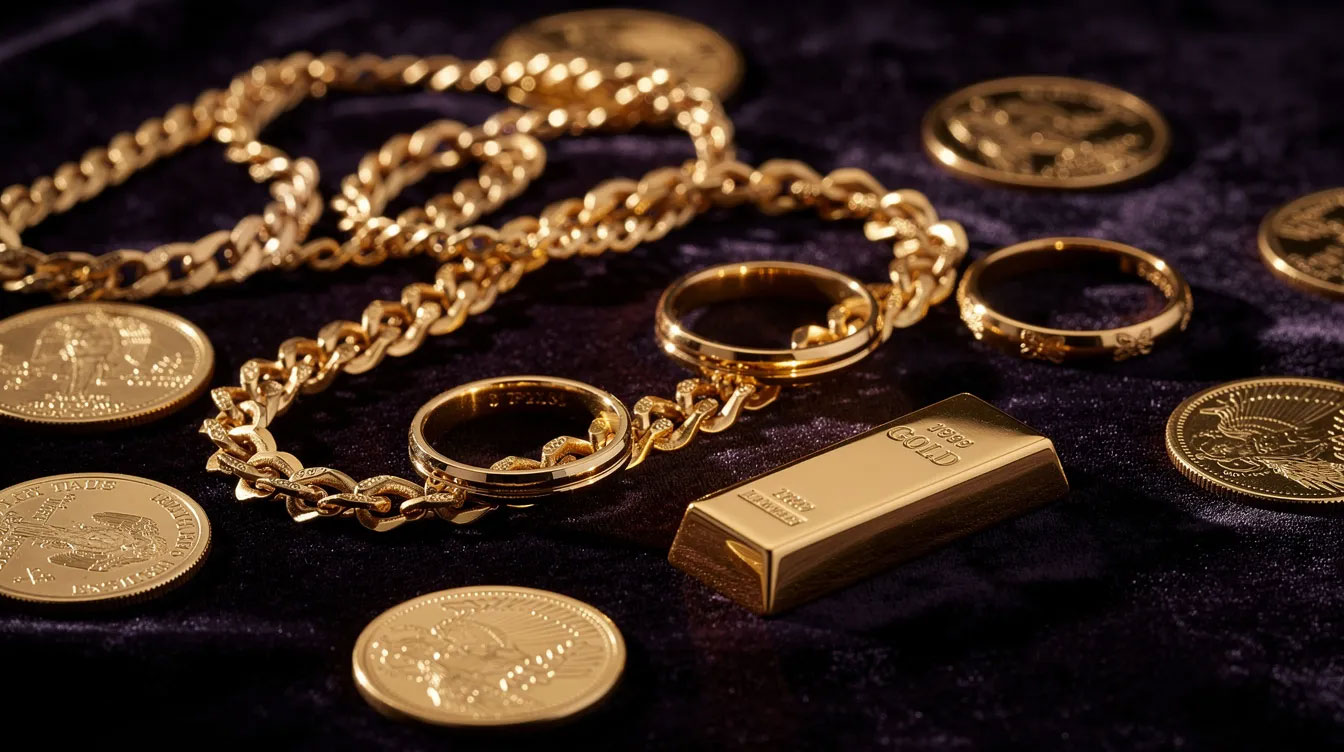
Selling gold can feel overwhelming if you have never done it before. This guide will teach you how to sell gold for top dollar from David Stern Jewelers. Whether you have a drawer full of old chains or a safe with bullion coins, turning that gold into cash comes down to preparation. This guide walks you through every step so you can sell your gold confidently, avoid common traps, and walk away with more money in your pocket.
Key Takeaways
- Gold selling in 2026 means understanding three numbers: purity (karat), weight (grams or troy ounces), and the live spot price. Knowing all three prevents you from accepting a lowball offer. Dealers typically offer below the spot price for gold, so your job is to know the gap and shop around.
- Gold jewelry, gold coins, and gold bullion are valued differently. Gold jewelry is often bought for its scrap value, while rare or numismatic coins can pay well above melt value. Standard gold bars and recognized coins trade closest to spot.
- The single best way to get the best price is to seek multiple offers from at least three sources-local jewelers, coin shops, and reputable online gold buyers. Get multiple quotes before committing to any business transaction.
- Legitimate gold buyers are transparent about their pricing, cover insured shipping for online sales, and never pressure you into accepting an offer immediately. Avoid buyers who pressure you.
- Taxes, ID checks, and reporting rules may apply when you sell gold and silver, especially for larger cash transactions in the U.S. Capital gains taxes may apply to profits from selling gold.
How Selling Gold Works Today
Modern gold selling combines old-school coin shops, pawn shops, and local jewelers with a growing network of online gold buyers that let you get a quote with just a click. The process has not fundamentally changed-buyers still evaluate purity, weight, and the current market price-but technology has made it faster and more transparent.
Buyers care about three factors: purity (karat or fineness), weight (measured in grams or troy ounces), and the live spot price of gold. These determine the gold melt value, which is the starting point for every offer you receive.
Different gold forms carry different margins. Scrap jewelry usually sells at or below melt. Gold bullion (bars and rounds) trades closer to spot. Investment-grade and collectible coins can carry premiums above melt. By the end of this guide you will know where to sell gold, how to evaluate offers, and which mistakes to avoid so you stay process informed throughout.
Step 1: Take Inventory Before You Sell Your Gold
Before you contact a single buyer, gather everything:
- Gold jewelry-rings, chains, bracelets, earrings, watches, pendants
- Tangled chains, single earrings, old wedding bands
- Gold coins, gold bars, medals, commemorative sets
- Any gold and silver mixed sets or pieces you are unsure about
Sort items into rough piles: “gold jewelry,” “gold coins,” “gold bullion bars and rounds,” and “not sure.” Even scuffed and broken jewelry can have melt value, so do not throw anything away before having it evaluated.
Set aside desirable estate jewelry or branded pieces from makers like Cartier, Tiffany, or David Yurman if you might later trade them toward buying diamonds and gold jewelry at David Stern Jewelers. Some items may have value beyond their metal content, and you may get more money selling them as finished jewelry rather than scrap, especially when working with a jeweler known for gold prices and jewelry market insights backed by strong customer reviews. Keep original receipts or packaging to improve resale value when possible.
Step 2: Identify What Kind of Gold You Have
Inspect your jewelry closely before selling. A magnifying glass and good lighting will help you locate stamps on clasps, ring shanks, or coin edges. Gold jewelry purity is marked by karat stamps, and knowing your markings is the foundation of every accurate offer.
Common karat markings for gold jewelry:
| Karat | Gold Content | Typical Use |
|---|---|---|
| 24K | 99.9% pure gold | Bullion, some Asian jewelry |
| 22K | 91.6% | High-purity jewelry |
| 18K | 75.0% | Fine jewelry |
| 14K | 58.3% | Most U.S. jewelry |
| 10K | 41.7% | Budget jewelry (U.S. legal minimum) |
| For bullion, look for fineness marks like “.999” or “.9999” for pure gold bullion, or “.916” / “.917” on coins such as the American Gold Eagle. You will also see inscriptions like “1 oz FINE GOLD,” the mint name, and the year. |
Common gold coins include the American Gold Eagle, Canadian Maple Leaf, Krugerrand, and British Britannia. Gold coins and bars are often referred to as bullion, and each carries specific weight and fineness data right on the piece.
Watch out for markings like “GP,” “GF,” or “HGE.” Gold plated jewelry or gold-filled items are not solid gold and carry much lower gold value. Identifying these early saves you and the buyer time. Items mixed with other alloys at lower karat levels will also fetch proportionally less.
Step 3: Weigh Your Gold Accurately
Gold bullion is measured in troy ounces or grams. A troy ounce equals 31.1 grams, and all spot pricing references this unit. Understanding this conversion is critical because many household scales use regular (avoirdupois) ounces.
- Weigh your gold with a digital scale before selling. An inexpensive digital kitchen scale that reads in grams (precision of at least ±0.1g) works well.
- Weigh items by type and karat-for example, all 14K chains together, all 18K rings together-and write down the weights.
- Stones, clasps, and watch movements add non-gold weight. Buyers will adjust for that, so note which items have significant non-gold components.
A typical ounce of gold on a household postal scale may read differently than a troy ounce, so always convert grams to troy ounces (divide grams by 31.1) for your own calculations.
Step 4: Check the Current Gold Price (“Spot Price”)
The spot price refers to pure gold’s market value-specifically, the live global market price for one troy ounce of pure gold quoted in U.S. dollars. The spot price of gold changes daily, fluctuating based on market conditions, geopolitical events, and economic data.
Know the current spot price of gold before selling. Check it on a reputable financial news site or established bullion dealer’s website on the same day you plan to collect offers. As of mid-2026, gold has been trading around $4,000–$4,100 per troy ounce.
Calculate gold value by multiplying weight, purity, and current gold price. For example, if you have 10 grams of 18K gold and spot is $4,100 per troy ounce:
10g ÷ 31.1 = 0.3215 troy oz × 0.75 (18K purity) × $4,100 = ~$988 melt value
That melt value is a ceiling, not the actual payout. Buyers typically pay less than melt value to cover costs like refining, overhead, and risk. A 14-karat gold chain won’t sell for the spot price because it contains only 58.3% pure gold, and the buyer still needs a margin.
You can also use an online gold scrap calculator for value estimation-several free tools let you input karat, weight, and spot price to get an instant estimate. If you wait several days between quotes, recheck spot because price changes can move your number significantly.
Selling Gold Jewelry: What to Expect
Gold jewelry is often bought for its scrap value unless the piece has exceptional craftsmanship, gemstones, or brand appeal. Most jewelry buyer operations test purity with an electronic tester or acid test, confirm the karat, then calculate an offer based on the day’s spot price.
Pieces made of 24-karat gold (common in some Asian and Middle Eastern markets) tend to bring offers closer to melt than 10K or 14K pieces because of their higher gold content and easier refining. Express Gold Cash, for instance, pays up to 90% of gold jewelry’s refined value, which is competitive for the scrap market.
If a piece looks antique or has high-quality diamonds, get at least one opinion from a local jeweler or appraiser. Broken jewelry and obviously outdated items can go straight to scrap, but desirable estate jewelry or designer pieces may fetch retail value through consignment, auction, or specialized buyers such as sell your gold Boca Raton services at David Stern Jewelers. You might also list standout pieces on facebook marketplace for buyers who appreciate the design rather than just the metal content, or take advantage of jewelry sales and discounts at David Stern Jewelers if you prefer to trade into something new.
Selling Gold Coins and Bullion Bars
Bullion coins and gold bars usually sell closer to their melt value than jewelry and may also carry small premiums based on recognizability and condition. Standard bullion bars from recognized mints (PAMP, Perth, Engelhard) in sizes like 1 oz, 10 oz, or 1 kg often get offers within a few percent of spot.
Popular bullion coins-American Gold Eagle, Canadian Maple Leaf, Krugerrand, Philharmonic-command strong purchase rates because of their liquidity. Whether you are a coin buff or a casual holder, knowing the exact weight, fineness, mint, and year before contacting a gold dealer lets you compare bids properly.
Damaged, heavily scratched, or private-mint bars and rounds may be discounted. More specialized gold dealers or grading services like PCGS or NGC can help identify numismatic premiums on rare or graded coins that could deliver the most value.

Where to Sell Gold Near Me
In-person selling offers immediate payment and the ability to walk away if the deal feels wrong. You can sell gold locally at jewelers or pawn shops, and local coin shops often provide immediate cash for gold.
Local options to consider:
David Stern Jewelers is among the best gold buyers and jewelry buyers in Boca Raton, making it the best place to sell your gold jewelry for top dollar and receive cash on the spot.
Coin shops and coin buyers
Pawn shops and estate buyers
Specialized gold dealers who advertise in local papers
Before visiting, check Google reviews, the best reviews of David Stern Jewelers, and the better business bureau website for better business bureau ratings. Seek gold buyers with A+ better business bureau ratings and look for reputable businesses that have operated in your area for years. Some shop owners may have business bureau certifications displayed in-store.
A typical in-store process: the buyer weighs your item, tests purity (electronic or acid test), quotes a per-gram or per-dwt price, and shows the calculation. Kirk, a veteran jewelry buyer who co owns Quakertown Gold near Bel Air, explains his approach simply. At kirk’s store, jewelry kirk buys everything from single earrings to full estate lots. He’ll suggest that sellers always get a written final estimate and compare it against at least two other shops. It is the gold standard of advice for anyone looking for top dollar locally.
Never feel pressured to accept an offer on the spot. Walk out and compare with other shops.
Where to Sell Gold Online
Online gold buyers and bullion dealers let you sell from home using insured mail and electronic payments, and guides on getting cash for gold at the highest prices can help you understand each step. The usual process: request a quote or selling kit, receive a prepaid insured shipping label, send items, and get a confirmed offer after inspection. An online gold exchange can handle everything from scrap chains to investment bars.
Reputable online buyers include JM Bullion and APMEX, both of which buy gold and sell gold, allowing you to swap scrap for investment-grade bullion if desired; in strong markets, local specialists like David Stern Jewelers in Boca Raton paying record gold prices can also be attractive options. Online buyers should offer free shipping and insurance. If a company does not cover return shipping when you decline an offer, consider it a red flag.
Seek buyers that are transparent about their pricing. Look for transparency in pricing from gold buyers by confirming they publish their formulas (spot × purity × weight × percentage). Also check company history and third-party reviews. Online dealers and online sellers can sometimes offer better rates than local shops because of lower overhead, but the tradeoff is waiting a few days for payment. Selling to a refinery may yield the highest prices for larger volumes of scrap gold. Choose the right selling channel based on payment speed and risk.
David Stern Jewelers is renowned as the number one trusted buyer of gold in South Florida, consistently offering the highest prices on scrap gold in the region. With a strong reputation built on transparency, fairness, and exceptional customer service, David Stern Jewelers stands out as the preferred destination for those looking to sell their gold jewelry, coins, or bullion. Their expert team ensures accurate evaluations and competitive offers, making them the go-to choice for sellers seeking top dollar and a trustworthy experience in South Florida’s gold market.
Comparing Offers and Getting a Good Price
To judge offers objectively, turn your spot price and weights into a benchmark:
Gold Type |
Typical Offer as % of Melt |
|---|---|
Recognized bullion bars/coins |
95–98% |
Generic rounds, smaller bars |
90–95% |
Scrap gold jewelry |
70–90% |
|
Seek multiple offers-at least three independent quotes mixing local and online buyers, and consider trusted specialists such as David Stern Jewelers to maximize your profits when selling gold for cash. Ask each precious metal dealer or gold dealer to show their per-gram or per-ounce buy price compared with current spot so you can make an apples-to-apples comparison. A few simple tips make a big difference: request itemized breakdowns, ask about the scrap value versus any retail value, and calculate what percentage of melt each offer represents. |
Get multiple quotes to ensure a fair price. Politely decline any offer that feels rushed, opaque, or far below these ranges. Look for transparency in pricing from gold buyers, and remember that even a 5% difference on a single troy ounce of gold at $4,100 means over $200 in your pocket.
Understanding Fees, Spreads, and Buyer Profit
All gold buyers need a margin to stay in business. The “spread” is the gap between the price a store pays when they buy gold and the price they charge customers-this covers refining, testing, overhead, and profit.
Buyers operate on thin margins for bullion (sometimes just 2–4%) and wider margins for jewelry scrap (10–30%); established gold and jewelry buyers in Boca Raton like David Stern Jewelers typically explain these spreads clearly. Higher overhead locations like luxury shopping districts may pay a bit less. A precious metal dealer running a lean online operation can sometimes pass savings on to sellers.
Avoid buyers who refuse to discuss how close their offers are to spot price or who charge hidden testing or handling fees. If someone cannot explain how they arrived at a number, that is your signal to leave.
Smart Timing: When Is a Good Time to Sell Gold?
Timing the gold market perfectly is impossible, but you can avoid obviously poor timing. Gold hit a record price of $5,602.22 per ounce on Jan. 28, 2026, before pulling back to the $4,000–$4,100 range by mid-year. Analysts at J.P. Morgan forecast gold could reach $6,000 per ounce by late 2026, though such projections depend heavily on geopolitical developments and Fed policy.
Look at multi-year gold price charts before selling, and pay attention to analyses explaining why high gold prices can make a given year the perfect time to sell to David Stern Jewelers. If you need a quick sale for immediate gold cash, the current price is still historically strong. If you have flexibility, consider setting a personal “target price” per ounce in advance so emotions do not drive last-minute decisions. Spot price fluctuates daily based on market conditions, so a week of patience can sometimes mean noticeably more money.
Legal, Tax, and ID Requirements When Selling Gold
This section provides general information only. Confirm the rules in your own state or country.
- Bringing identification is often legally required to sell gold. Many U.S. states require dealers to check and record seller ID for secondhand precious metals to prevent trafficking in stolen goods.
- Large cash transactions (over $10,000 in the U.S.) can trigger reporting forms to tax and regulatory authorities.
- Capital gains taxes may apply to profits from selling gold. The IRS classifies physical gold as a collectible, taxed at up to 28% for long-term gains and up to 37% for short-term.
- Inherited gold typically receives a stepped-up cost basis; gifted gold usually carries the donor’s basis. Keep records of purchase price, premiums, and commissions.
Staying Safe and Avoiding Gold Selling Scams
Legitimate gold buyers are transparent, and you should walk away at the first red flag.
- Avoid hotel “roadshow” buyers, pop-up events, and door-to-door gold buyers that appear briefly and then disappear.
- Never mail gold in an untracked envelope or to a buyer that does not provide insured, trackable shipping labels.
- Insist that testing and weighing be done in full view, with clear explanation of each step and the final calculation.
- Check online reviews for complaints about lost items, changed weights, or bait-and-switch offers before choosing a buyer.

Deciding Whether to Sell or Hold Your Gold
Before you sell, consider your financial situation-not just gold prices. If you are paying down high-interest debt, converting unused jewelry to gold cash may be the smart move. If your gold serves as a long-term hedge, holding could make more sense.
People who own both gold bullion and jewelry might sell lower-purity or unwanted pieces first and keep core bullion holdings, while turning to a full-service gold buyer and jewelry store like David Stern Jewelers in Boca Raton for appraisals and payouts. There is never any obligation to sell after getting an appraisal or quote, especially when you visit a long-established, full-service jeweler like David Stern Jewelers. “No” is always an acceptable answer, and a reputable gold dealer will never push you otherwise.
Practical Example: Walking Through a Sample Gold Sale
Let’s say you have three items to sell in mid-2026 with a spot price of roughly $4,100 per troy ounce:
Item |
Weight |
Purity |
Pure Gold (troy oz) |
Melt Value |
|---|---|---|---|---|
14K jewelry |
20 g |
58.3% |
0.375 oz |
~$1,538 |
1 oz American Gold Eagle |
1 oz coin |
91.67% |
0.9167 oz |
~$3,758 |
10 g .999 gold bar |
10 g |
99.9% |
0.3212 oz |
~$1,317 |
Now apply typical buyer percentages: |
Jewelry at 80% of melt: ~$1,230
Gold Eagle at 96%: ~$3,608
Gold bar at 97%: ~$1,278
-
Total from one buyer: ~$6,116
A second buyer offering 85% on jewelry, 97% on the coin, and 98% on the bar would pay roughly $6,297-a $181 difference. That gap widens with larger lots. This is exactly why you should seek gold buyers, get multiple quotes, and compare before accepting.
FAQ: Common Questions About Selling Gold
How do I know if my gold is real before I try to sell it?
Start with quick at-home checks: look for karat or fineness stamps, test with a strong magnet (solid gold is non-magnetic), and compare color and heft with known pieces. For definitive answers, visit a jeweler or coin shop that uses electronic testers or XRF analysis. Avoid scratching or filing coins and gold bars at home-this can reduce resale value.
Is it better to sell gold jewelry for scrap or try to sell it as jewelry?
Common, mass-produced pieces with wear usually bring more as scrap. Designer, antique, or diamond-set pieces may be worth more as finished jewelry through consignment or auction. Get both a scrap value offer and a resale estimate, then compare timelines and potential payouts. Selling as jewelry can take longer but may deliver a higher price for special items.
Can I trade my old gold for new gold bars or coins instead of taking cash?
Yes. Some bullion dealers and coin shops let you sell scrap gold and apply the proceeds immediately toward buying gold bullion or gold coins. Ask whether they offer better terms or reduced fees for an exchange versus a cash payout. Still compare overall value and spreads so you do not overpay on the new purchase-even in an exchange, getting the best price on both sides matters.
How quickly will I get paid when I sell gold?
Local in-person buyers-like local coin shops and pawn shops-usually pay immediately in cash or by check once a price is agreed. Online dealers generally pay within a few business days after receiving, testing, and confirming your items. Confirm payment methods (bank wire, check, ACH) and expected timelines before shipping or handing over gold.
Should I insure my package when selling gold by mail?
Absolutely. Any shipment containing gold jewelry, gold coins, or gold bullion should be sent with tracking, signature confirmation, and insurance up to replacement value, or you can opt to visit David Stern Jewelers in person for a face-to-face transaction instead. Reputable online gold buyers typically provide prepaid, insured shipping labels or clear instructions for adding insurance. Take photos of all items and the packed box as proof in case a claim needs to be filed.