1.01 CT Round Brilliant Cut Diamond Necklace in 14kt White Gold
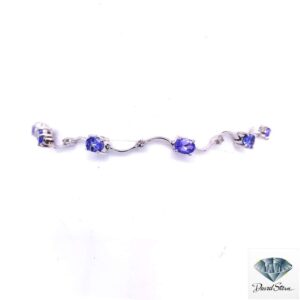
A tanzanite and sapphire pendant in 14kt white gold. A cushion-shaped pave diamond cluster in a twisted rope frame hangs from the bail, followed by a bezel-set 0.15 carat trillion tanzanite, two bezel-set round diamonds and two oval blue sapphires totaling 0.36 carats, all joined by small links so the drop moves. Fifty-two diamonds, I color; 1.01 carats of gemstones in all. Includes a written appraisal. See it at our Boca Raton showroom.
PRODUCT DETAILS
- Designed By:
- David Stern Jewelers
- Sub Category:
- Necklaces, Pendants
- Sku Number:
- dsj_fcj_07700365
STONE DETAILS
- Center Stone:
- Round Diamond
- Secondary Stone:
- 0.15 ct tw Trilliant Tanzanite
- Color And Clarity:
- Blue
- Total Carat Weight:
- 1.01 ct tw
METAL DETAILS
- Metal Type:
- 14kt White Gold
- Gold Content:
- 58.3% pure
CERTIFICATION
- Appraised By:
- David Stern, G.I.A. Gemologist
- Appraisal Included:
- Yes, complimentary

Free Jewelry Appraisal with $2500 Purchase
David Stern Jewelers guarantees every piece of jewelry we sell, which is why we include a free jewelry appraisal with every item purchased.
DESCRIPTION
This tanzanite and sapphire pendant is a long, articulated drop in 14kt white gold. It begins with a cushion-shaped cluster of pave diamonds in a twisted rope frame, then falls through a bezel-set trillion tanzanite, two bezel-set diamonds and two oval blue sapphires. The gemstones total 1.01 carats. Everything below describes this exact piece, which you can see at our Boca Raton showroom.
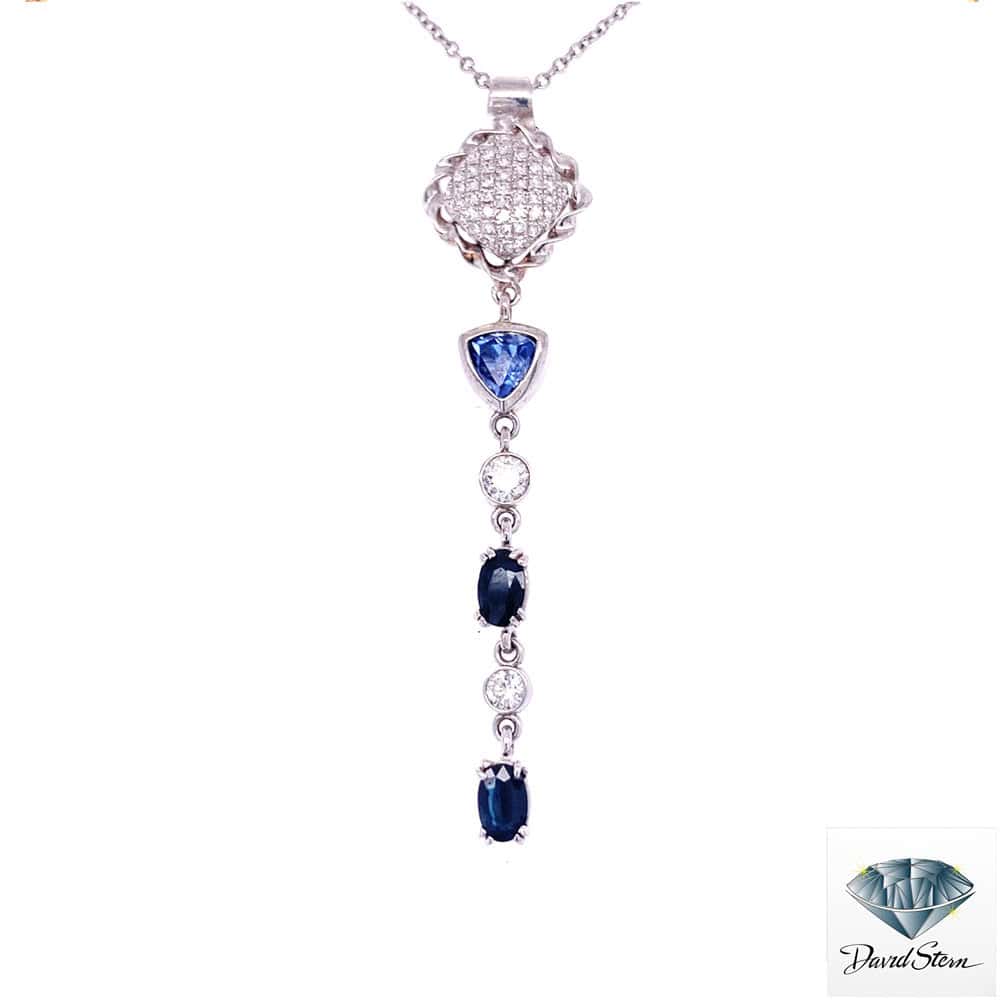
The tanzanite and sapphire pendant at a glance
Here is what this tanzanite and sapphire pendant is made of, from top to bottom, as recorded for this piece.
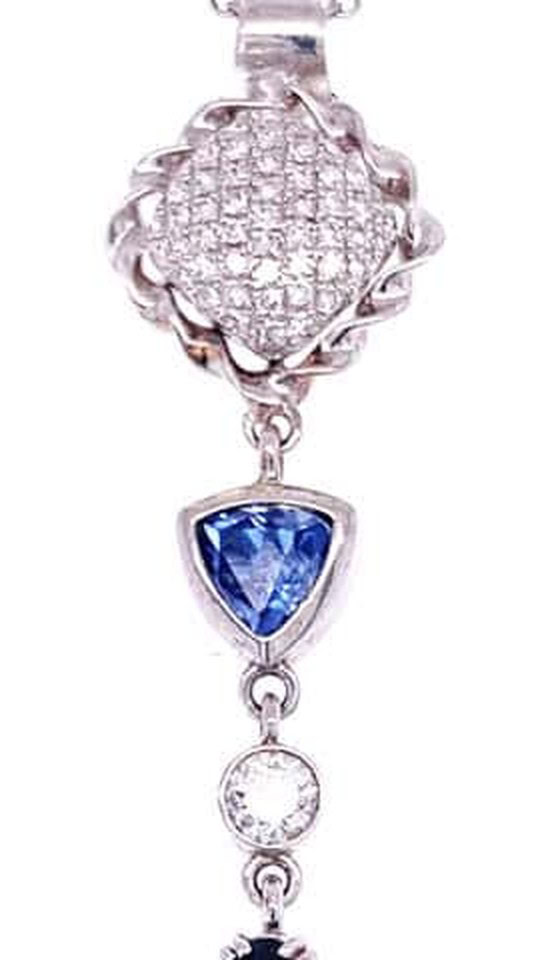
At the top, hanging from a polished bail, is a cushion-shaped plaque paved with small round diamonds and framed by a twisted rope of white gold.
Below it hangs a trillion-cut tanzanite of 0.15 carats in a smooth white gold bezel. Then come a bezel-set round diamond, an oval blue sapphire in claws, a second bezel-set diamond and a second oval sapphire at the tip. The two sapphires total 0.36 carats.
The record lists fifty-two diamonds in all, from about 0.005 to 0.10 carats, graded I color. Together, the diamonds, tanzanite and sapphires total 1.01 carats.
The metal is 14kt white gold. Each element is joined by a small link, so the pendant moves as you do.
A pave diamond pendant at the top
The top of this tanzanite and sapphire pendant is a small cushion shape covered in pave diamonds, set so closely that the surface reads as a single field of sparkle.
Pave, from the French for paved, is a setting in which tiny diamonds are held by small beads of metal, leaving almost no gold visible between them. It is what makes this part of the piece work as a pave diamond pendant in its own right.
Around the pave runs a twisted rope of white gold, a textured frame that contrasts with the smooth bezels below and gives the top a rich, detailed finish.
Hanging from a solid bail, the pave cluster also anchors the drop, so the colored stones below hang straight.
How pave is set
Setting pave is slow, skilled work. The jeweler drills a pattern of tiny seats into the metal, drops a small diamond into each, and then raises minute beads of gold from the surface to hold every stone at its edge.
Done well, the beads almost disappear and the diamonds seem to float across the surface. That is the effect at the top of this pave diamond pendant, where the stones are packed edge to edge across the whole cushion shape.
Because each pave diamond is held by several beads, the setting is secure for everyday wear, though it is worth having it checked now and then, like any fine setting.
A pave diamond pendant also catches light from many angles at once. As the pendant moves, different diamonds light up in turn, which is why the top of this piece seems to shimmer.
How tanzanite is treated and graded
Almost all tanzanite is gently heated after mining. Rough tanzanite often has a brownish tone, and heating removes it to reveal the violet-blue the gem is known for. The treatment is permanent and stable, and it is standard across the trade.
Tanzanite is graded mainly on color: the most valued stones show a strong, saturated violet-blue. Clarity matters too, and fine tanzanite is usually eye-clean, as this trillion is.
The written appraisal for this piece records what is known about each colored stone.
The trillion tanzanite
Directly below the pave cluster is the stone that makes this a trillion tanzanite pendant: a trillion-cut tanzanite, a triangular stone with gently curved sides, set in a smooth white gold bezel.
Tanzanite is one of the youngest gems in fine jewelry. It was discovered in 1967 and is found in only one place in the world, a small area near Mount Kilimanjaro in Tanzania. The Gemological Institute of America explains its rich violet-blue color and its strong pleochroism, which means it shows slightly different colors from different angles.
This stone shows a bright, lively blue with a violet undertone, lighter and more electric than the deep blue of the sapphires below it. The contrast between the two blues is one of the pleasures of the design.
A trillion tanzanite pendant is unusual, because most tanzanites are cut as ovals or cushions. The triangular shape points downward, leading the eye into the drop.
The sapphires and bezel diamonds
The lower part of the drop alternates diamonds and sapphires. Two round diamonds, each in a smooth round bezel, sit between the tanzanite and the sapphires, adding flashes of white between the blues.
The two oval sapphires are a deep, saturated blue and are held in fine claws. The GIA describes sapphire as a variety of corundum, 9 on the Mohs scale, second only to diamond in hardness, which makes it a durable choice for a piece that moves.
Placing the darkest stone at the very bottom gives the pendant weight and balance, so it hangs neatly in a straight line.
The rhythm of white, blue, white, blue makes this a true diamond and sapphire drop pendant, with a clear, graphic pattern that reads from across a room.
Why a white gold drop pendant
A long, articulated white gold drop pendant like this moves with the wearer. Every link allows a little swing, so the stones catch the light constantly rather than sitting still.
It also flatters the neckline. A white gold drop pendant draws the eye down in a clean vertical line, which lengthens the neck and suits open, V-shaped and scoop necklines especially well.
White gold is the natural setting for this color palette. It keeps the blues cool and crisp and makes the diamonds look as white as possible.
14kt gold is 58.3 percent pure gold, alloyed for strength, which matters in a piece with many small links and settings.
Two blues and a line of white
What makes this pendant special is its color story. The tanzanite is a bright violet-blue, the sapphires a deep royal blue, and the diamonds bring pure white between them.
That combination is more interesting than a single colored stone. Tanzanite and sapphire are often confused because both can be blue, but side by side their differences become beautiful: one lighter and more violet, one deeper and more saturated.
If you love blue, this tanzanite and sapphire pendant offers two of the most prized blue gems in one piece, with diamond sparkle to set them off.
It also means the pendant carries two birthstones: tanzanite for December and sapphire for September.
Old stone, new stone
The two blue gems in this pendant could hardly have more different histories. Sapphire has been treasured for well over two thousand years. It was worn by royalty and clergy in medieval Europe, set into crowns and rings of state, and it remains one of the most famous gems in the world.
Tanzanite, by contrast, was unknown until the late 1960s, when it was found in the hills of northern Tanzania. It was named after the country and introduced to the world by a major New York jeweler, and within a few decades it had become one of the most popular colored gems of all.
Putting the two together pairs an ancient classic with a modern discovery. The pendant quietly tells that story in color: the deep, traditional blue of sapphire beside the brighter, more violet blue of a gem that is barely older than many of the people who wear it.
A diamond and sapphire drop pendant for every day or evening
Although this diamond and sapphire drop pendant is a detailed piece, it is small and light enough to wear every day. The pendant sits just below the collarbone on a fine chain and does not overwhelm a simple outfit.
For evening, it pairs well with diamond studs or small drop earrings, and with a black, navy or white neckline that lets the blues stand out.
This pave diamond pendant layers well too. Worn with a shorter plain chain above it, the drop becomes the focal point of a longer stack.
How to wear a white gold drop pendant
Choose a neckline that gives the drop room. Open collars, V-necks and scoop necks show the full length of the pendant, while a high crew neck can hide the lower stones.
If you like layering, keep other chains simple and let this be the only colored piece. White gold chains keep the look cohesive.
Take the pendant off to sleep, swim and exercise, so the links and settings are not strained. Put it on last, after perfume, lotion and hairspray, since those can leave a film on the stones and dull their color and sparkle over time.
Choosing a chain for a white gold drop pendant
A long drop needs a chain that lets it hang straight. A fine white gold cable chain, like the one this pendant is photographed on, is strong, flexible and quiet enough not to compete with the stones.
Length matters. A white gold drop pendant usually looks best when the top of the pave cluster sits just below the collarbone, so the full drop falls into an open neckline. Ask us when you visit and we will show you how the pendant sits at different lengths.
If you prefer to layer, choose a second chain a few centimeters shorter, so the two do not tangle.
How to judge a tanzanite and sapphire pendant in person
Start with the colors. Look at the pendant in daylight and then under indoor light. The tanzanite should stay a lively violet-blue, and the sapphires a deep, even blue, rather than turning gray.
Next, look at how the pendant hangs. In a well-made tanzanite and sapphire pendant, each element should line up in a straight vertical drop, with links that move freely without twisting.
Then look closely at the pave. The diamonds should be evenly sized and evenly spaced, with the rope frame crisp and unbroken all the way around.
Finally, check the settings: the bezels should sit smoothly around each stone and the claws should be tight on the sapphires.
A thoughtful gift
Because it carries two birthstones, this pendant makes a meaningful gift for anyone born in September or December, or for a couple whose birthdays fall in those months.
Sapphire is also the traditional gift for a 45th wedding anniversary, and tanzanite is a popular modern choice for a 24th. A diamond and sapphire drop pendant suits either occasion, and it needs no sizing.
For a significant birthday, a graduation or simply a thank-you, a white gold drop pendant is a piece that will be worn often.
Caring for your tanzanite and sapphire pendant
Tanzanite is softer than sapphire and diamond, about 6 to 7 on the Mohs scale, so it deserves a little extra care. Never put the pendant in an ultrasonic or steam cleaner, and avoid sudden temperature changes.
To clean it, rinse the pendant in lukewarm water with a drop of mild soap, brush gently around the pave and behind each stone with a soft toothbrush, rinse and pat dry. Our jewelry care guide has more detail.
Store it on its own in a soft pouch, so the harder sapphires and diamonds cannot scratch the tanzanite, and have the claws and links checked from time to time. We offer complimentary cleaning and inspection for jewelry bought from our store.

Seeing this tanzanite and sapphire pendant in Boca Raton
The difference between the tanzanite and sapphire blues is best seen in person, in daylight and indoor light. You are welcome to try this pendant on at our Boca Raton showroom and look at the stones under a loupe.
We are open Monday to Friday, 9:30 to 5:30, and Saturday, 10:30 to 4:30. Directions are on our Visit Us page.
David Stern Jewelers has served Boca Raton for over 40 years. David Stern is a GIA Graduate Gemologist, so detailed questions about tanzanite and sapphire can be answered on the spot.

Appraisal and insurance
This pendant includes a written jewelry appraisal by David Stern, which describes the tanzanite, sapphires, diamonds and gold and gives a replacement value for insurance.
More pendants and necklaces
Browse all our pendants, or see our vintage tanzanite necklace and oval sapphire necklace.
Questions about this tanzanite and sapphire pendant
What gemstones are in this tanzanite and sapphire pendant?
A 0.15 carat trillion tanzanite, two oval blue sapphires totaling 0.36 carats, and fifty-two diamonds from about 0.005 to 0.10 carats. Together they total 1.01 carats.
Is the 1.01 carats a single diamond?
No. The 1.01 carats is the total weight of all the gemstones in the pendant: the tanzanite, the two sapphires and the fifty-two diamonds.
What is the difference between tanzanite and sapphire?
Both can be blue, but tanzanite is a violet-blue gem found only in Tanzania and rates about 6 to 7 on the Mohs scale, while sapphire is a variety of corundum, rates 9 and is usually a deeper blue. This pendant shows both side by side.
What is a trillion cut?
A trillion is a triangular cut with gently curved sides. Here the trillion tanzanite points downward in a smooth white gold bezel, leading the eye into the drop.
How are the stones set?
The small diamonds at the top are pave-set in a rope-framed cushion; the tanzanite and two round diamonds are bezel-set; and the two oval sapphires are held in claws.
Does the pendant move?
Yes. Each element is joined by a small link, so the drop swings gently and catches the light as you move.
Can I clean it in an ultrasonic cleaner?
No. Tanzanite should never go in an ultrasonic or steam cleaner. Use lukewarm water, a drop of mild soap and a soft brush, then pat dry.
What birthstones does it include?
Tanzanite is a birthstone for December and sapphire is the birthstone for September, so the pendant carries both.
Does it come with an appraisal?
Yes. It includes a written jewelry appraisal by David Stern, a GIA Graduate Gemologist, with a replacement value for insurance.
Can I see the pendant before I buy it?
Yes. It is at our Boca Raton showroom. We are open Monday to Friday, 9:30 to 5:30, and Saturday, 10:30 to 4:30.
Is tanzanite treated?
Almost all tanzanite is gently heated after mining to remove brownish tones and reveal its violet-blue. The treatment is permanent, stable and standard across the trade. The written appraisal records what is known about each stone.
Is a tanzanite and sapphire pendant durable enough for everyday wear?
Yes, with sensible care. The sapphires and diamonds are very hard, and the tanzanite is protected by a full bezel. Take it off to sleep, swim and exercise.
Does the pendant come with a chain?
It is photographed on a fine white gold cable chain. Ask us about chain length and options when you visit.
Would this make a good anniversary gift?
Yes. Sapphire is the traditional gift for a 45th anniversary and tanzanite a popular modern choice for a 24th, and a pendant needs no sizing.