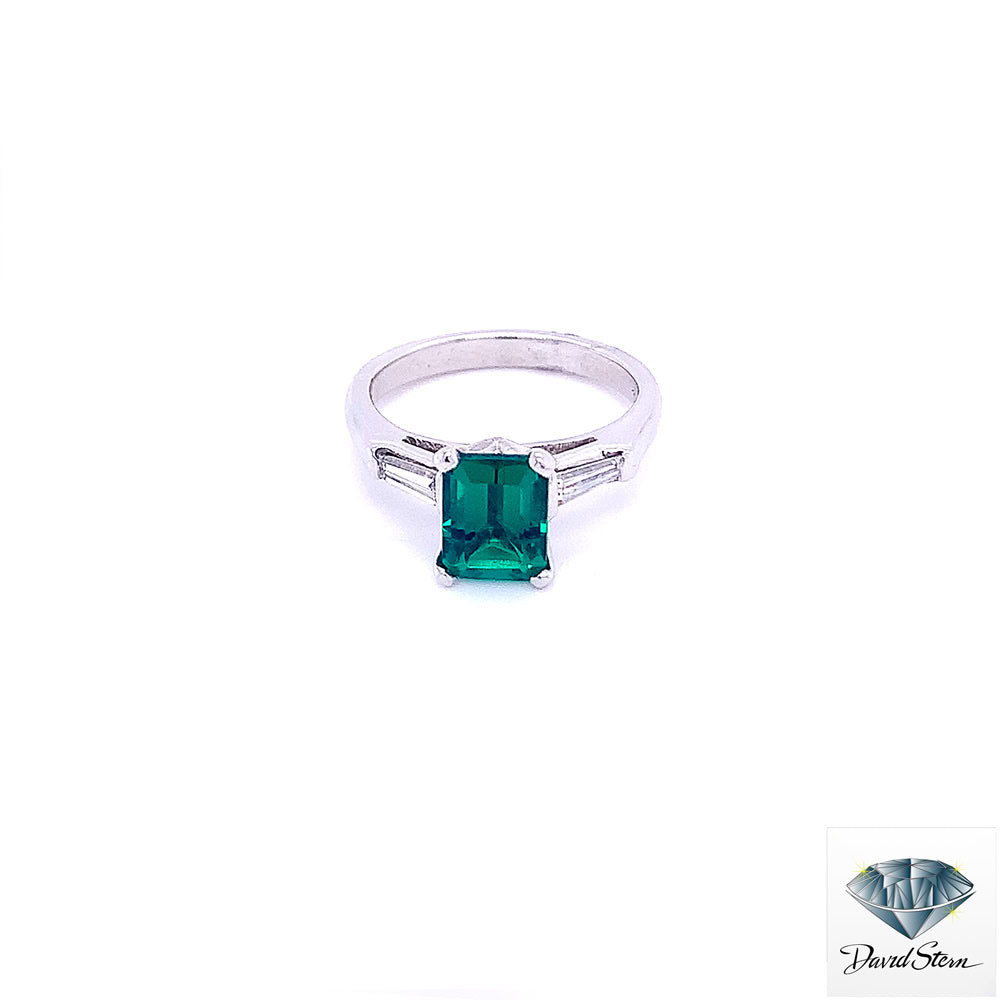
1.40 CT Chatham Emerald Engagement Ring in Platinum
A Chatham emerald engagement ring in platinum. The center is a 1.40 carat emerald-cut Chatham lab-created emerald, a saturated green held in four corner claws, between two tapered baguette diamonds totaling 0.25 carats, I color. 1.65 carats of gemstones in all, in a classic three-stone design. The emerald is lab-created, not mined, and the included written appraisal identifies it as such. Try it on at our Boca Raton showroom.
PRODUCT DETAILS
- Designed By:
- David Stern Jewelers
- Sub Category:
- Engagement Rings
- Sku Number:
- dsj_fcj_07700034
STONE DETAILS
- Center Stone:
- Emerald Chatham Emerald
- Secondary Stone:
- 0.25 ct tw Round Diamond
- Color And Clarity:
- I
- Total Carat Weight:
- 1.65 ct tw
METAL DETAILS
- Metal Type:
- Platinum
- Gold Content:
- 95% pure
CERTIFICATION
- Appraised By:
- David Stern, G.I.A. Gemologist
- Appraisal Included:
- Yes, complimentary

Free Jewelry Appraisal with $2500 Purchase
David Stern Jewelers guarantees every piece of jewelry we sell, which is why we include a free jewelry appraisal with every item purchased.
DESCRIPTION
This Chatham emerald engagement ring sets a 1.40 carat emerald-cut Chatham lab-created emerald between two tapered baguette diamonds in platinum. It is a classic three-stone design: a vivid green center, a flash of white on each side, and a clean platinum band. The emerald is lab-created, not mined, and everything below describes this exact piece, which you can see at our Boca Raton showroom.
The Chatham emerald engagement ring at a glance
Here are the specifications of this Chatham emerald engagement ring, as recorded for this piece.
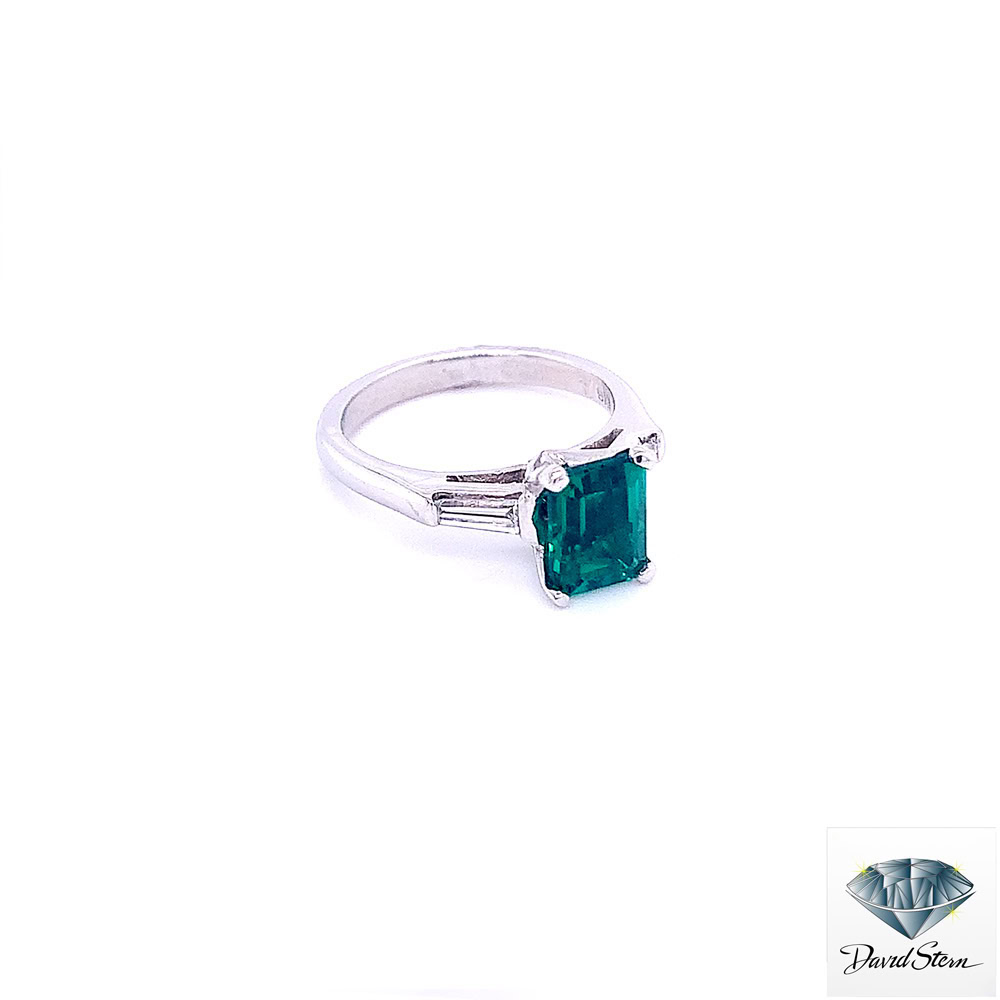
The center stone is a Chatham lab-created emerald of 1.40 carats, cut in the rectangular step cut known as the emerald cut. It is a saturated, slightly bluish green and is held in four corner claws.
On each side is a tapered baguette diamond, set into the shoulder of the band. The two diamonds total 0.25 carats and are graded I color. Together with the emerald, the ring carries 1.65 carats of gemstones.
The metal is platinum. The ring can be sized to fit.
In short, this is a lab created emerald engagement ring in the most classic shape there is, an emerald cut engagement ring in platinum, at a price that puts a large, clean, vivid green center within easy reach.
What a Chatham lab-created emerald is
We want to be clear from the start: the emerald in this ring is lab-created, not mined. It was grown by Chatham, one of the oldest and best-known makers of laboratory-grown gemstones, which has been producing created emeralds since the 1930s.
A Chatham-created emerald is real emerald in the mineral sense. It is beryl colored green by chromium, with the same chemical composition, hardness and optical properties as an emerald from the ground. The difference is where it formed: in a laboratory over months, rather than in the earth over millions of years.
The International Gem Society explains how lab-created gemstones are grown and how they compare with natural stones. You can also read about the grower on Chatham's own website.
Federal guidance requires a lab-created gem to be described as such, and we would rather you know exactly what you are buying. Your appraisal will describe the stone as a Chatham lab-created emerald.
Why choose a lab created emerald engagement ring
The first reason to choose a Chatham emerald engagement ring is clarity. Natural emeralds are almost always heavily included, and most are treated with oil or resin to hide fissures. A Chatham lab-created emerald grows under controlled conditions, so it is typically much cleaner, with brighter color and fewer visible inclusions.
The second is durability. Fewer inclusions and no fracture filling mean fewer weak points, which matters in a ring you plan to wear every day. It is still emerald, so it deserves care, but it is a sturdier choice than most natural emeralds of similar size.
The third is value. A lab created emerald engagement ring costs a fraction of a natural emerald of the same size and color, so a 1.40 carat center with this kind of saturation fits a very reasonable budget.
And for many couples, known origin matters too. A Chatham emerald involves no mining, and its origin is fully documented.
Chatham emerald, natural emerald or a diamond?
If you are choosing a center stone, it helps to see the options side by side.
A natural emerald has rarity and the romance of a stone formed in the earth. But most natural emeralds are heavily included and treated with oil or resin, they need more careful handling, and a clean natural stone of 1.40 carats with this color would cost many times the price of this ring.
A diamond is the hardest option and the most traditional, but it is colorless. If what you love is green, no diamond will give you that.
A Chatham emerald engagement ring sits between the two. It gives you true emerald color in a cleaner, sturdier stone, with honest disclosure and a far more approachable price. For many couples, that is the right balance: the color they want, in a ring they can wear every day without worry.
We are happy to show you natural emeralds, lab-created emeralds and diamonds together when you visit, so you can compare them directly.
How to judge an emerald cut engagement ring
Because the emerald cut has a large, open table, it shows everything inside the stone. That makes clarity more visible than in brilliant cuts, and it is why an emerald cut engagement ring rewards a clean stone like a Chatham emerald.
Start by looking straight down into the center. The step facets should form a clean, symmetrical pattern of rectangles, like a series of steps or mirrors. The corners should be evenly cut.
Next, look at color across the stone. It should be even from end to end, without pale windows or dark patches. This stone shows a consistent, saturated green across its whole face.
Finally, look at the proportions. Emerald cuts vary from nearly square to long and narrow. This one is a classic rectangle, which balances well with the tapered baguettes on either side.
The emerald cut
The emerald cut is a rectangle with cut corners and long, stepped facets running parallel to its edges. It was developed for emerald, and it remains the classic way to cut the stone.
An emerald cut engagement ring has a very particular look. Instead of the scattered sparkle of a round brilliant, the step facets create broad flashes of color and light, often described as a hall-of-mirrors effect. The result is calm, elegant and architectural.
The cut also shows color beautifully. The large, open table lets you look deep into the stone, which suits a vivid green like this one. It is a cut that rewards a clean stone, which is another reason it pairs so well with a Chatham emerald.
The cut corners are not just a style choice. They protect the stone, removing the sharp points where a rectangle would be most likely to chip.
Tapered baguette diamonds
On each side of the emerald sits a tapered baguette diamond: a long, narrow step-cut diamond that is wider at the end nearest the center and narrows toward the band. That shape makes this a tapered baguette engagement ring, one of the most elegant three-stone designs there is.
Because baguettes are step-cut, just like the emerald, the three stones share the same linear, mirror-like character. The effect is cohesive and tailored rather than busy.
The tapered shape also leads the eye in toward the center, making the emerald look larger and giving the ring a graceful line along the finger.
The two diamonds total 0.25 carats and are graded I color, near-colorless. Set in white platinum next to a vivid green, they read as bright white accents. Our guide to diamond color shows where I sits on the scale.
Why a platinum engagement ring
Platinum is the classic metal for fine engagement rings, and a platinum engagement ring is built to last. It is dense, strong and naturally white, so it never needs replating the way white gold does, and it holds claws and set stones securely for a lifetime of wear.
A platinum engagement ring also ages gracefully. When platinum is scratched, the metal moves rather than being lost, so the ring keeps its weight over decades. Over time it develops a soft satin patina, which some owners love and others have polished away.
Platinum is naturally hypoallergenic, which makes it a good choice for anyone with sensitive skin.
For a green center, white platinum is a striking frame. It keeps the green crisp and cool, and it lets the white baguettes stand out cleanly on either side.
Platinum or white gold?
Both look white, so the difference is in how they wear. White gold is gold alloyed with white metals and usually plated with rhodium; over time the plating wears and needs renewing. Platinum is white all the way through and never needs plating.
Platinum is also denser and heavier, and it holds claws and set stones especially securely, which is why it is the traditional choice for a fine platinum engagement ring. White gold is lighter and costs less.
For a ring you plan to wear every day for decades, platinum is the lower-maintenance choice, and it is the metal this ring was made in.
An emerald engagement ring tradition
Emerald has a long history in engagement jewelry. It is associated with loyalty, renewal and new beginnings, and green engagement rings have been chosen by couples who want something distinctive for generations.
Emerald is also the birthstone for May and the traditional gift for a 20th and a 55th wedding anniversary, so a Chatham emerald engagement ring can carry more than one meaning.
The three-stone layout adds its own symbolism, often read as past, present and future. Here the center carries the color, and the two baguettes frame it.
If you want an engagement ring that stands apart from a white diamond solitaire but still feels timeless, a tapered baguette engagement ring with an emerald center is one of the most classic ways to do it.
Wearing a Chatham emerald engagement ring every day
A Chatham emerald rates 7.5 to 8 on the Mohs scale, hard enough for daily wear with sensible care. It is more brittle than diamond or sapphire, so a hard knock can chip it.
To protect it, take the ring off for the gym, gardening, heavy cleaning and anything that might strike it. Put it on after hand cream and hairspray.
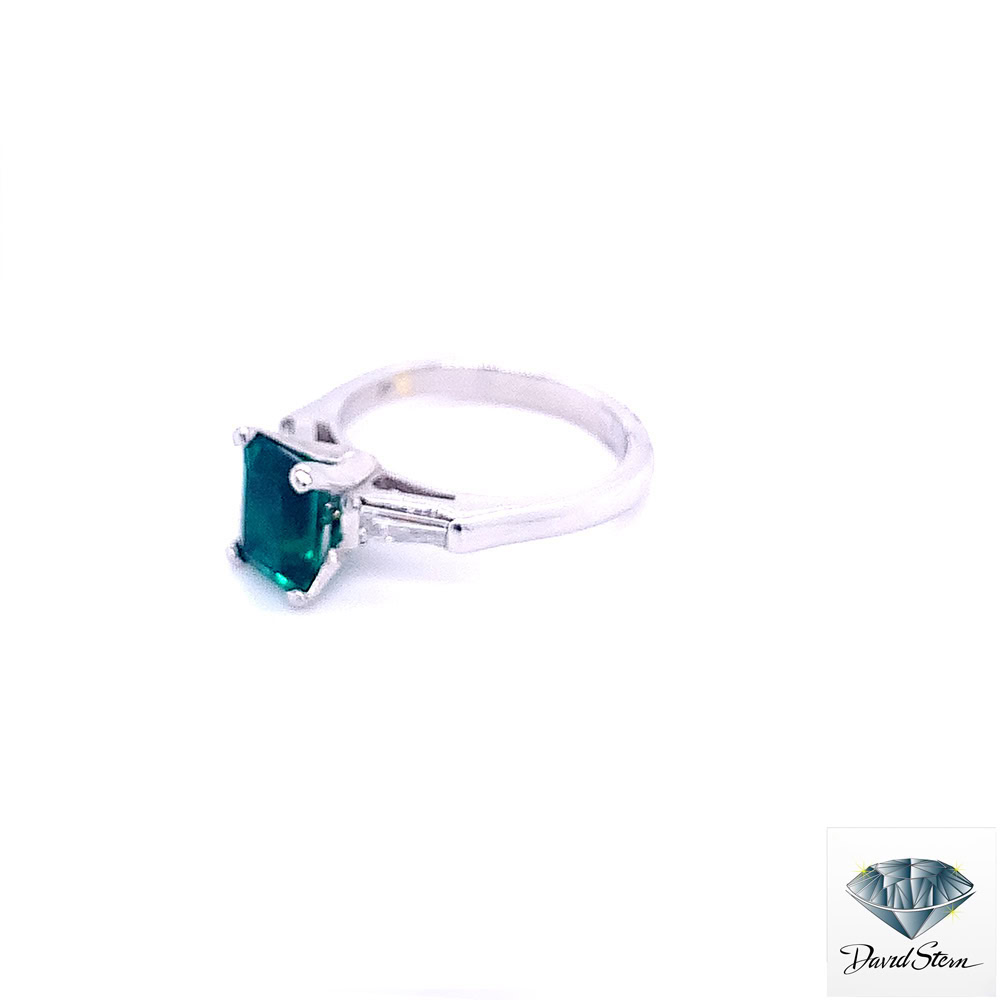
The four claws hold the emerald at its corners, where the cut corners of the stone protect it. Have a jeweler check the claws once or twice a year; it only takes a few minutes.
A straight wedding band usually sits comfortably beside a three-stone ring like this. A plain platinum band keeps the look clean; a thin diamond band adds sparkle. Bring a band in, or try one of ours, to see how they sit together.
Caring for your emerald cut engagement ring
Clean the ring in lukewarm water with a drop of mild soap, brush gently around the claws and baguettes with a soft toothbrush, rinse and pat dry. Our jewelry care guide has more detail.
Because a Chatham emerald is not oiled like most natural emeralds, it is less sensitive than a natural stone, but we still recommend avoiding ultrasonic and steam cleaners, harsh chemicals and sudden temperature changes.
Store it on its own in a soft pouch so the diamonds cannot scratch it or other jewelry. We offer complimentary cleaning and inspection for jewelry bought from our store.

Seeing this Chatham emerald engagement ring in Boca Raton
Emerald color is best judged in person, in different light, and an engagement ring always looks different on the hand than in a photograph. You are welcome to try this Chatham emerald engagement ring on at our Boca Raton showroom and look at the stone under a loupe.
We are open Monday to Friday, 9:30 to 5:30, and Saturday, 10:30 to 4:30. Directions are on our Visit Us page.
David Stern Jewelers has served Boca Raton for over 40 years. David Stern is a GIA Graduate Gemologist, so detailed questions about lab-created gemstones can be answered on the spot.

Sizing, appraisal and insurance
This ring can be sized to fit. Platinum can be resized by a skilled jeweler; because the baguettes sit in the shoulders, we will look at the ring with you and confirm how far it can be sized before any work is done.
It includes a written jewelry appraisal by David Stern, which identifies the emerald as a Chatham lab-created emerald, describes the diamonds and the platinum, and gives a replacement value for insurance.
More engagement rings and emerald jewelry
If you love Chatham emerald, see our Chatham emerald necklace. For a natural emerald, see our pear emerald ring. You can browse all our engagement rings, or build your own ring with a setting and center stone of your choice.
Questions about this Chatham emerald engagement ring
Is the emerald in this Chatham emerald engagement ring real?
It is a real emerald in the mineral sense, with the same chemistry, hardness and optical properties as a mined emerald, but it is lab-created by Chatham rather than mined. Our appraisal identifies it as a Chatham lab-created emerald.
How large is the emerald?
The center is a 1.40 carat emerald-cut Chatham lab-created emerald. With two tapered baguette diamonds totaling 0.25 carats, the ring carries 1.65 carats of gemstones.
What are the side stones?
They are two tapered baguette diamonds, one set into each shoulder of the band. Together they total 0.25 carats and are graded I color.
Is a lab created emerald engagement ring durable?
Yes, with sensible care. A Chatham emerald rates 7.5 to 8 on the Mohs scale and is usually cleaner than a natural emerald, which makes it sturdier. Remove the ring for sports, gardening and heavy cleaning.
Why choose a Chatham emerald over a natural emerald?
A Chatham emerald is typically cleaner and more vivid than a natural emerald of the same price, is not oil-treated, and has a fully documented origin. A natural emerald of similar size and color would cost many times more.
Why is platinum used for this ring?
Platinum is strong, dense and naturally white. It holds the claws and baguettes securely, never needs replating, keeps its weight over time and is hypoallergenic.
Can I clean it in an ultrasonic cleaner?
We recommend against it. Use lukewarm water, a drop of mild soap and a soft brush, then pat dry, and avoid harsh chemicals and sudden temperature changes.
Can the ring be resized?
Yes. Platinum can be resized. Because the baguettes sit in the shoulders, we will inspect the ring with you and confirm how far it can be sized before any work is done.
Does the ring come with an appraisal?
Yes. It includes a written jewelry appraisal by David Stern, a GIA Graduate Gemologist, identifying the emerald as Chatham lab-created and giving a replacement value for insurance.
Can I see the ring before I buy it?
Yes. The ring is at our Boca Raton showroom. We are open Monday to Friday, 9:30 to 5:30, and Saturday, 10:30 to 4:30.
Is this an emerald cut engagement ring or an emerald engagement ring?
Both. The center stone is a Chatham lab-created emerald, and it is cut in the emerald cut, the rectangular step cut developed for emerald.
Is a Chatham emerald a good choice for an engagement ring?
For many couples, yes. It gives true emerald color in a cleaner, sturdier stone than most natural emeralds, at a much more approachable price, with honest disclosure of its lab-created origin.
What does a tapered baguette engagement ring mean?
It is a ring with a long, narrow step-cut diamond on each side of the center stone, wider nearest the center and narrowing toward the band. The shape leads the eye to the center stone and makes it look larger.